by Mark Humpage | Aug 10, 2011
Credit: Mark Humpage
Meteor Watch, 2011. Well it’s that time of the year again. The air is warm, days are long, Noctilucent are departing, which can mean only one thing – Meteorwatch is back.
There are many subjects within our night sky that are fascinating to watch and equally challenging to capture on camera. However, there really is something quite exciting and magical about spotting balls of fire streaking across a star filled sky. Maybe my affinity with severe weather and, in particular, lightning was the catalyst for fascination, or perhaps the fact that objects the size of a grain of sand can ironically put on such a grand fireworks display. History, in the form of a meteor shower 200 years ago is said to have inspired Samuel Taylor Coleridge’s lines from his famous poem The Rime of the Ancient Mariner. It’s amazing to think that distant evening, when Coleridge was walking along the Somerset coast witnessing the upper air burst into life, would inspire others as we once again prepare for showers.
Whilst there are many displays throughout the year, the most visible meteor shower is the Perseids which light up the skies around mid August each year and offer peak shows of more than 1 meteor every minute – a perfect viewing event. The moon cycle can invariably weaken the viewing event (depending on phase) but even so the challenge of course is not necessarily to witness but to capture on camera. With this in mind, let us look at some useful pointers which will help camera owners increase their odds of pulling off a meteoric masterpiece over the coming weeks.

Credit: Mark Humpage
Firstly, what Camera Equipment is required? Let’s not pull any punches. To capture a decent meteor image will require a good quality camera. Shooting a subject in low light or darkness will require a camera that allows full manual control of the settings and interchangeable lenses. In this respect a dslr fits the bill perfectly. Talking of lenses, my ideal selection would a choice of two (or both). A wide angle, something in the range of *7-14mm (14-28mm 35mm equivalent) together with a lens to get a bit closer, such as the *12-60mm (24-120mm 35mm equivalent). I’ll talk about why I suggest these two lenses a bit later within the technique section. Another pre-requisite piece of equipment is a tripod. This will give stability for those long exposures, and prevent motion blurring. Finally, I would recommend using a cable release or remote method of triggering the camera shutter. Combined with a tripod for steadying this will minimise camera vibration – you would be surprised how much vibration is created by simply pressing the shutter release button with your finger!
Camera Settings – It’s important not to forget our camera subject which is essentially a fast moving bright object visible for a very short period of time. Successfully capturing a meteor with a short exposure time, in darkness, is near on impossible because timing will be down to luck (extremely low odds) and the foreground (for wide angle shots) will be too dark. In this respect, and to increase our odds of a successful capture we need to use a long exposure time. To do this firstly set the camera to manual mode (M). Now set the exposure time to between 15s and 30s (15s for continuous and 30s for single shooting – I will explain this more in the technique section) and shutter speed to the lowest setting (a good quality lens should get down to F2.8). Set the ISO to 500. This will be good starting point for most cameras. Bear in mind that camera systems and models vary tremendously depending on the technology inside, such as the sensor and processing engine. Personally, I have found 15s-30s is sufficient to capture the duration of a single meteor. Combined with a mid value ISO of around 500 will provide sufficient light to deliver a pleasing image of both foreground and subject whilst keeping noise (grainy effect) to a minimum.
Camera Technique. I must reinforce the fact there is a great element of luck in capturing a meteor on camera. One can advise on the optimum camera equipment and settings but there is never any guarantee of success. The key is not success but rather improving ones odds of success. I can certainly increase your odds and results by using the following techniques, based around lens choice. Firstly and desirably find a location away from populated areas and light pollution. Set up the camera with a Wide Angle Lens and try to position an on object in the foreground, such as a tree or man made structure. This will add perspective or scale to an image. Position the camera/lens to cover the north east skyline keeping a small portion of land in the bottom third or quarter of the frame. Ensure focus is set manually to infinity. Using a 15s exposure time and remote cable (set to lock) pop the camera into sequence shooting and hit the shutter release button (If you don’t have a remote cable simply keep the finger pressed on the shutter release button, although it will get numb quickly!). This effectively primes the camera to take continuous frames until you switch the camera off (or the battery runs out). What you will end up with here is as many (or little) images as desired and which can be imported into stacking software. A final composite image could be as long as the night combining a star trail effect with hopefully a meteor or two. If using this technique a good tip, to improve composition, is choose a foreground subject with something of interest and paint it with light. This can be done simply by setting off a few rounds of flash remotely whilst the camera is shooting or waving a lit torch around the foreground.
Pros – Excellent success rate of meteor capture with good image composition.
Cons – Captured meteors will appear small, with little detail against a wide angle frame.
The second technique involves using a lens with greater focal length or Zoom. The far end of a mid level zoom range would suffice (60mm or 120mm 35mm equivalent) or, if available, a high end zoom lens allowing anything up to 200/300mm (400/600mm 35mm equivalent).
Once again manually set the focus to infinity and use a 30s exposure time. Train the camera/lens on an area of sky alone and fire away as and when you feel. To start, concentrate on an area of north-east sky near the Perseids radiant (see Perseids section) but do vary the location all around the sky.
Pros – Captured meteors will fill the frame with great detail (and colour).
Cons – Low success rate of meteor capture (due to small area of sky concentration)
In addition, do experiment by adopting the 15s continuous shooting technique with a zoom lens. This will also increase capture odds. Personally, I shoot with two cameras using both these techniques to really maximise the odds of capture, composition and detail.
The Perseids are meteors which appear to originate from a point within the constellation of Perseus in the north-eastern sky. This point, known as the shower’s radiant is a good starting point for aiming the camera lens. Do note that one might see a meteor anywhere in the sky but the direction of motion, when traced back, will point to the radiant. A meteor that does not point back to the known radiant for a given shower is not considered part of that shower. Locating the Perseids’ radiant is very simple and situated in the constellation Perseus, just below the familiar ‘W’ of the constellation of Cassiopeia.
Finally, it is worth making a quick point about Iridium Flares. Sometimes it is hard to tell the difference between an Iridium flare and a meteor. (See top photo). Iridium Flares are common communication satellites which illuminate when the sun reflects off their bright antennas. Usually the brightness, colour and trajectory are a giveaway (noticeably brighter in the center and dimmer at its ends). Iridium flares can also be accurately predicted (http://www.heavens-above.com) and which is the best indicator for confirming, as long as you note the time, direction and elevation.
May all you showers light up!
Mark Humpage July 2011
* based upon Olympus E-system 4/3 sensor camera

Credit: Mark Humpage

by VirtualAstro | Aug 10, 2011
Out there somewhere in our solar system is a 26 kilometre wide comet, a chunk of dirty ice on a 130 year orbit of the Sun. This giant cosmic snowball was thought to have been born in the Oort Cloud, a vast spherical region of icy objects nearly 6 trillion miles from the Sun, almost a light year. With a total mass of roughly 40 times that of Earth, the Oort Cloud is so far out that the Sun’s gravity is weak but the gravity of nearby stars can have an effect, nudging these remote icy chunks out of position and sending them on a long journey towards the inner solar system. One of these mysterious icy travellers is called Comet Swift-Tuttle, much larger than the object thought to have spoiled the party for the dinosaurs, and the largest known chunk of space stuff to make repeated passes near the Earth. Although you can breath a sigh of relief, as it poses no degree of threat for at least a few thousand years, so we get to see its associated meteor shower without that bothersome mass extinction. Comet Swift-Tuttle, which last made its closest approach to Earth in 1992, is the particular comet in question that we’re interested in for August as it produces the Perseid meteor shower.
As this comet makes its way around the solar system it leaves a trail of dusty material in its wake. Every August as the Earth passes through this debris stream we get to see probably the most reliable and best meteor showers of the year. The fine grains zip through the atmosphere at 130,000 miles per hour, at a rate of up to 90 to 100 an hour. As with anything in astronomy it’s always best to view a meteor shower from a darker location, and hopefully with the bright Moon out of the way.
OK, so here’s where your view of the August 2011 Perseids may be taken down a slight notch as compared to other years. The Moon normally gives cracking views in your binoculars or telescope, but our old friend Lunar is nobody’s friend when it comes to meteor showers as its light can wash out all but the brighter of those spectacular shooting stars. This year we have a full Moon unfortunately on the two nights of the shower’s peak. This peak time is during the pre dawn hours of Friday the 12th and Saturday the 13th of August…so that’ll be the 11th beyond midnight, and the 12th beyond midnight. You have more chance of seeing meteors in the small hours as Earth faces into the shower during this time, resulting in the chance of seeing more and faster meteors. The Perseid meteor shower actually starts from the end of July and goes up until late August, but peaks on the mornings of the 12th and 13th of August. So keep your eyes peeled for Perseids in the weeks either side of the peak too. You’ll see the the Perseids seeming to radiate from, you’ve guessed it…the constellation Perseus. Although you can actually catch them streaking across any part of the sky, they’ll just seem to be coming from the direction of that constellation. Look to the north-east after dark and you’ll see Perseus rising, it then moves higher to the east before dawn. Even though the Moon will be in the sky during the peak, don’t let that dissuade you as it’s still well worth getting outside…don’t miss it.
The great thing about meteor showers is that the only equipment needed is your eyeballs, so everyone can join in. Get some friends and make a night of it, and the best thing about the Perseids is they conveniently come at the best time of the year when it’s nice and warm (hopefully). Meteor watching requires a lot of patience, but if you sit back, relax and put some time in you should be rewarded. There’s actually another night sky attraction to admire while you’re waiting for shooting stars, and that’s the solar system’s heavyweight Jupiter. The gas giant starts rising from the east shortly before midnight on the dates of the meteor shower peak. Check it out naked eye, but if you happen to have some binoculars with you grab a quick peek at the stormy planet blazing brightly at magnitude -2.36, and get a look at those moons. Don’t get too distracted though as you’ll want to keep an eye out for Comet Swift- Tuttle’s fireworks.
Don’t forget to get involved with Meteorwatch on Twitter…tweet your location and how many meteors you observe, and see your results on the Meteormap. Good luck !
Article by John Brady of Astronomy Central

by VirtualAstro | Aug 10, 2011
One of the biggest factors when observing meteor showers or not in some cases, is the weather.
Meteor showers are usually best seen a few days before and right up until their peak, so being able to plan your observing around the weather is essential.
Luckily the Met Office have developed a new interactive website: WOW Weather Observations Website, where users of the site can enter their own observations and the results will be shown on a map. Very similar to the meteorwatch meteor map.
This new tool, will be excellent for planning your meteorwatch, Astronomy, or any other weather dependent activity.
Register and start enjoying WOW.

by VirtualAstro | Aug 9, 2011
During meteorwatch and the Perseid meteor shower, many people will be having a go at imaging perseid meteors.
See here for more information on how to image and record meteors.
Once you have an image or images of the night sky, or even pictures of you and your friends at your observing site or meteorwatch party. Tweet them using the #meteorwatch hashtag and they will automatically appear on the meteorwatch photo gallery.
You can also upload your images to the meteorwatch flickr group and view them on the flickr gallery
by VirtualAstro | Aug 8, 2011
You are outside, the night sky is clear, you look up and then WOOSH! You see a shooting star!
If you see a shooting star this week will probably be a Perseid from the Perseid meteor shower.
Like most things in astronomy, you don’t need expensive telescopes or equipment to enjoy the Perseids; you just need to be comfortable and patient. Please see here on how to enjoy observing meteors.
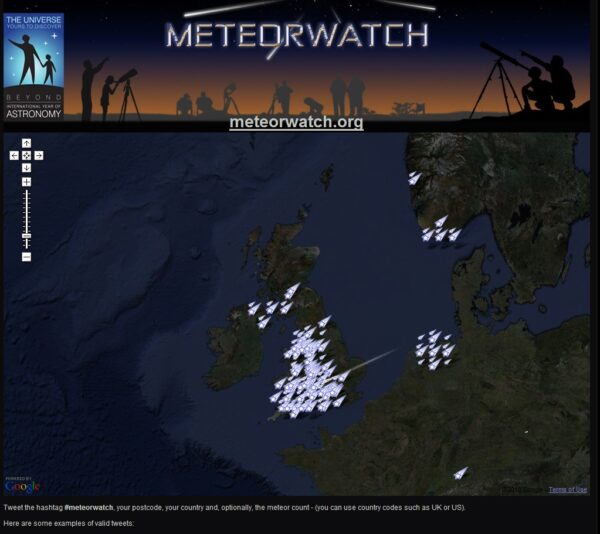
When you see a meteor, share your experience on twitter by tweeting what you saw for the meteor map.
The meteor map displays tweets of meteors seen by location and is very simple and fun to use.
Tweet the hashtag #meteorwatch then the first part of your postcode, then your country code and then optionally how many meteors you saw. Your results will then be displayed on the map shortly afterwards. Instructions can be found at the bottom of the map page.
Let’s see how many people saw a meteor or more?

by VirtualAstro | Aug 8, 2011
If you are looking for a great spot to see the shooting stars of the Perseids away from bright lights and light pollution, there are some very good National Trust sites you can go to in the UK.
These sites are ideal for all kinds of stargazing any time of the year and are set in some of the most beautiful locations in the country
The seven best National Trust sites for star gazing and see the wonders of the night sky are:
- Black Down in Sussex – Get closer to the stars on the highest point in the South Downs, just over a mile from the town of Haslemere.

Download the guide for Black Down
- Teign Valley in Devon – Discover the stars at this Trust property within Dartmoor National Park and close to Castle Drogo.

Download the guide for Teign Valley
- Penbryn Beach in Wales – Beautiful, unspoilt mile-long beach on the Ceredigion coast in west Wales, great for a bit of star gazing and a late night paddle.

Download the guide for Penbryn Beach
- Stonehenge Landscape in Wiltshire – Step back in time and discover the ancient skies of Salisbury Plain’s chalk downlands, home to the impressive prehistoric stone monument.

Download the guide for Stonehenge Landscape
- Wicken Fen National Nature Reserve in Cambridgeshire – Close to historic Ely, the wild landscape of the National Trust’s oldest nature reserve offers dark skies and a wealth of nocturnal wildlife to listen out for.

Download the guide for Wicken Fen
- Mam Tor in Derbyshire – Escape the bright city lights of Sheffield and experience the peace and tranquillity of Mam Tor’s dark skies in the Peak District.

Download the guide for Mam Tor
- Friar’s Crag in Cumbria – Surrounded by the breathtakingly beautiful scenery of the Lake District, Friar’s Crag in Keswick juts out into the spectacular lake of Derwentwater; a restful place to contemplate the world above us.

Download the guide for Friar’s Crag
More information about all of these sites is available by visiting: http://www.nationaltrust.org.uk/darkskies and enjoy stargazing and meteorwatch at these fabulous locations.