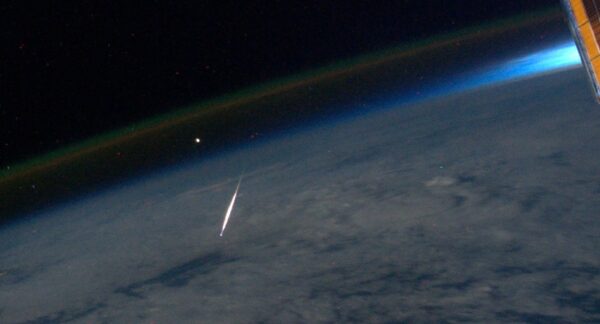
On Saturday 8 October 2011 a rare event may occur – a meteor storm! The usually sedate Draconids meteor shower only produces a few shooting stars per hour in most years, but in some years we have a meteor storm, and that’s just what’s predicted for this year.
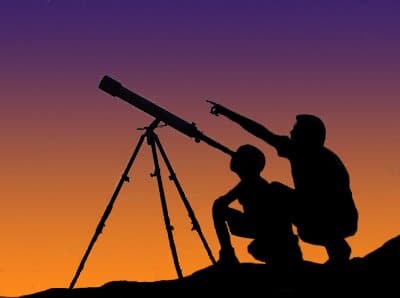
It Won't Look Like This
During a meteor storm the Earth passes through a particularly dense clump of comet dust, meaning that rates of shooting stars temporarily spike, and estimates this time suggest the possibility of up to 10 shooting stars per minute during the peak of the storm. However a nearly full Moon may spoil the view, possibly drowning out all but the brightest meteors, reducing the actual observed rate perhaps 1 per minute – still well worth looking out for.
The peak is set to occur at 2000UT (2100 BST), and is ideally placed for observers in the UK. Activity is expected to increase from 1600UT (1700 BST) but at that stage the sky will still be bright in the UK.
If you’re keen to witness this (possibly) amazing event here are some top tips:
Head out early. Start your meteorwatch once the sky gets dark enough. For most people in the UK this will be from 1900 – 1930 BST (anyone living in the north of Scotland will have to wait a bit longer). Although the peak of the storm is estimated to occur around 2100 BST there will be plenty to see in the hours leading up to the peak.
Know where to look. The Draconids all appear to originate from the constellation Draco, which will be high in the NW sky, just above and to the left of the north star, Polaris. However the meteors will streak across the entire sky so don’t just look NW.
Know what to look for. Meteors appear as bright streaks of light moving rapidly across the sky. They last for a fraction of a second, but the Draconids are unusually slow meteors. Still, blink and you might miss one.
Keep the Moon to your back. The full Moon will drown out the light from all but the brightest Draconids, and if you look at the Moon it will spoil your night vision, so keep it behind you, ideally blocked out by a building or tree.
You just need your eyes. Binoculars and telescopes, while ideal for observing faint nebulae and planets, are no good for meteorwatching. You want to take in as much of the sky as you can, and have as wide a field of view as possible, so just use your eyes.
Get comfortable. The best bit of meteorwatching kit is a reclining lawn chair. Point it towards the NW, lie back, look up and enjoy the show.
Keep warm. It will be very cold outside if it is clear, so wrap up warm. If you’re lying back on a reclining chair, wrap yourself in a blanket or sleeping back form maximum warmth.
Get away from city lights. This isn’t as important for this shower, as the Moon is flooding the sky with natural light anyway, but in general the fewer lights you have around you the better.
Get away from clouds. This hopefully goes without saying, but if your sky is cloudy you won’t see much. The UK Met Office website can tell you if there is a clear sky anywhere near you, and you should consider traveling to get clear skies. You can also check out meteor activity using the Meteor Live View.
Sure, you’ve heard of the August Perseids that come blazing across the sky and are invariably trumpeted by the news as the “Meteor Shower of the Millennium!” on a yearly basis. Perhaps you’ve even heard of the Leonids, normally a feeble November shower prone to legendary outbursts roughly every 33 years. But have you ever heard of the October Draconids?
I’ll admit I hadn’t until the October 1998 issue of Sky & Telescope arrived on my doorstep. Or should I say tent-flap? You see, the last half of 1998 found me deployed with my U.S. Air Force squadron to Al Jaber, Kuwait. In those days, email (and spam) were still a hip “new thing,” giant washing-machine-like CRT monitors adorned many office desks, and we were involved with a cat-and-mouse game between Saddam and the U.N. Inspectors that eventually became the shooting war of Operation Desert Fox. A military base in the desert was also a fine place to do some causal astronomy. The Leonids put on a fine show that year approaching storm levels of 1,000 per hour from our longitude. I remember mentioning the Leonid meteors to one of our F-16 pilots, and they later briefed not to mistake the fireball flashes for Iraqi AAA (an important distinction!) (more…)
Meteors streaking across the sky are an amazing sight. Every time I see a meteor is a thrilling moment.
I’m not a professional astronomer or even a specialized expert. I’ve just been watching the skies for meteors and showing others how to spot them for a long time. I particularly enjoy helping people who have never seen a meteor before experience their first sighting. My greatest success is watching the Perseid Meteor shower together with my kids while we were camping in the mountains together. It is an emotional memory that we’ll share all our lives.
Watching meteors is special because it truly takes no special equipment whatsoever. Telescopes or cameras just restrict your field of view – for best viewing simply lie back and enjoy the sky in front of your own eyes.
Meteorwatch itself is special for a lot of reasons. It is a world-wide event of professional and amateur astronomers getting together to share the heaven’s most showy display of the year. It’s an opportunity to collect real data that may be useful for astronomers to work with to increase our understanding of space. For me, meteorwatch is a chance to share my excitement with others who have never seen the beauty of a meteor flashing overhead.
Our goal for meteorwatch is to increase the odds for everyone to find meteors. Meteorwatch occurs August 12 through August 14 to correspond with the Perseid Meteor shower. The Perseids are a predictable shower that comes every year. In fact, meteors from the Perseids have been observed for about 2000 years already! The meteors are frequent and fairly bright, so it’s likely that you’ll be able to spot one if you go out prepared.
The first step of being prepared is that you need to find the darkest place you can find, as far away as possible from lights that will disrupt your night vision. If the moon is out while you’re observing, try to block it as best as you can with trees or a hill so you don’t look at it and ruin your night vision. If your night vision does get disrupted, you will not be able to see the dimmer meteors at all, so keep your eyes up and don’t pull out your phone to tweet every few minutes.
It’s true that Perseid meteors will likely come at between one and two meteors every minute, but you won’t be able to see that many because most of them are dim and washed out by city lights. The darker it is, the more meteors you will see! When I’m in a reasonably dark area near the outskirts of my city I’m happy to see one meteor every five minutes or so. If you can’t get out of the city, you may have to wait longer because you will only see the brightest meteors. There are plenty of sightings from the heart of cities, so it’s not impossible, just more difficult. It’s certainly worth an attempt if you can find a park without lights or some other dark area near you.
The second step is to make sure that you’re comfortable while waiting. A good chair that supports your neck while you look up is helpful. Even though the Perseids occur during summer, the nights can get quite chilly so dress warmly and bring something warm to drink.
The third step is to keep it an enjoyable outing. Some people like to go out alone and listen to music while waiting. That’s great too, but I usually tell first-timers to go out in groups. I especially encourage people to take their kids out. Young eyes may see phantom meteors at first, but once they get the hang of it they’ll spot meteors too dim for you or I to spot any more. Kids are fantastic at spotting meteors and it encourages them to be interested in the world around them. Besides, who wouldn’t appreciate a late night out once in a while?
The most frequent question I get asked year after year has been, “Where should I look in the sky to see the meteors?” In the past I’ve tried to describe how to find the constellation Perseus, but it’s rather unnecessary. Accustom your eyes to the dark, and after you’ve seen three or four meteors you should be able to figure out where Perseus is in the sky all on your own! It’s most important to look up, be relaxed and patient, and the meteors will dazzle in front of you as long as you are willing to watch.
Unfortunately, we don’t all get clear skies. Some of us are clouded out and have no chance at spotting meteors above us, but that doesn’t mean you’re out of luck. Follow the #meteorwatch hashtag on twitter for tips, pictures, radio observing and to share your experiences with other enthusiasts around the world. Go to www.meteorwatch.org for news and information and be sure to follow twitter.com/VirtualAstro for fantastic coverage of the Perseid Meteor shower direct from his Astrobunker.
Mark Zaugg is an amateur astronomer and enthusiast who particularly enjoys introducing people to the excitement of seeing a meteor in person. You can find him at twitter.com/Zarquil
A classic summer astronomical standby may be in trouble this year, but that shouldn’t stop you from looking. That’s right, we’re talking about the Perseids, that “old faithful” of meteor showers which sees northern hemisphere residents getting bundled up to camp out under the summer stars every mid-August.
Some of our earliest astronomical memories come from watching this very shower under the dark northern Maine skies of our 1970’s childhood… yes, the Perseids are public crowd-pleaser and even an occasional Yahoo-trending fave that can even knock the likes of Brittany & friends down to the number 2 slot for a 12 hour period… so, what’s this news of the Perseids being “troubled?” They haven’t been threatened by irate pop stars, have they?
Unfortunately, this year’s menace is a more inviolate force; the Full Moon. Yes, this year’s Perseid meteor shower peaks the morning of August 13th, mere hours before the Moon reaches Full status on the same day at 14:57EDT/18:57UTC. Instead of the usual respectable zenithal hourly rate (ZHR) of around 100 meteors per hour, observers can only expect to see a paltry few of the very brightest fireballs…
But all is not lost. With a little planning, a few factors can work in YOUR favor this year. Keep in mind that the Perseids have a very broad peak, and the radiant near the head of the constellation Perseus lies above the horizon all night for observers north of 32° latitude. Plus, this month’s Full Moon (known as a Sturgeon Moon) has a southerly declination of about -11° degrees; your best bet for catching Perseids this year may lie with watching several mornings prior, in the window of time between the setting of the waxing gibbous Moon and the beginning of local twilight… and yes, you CAN still watch a meteor shower during a Full Moon and see an occasional Perseid.
Generally speaking, the farther north in latitude you are located, the more likely you’ll be able to take advantage of these twin factors. Finding as dark a site as possible and putting something physically between yourself and the bright Moon is the key. A building or a hill makes an excellent “Moon-block.” Perseids are swift movers with an atmospheric entry velocity of about 61 km/sec.
The meteors are tiny grain-like debris shed by the comet Swift-Tuttle, and the shower occurs as the Earth intersects the path of the comet every mid-August. The Perseids are also famously known as the “Tears of Saint Lawrence” who was martyred on August 10th, and are probably the most well known of all meteor showers because of their annual dependability and their timely occurrence with the northern hemisphere summer vacation and holiday season.
Historic ZHR rates have always hovered around 60, but the past several years have seen an enhanced ZHR of +100. This shower is also infamous for sparking “Meteor Shower of the Millennium!” headlines annually, Although I have yet to see the same occur this year… a shower that MAY be a contender for said headline is the Giacobinids (or do you say Draconid?) meteors in early October 2011, an obscure shower that may dazzle this year… more on this to come in October.
Wonder what that the above graphic has to do with anything astronomical? You are looking at what is known as a nomogram, a graphical device that is a neat way to show interrelationships between factors. (Hey, how do you spend your weekend?) The graphic above was adapted from a nomogram featured in the November 2002 issue of Sky & Telescope; it shows the interrelationship between the two biggest factors that affect the zenithal hourly rate; namely, the radiant’s elevation above the horizon, and the limiting magnitude of your sky. (For a way “math-y-ier” dissertation on nomograms and the ZHR, click here).
This device will be your indispensible friend and secret weapon as you plot your meteor observing adventures for this or any shower. The ZHR is a theoretical limit; it assumes that you have absolutely perfect skies with a radiant directly overhead and an unwavering 360°degree view. Unrealistic, right? Well, it’s something to strive for. As you can see after playing around with the graphic a bit, the biggest killer of how many meteors you’ll see is how dark a sky you are under.
Even when the Perseid radiant is half way (45° degrees) in altitude towards the zenith, a limiting magnitude of +4 (as is typical around a Full Moon) means you’ll see roughly 10% of the zenithal hourly rate, i.e. 6-10 meteors per hour instead of 60-100. Yes, light pollution, both natural and manmade, is a real meteor shower buzz-kill. And keep in mind, other factors can conspire to lower that rate even further, such as obstructions on the horizon and the fact that a sole observer can only cover a limited swath of the sky visually. Still, the sight of a well placed fireball can be unforgettable and just plain pure magic to witness.
Do get out there on days leading up to this week’s Perseid meteors, and be sure to follow and report the magic via #meteorwatch on Twitter; they’re worth setting an early alarm for!
I am horseshoe carelessly nailed upside down so all the good luck falls out down a grid.
If you ever see me coming to stand next to you at a star party, meteor shower, or eclipse, you have permission to make the cross sign with your fingers and run backwards as fast as you can.
That’s because, for my 33 and a half years of sky gazing, I have managed to cause cloudy skies and inclement weather at every single major event I have attended.
Just for the record, I’m a keen amateur astronomer without a telescope. I follow as many Twitter astro accounts as I can, avidly retweeting the latest data from Cassini, and following lonely Mars landers as they bump across rusty rocks. I cried the first time I saw the ISS, and as a child, I used to stand in the garden with a compass, straining hard to see the northern lights. I never did.
My bad luck began in earnest when I went to Cornwall for the eclipse. A boyfriend and I spent a small fortune hiring out a dank, uncomfortable cottage in the middle of nowhere. I was so excited that I woke up at 6.30am every morning, causing us to be grey faced and exhausted for the whole pitiful ‘holiday.’ And of course, on the big day, there was 100% cloud cover and it was so cold we had to wear gloves.
One night, me and the chap were out in Sefton Park, Liverpool, admiring a wonderful conjunction of several planets dancing around a new moon like fairy lights. Flushed with happiness, we went in and congratulated ourselves for figuring out how to use a planisphere. Next morning we were mortified to find out aurora had been visible ten minutes after we went in.
And indeed, only last week, I was photographing some incredible clouds where I live in Bristol, only to be told a short while later that even more aurora had decided to shimmy their way on to the sky’s stage while I had my back turned.
I travelled to America last year, and on my first night, I was so jetlagged that I shut the blind to keep out an incredibly bright moon. Mr Moon was very cross at my ignorance, and proceeded to turn bright red with rage, causing me to miss a spectacular lunar eclipse.
But the thing I have had the LEAST luck with…is meteor showers. I have stood out in back gardens and dark fields trying to catch a glimpse of these fleeting sky streaks at least three times a year from the age of 15. And guess what? Except for ONE Leonid I saw, cutting through soupy orange cloud two years ago, I have not had ANY luck. Truly disheartening.
That is, if you forget about last year. I was in Portland, on the west coast of America. Through a set of remarkable coincidences, which really do make me wonder if we are being pulled through our lives by twinkling cosmic threads, I ended up meeting some wonderful people who shared my love of all things that require tipping your chin up to 90 degrees to observe.
They took me out to a pitch-black nature reserve, bundled up with blankets and deckchairs, as bullfrogs boomed in the blackness, and baby racoons cavorted in the undergrowth.
On that magical, starry, starry night, we counted several hundred Perseids, each one causing me to gasp and grip the arm of my chair. One of the most memorable experiences of my life and one I long to repeat.
So. Will I be turning my head skywards for the Perseids this year? Of course I will. But judging from past form, I’d say, chances are, Bristol is not going to enjoy clear skies. I just seem to have that unfortunate effect on the sky over my head.
So if there are any astronomers in the Bristol area hoping for a good viewing, you may want to drive me out of town with planks and pitchforks. Either that, or take a trip to Inverness.
Follow me for further antics on twitter, I am @RadioVicky