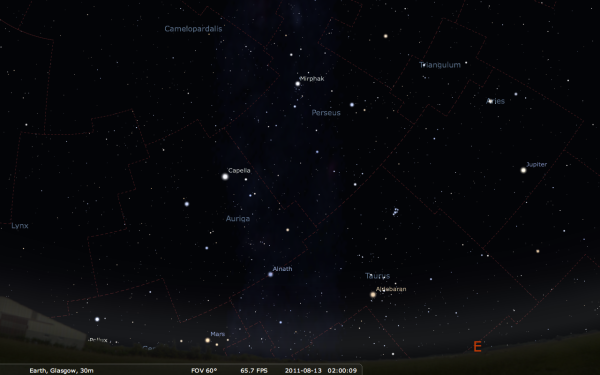
This is one of the most prolific meteor showers and is associated with the comet Swift-Tuttle. During the peak of the perseids, the radiant (the place the meteors appear to come from) often seems to be the ‘sword handle’ within the constellation of Perseus.
(the above image was taken using the iPhone app Star Walk)
The Perseid meteor shower peaks on 12/13 August every year and can have anything from 80 to 140 meteors an hour. Observers have been known to describe Perseid meteors as being fast and bright in appearance. Often a large number of them leave a trail behind them as they enter the Earths atmosphere and in the past many of them have turned into fireballs.
It wasn’t until 1866 that the association with Comet 109P/Swift-Tuttle was proved by Giovanni Schiaparelli. The Perseid meteor shower itself has been known and observed for a long time. The first known recorded accounts were by the Chinese in AD36. Both the Japanese and Koreans also have documentation of observing the Perseids from the 8th century onwards. Western observations seem to start during the 19th century, or at least the ones that were documented.
Now with advances in technology we can watch the meteor shower (Moon dependent of course this year) from the comfort and warmth of our own living rooms. We can track who has seen meteor showers by using a twitter map and discuss in real time if any of our online friends spot a fireball. Modern technology gives us new ways to interact with other astronomers, and not just locally, it allows us to encourage others to get out in the back garden and just look up.
Originally posted on Dark Sky Diary as “Perseids Meteor Shower 2011” by Steve Owens @darkskyman on twitter
This month sees the most reliable meteor shower of the year; the Perseids. You can begin watching for Perseid meteors now, and the shower will last until mid-August, but the peak of the shower occurs in the small hours of Saturday 13 August 2011.
Perseus under dark skies
Perseus under moonlit skies
Unfortunately this year’s shower will be obscured by the full Moon which occurs on the same day, and so it won’t present its usual excellent display.
The number of meteors that you will observe every hour depends on a number of factors:
the density of the cloud of dust that the Earth is moving through, that is causing the shower in the first place;
the height above the horizon of the radiant of the shower, the point from which the meteors appear to radiate;
the fraction of your sky that is obscured by cloud;
the naked-eye limiting magnitude of the sky, that is a measure of the faintest object you can see.
Please visit Dark Sky Diary for the rest of this article………..
Everyone is welcome to join in, whether they are an astronomer, have a slight interest in the night sky or just wonder?
As well as looking up, enjoying the night sky with us and seeing meteors, maybe for the first time? You will have the opportunity to contribute for fun with images and online, or to Scienceif you wish, by tweeting and seeing your results on a map, or by submitting Observing Forms if you are a more serious observer.
This event follows on from the popular Twitter Meteorwatchheld in August and December of 2009 and 2010 “Meteorwatch 2009”
Use the hash tag: #Meteorwatch and get involved, ask questions, do some science, follow the event and enjoy the wonders of the night sky with us. Images and other information will be tweeted as it happens. Live!
The highlight of the summer meteor showers: The Perseids reach maximum around the 12th/ 13th of August and may put on a display of approximately 80 to 100 meteors per hour under ideal viewing conditions.
Conditions this year aren’t ideal due to there being a full moon, but the brighter meteors will be seen. Let’s hope the skies stay clear.
Perseid meteors are often bright with persistent trails which can linger for a while after the meteor has burned up. Further information on the Perseid meteor shower and how to view it, can be found here.
While you are looking formeteors, there will be other objects to look out for such as the Planet Jupiter late in the evening, the Milky Way, Summer Triangle, manmade Satellites and more.
The Twitter Meteorwatch will start at 21.00 BST on the 11th of August and will continue through to the evening of the 13th. Amateur and professional astronomers and stargazers from the US and other countries are invited to join in and take over from the UK, when the sun comes up here, helping make the event run continuously and be truly international.
Soon you may see an eerie spectacle on clear summer nights if you are located at latitudes between 50° and 70° north and south of the equator: Noctilucent Clouds.
These ghostly apparitions are a delight to see and are quite rare. It is incredibly difficult to predict exactly when they will appear, but we do know they should begin to appear soon.
The season for Noctilucent Clouds (Noctilucent = Latin for “Night Shining”) starts early June and continues into late July. They are seen just after dusk, or before dawn and an apparition can last around an hour.
These mysterious clouds, with their bizarre tenuous wispy shapes reminiscent of ripples in sand or the changing surface of a pool of water, spread like a glowing web across the northern sky. Colours can range from brilliant whites, with tinges of blue, pink and orange.
Formed by tiny ice crystals, they are the highest clouds in the Earth’s atmosphere, located in the mesosphere at altitudes of around 76 to 85 kilometers (47 to 53 miles) almost at the edge of space.
They are normally too faint to be seen, and are visible only when illuminated by sunlight from below the horizon, while the lower layers of the atmosphere are in the Earth’s shadow. Noctilucent clouds are not fully understood and are a recently discovered meteorological phenomenon, only being recorded for about 120 years.
Noctilucent clouds can only form under very restrictive conditions, and their occurrence can be used as a guide to changes in the upper atmosphere. Since their relatively recent classification, the occurrence of noctilucent clouds appears to be increasing in frequency, brightness and extent.
There is evidence that the relatively recent appearance of noctilucent clouds and their gradual increase, may be linked to climate change. Another recent theory is that some of these bright displays come from particulates and water vapour in the atmosphere left over from Space Shuttle launches.
How can you see Noctilucent Clouds?
Over the next couple of months look north during dusk and dawn and try and spot this mysterious and elusive phenomenon. They are best seen when the sun is between 6 and 16 degrees below the horizon, and seem to occur more frequently in the Northern hemisphere than the Southern.
I am often asked or hear about bright fireballs in the sky, often reported by non astronomy minded people, so when you ask where was it and what direction it was travelling etc, you get very sketchy information back like: It was over my house and headed towards town, I think?
Only if you have many sightings of the same fireball can you interpolate where it was and what direction etc it was travelling? Things are going to be made a lot easier if you live in some parts of the United States.
NASA is building a network of "Meteor Cameras" in a few of States in the US called the "All-sky Fireball Network". This is a network of cameras set up by the NASA Meteoroid Environment Office (MEO) with the goal of observing meteors brighter than the planet Venus, which are called fireballs. The collected data will be used by the MEO in constructing models of the meteoroid environment, which are important to spacecraft designers.
The Network will eventually consist of up to 15 overlapping cameras in north Alabama, northwest Georgia, and southern Tennessee, placed on public buildings and schools. The network will use sensitive black and white cameras which are able to see the whole of the sky (All Sky).
Because the cameras have overlapping fields of view, more than one camera can see the same meteor at the same time, helping in getting data about its trajectory and with clever data collection software, ascertain if the meteor came from a comet or an asteroid.
NASA’s All-sky Fireball Network uses ASGARD (All Sky and Guided Automatic Realtime Detection). ASGARD not only handles all the data processing (which is considerable) it also automatically pushes the results to the web. See the results here: http://fireballs.ndc.nasa.gov
Originally posted on Sky and Telescope by by Kelly Beatty, October 6, 2010
Everyone enjoys a great meteor shower, those special times each year when a profusion of shooting stars zip across the sky. So here's a head's up: all of you should circle October 8th on next year's calendar.
This is the yearly date when Earth plows through a tenuous band of space dust created by Comet Giacobini-Zinner along its orbit. Ordinarily, the Draconid shower (formerly called the Giacobinids) puts on a so-so celestial show, delivering about 20 meteors per hour if you can view them under a moonless, pitch-black sky. That's hardly worth staying up for: after all, from a similarly clear, dark site you'll see six or seven random ("sporadic") meteors per hour.
However, this shower has a Jekyll-and-Hyde personality. In 1933 and 1946 the Draconids dazzled skywatchers with astounding meteor "storms" — delivering shooting stars at rates that briefly topped 10,000 per hour! — because Earth crossed through a particularly dense ribbon of debris shed by the comet in 1900. The shower hasn't put on that kind of performance in the years since, though in 2005 it surged unexpectedly to double or triple the usual rate.
If celestial prognosticators are right, we're in for a treat next year, when Draconid rates could top 600 per hour — that's 10 per minute — under ideal viewing conditions. That surge is in the cards because we'll likely clip the stream of particles ejected in 1900. Odds are that it's still largely intact, even though the comet's 6½-year-long orbit periodically puts it in Jupiter's disruptive vicinity.
On October 8, 2011, Earth will pass through several streams of particles ejected over the past 200 years by Comet Giacobini-Zinner.
J. Vaubaillon & others
At a meeting of planetary scientists now under way in Pasadena, California, meteor dynamicist Jérémie Vaubaillon (IMCEE, France) put forth predictions that he'd calculated with colleagues Mikiya Sato and Jun-ichi Watanabe (NAOJ, Japan). If they're right, next October 8th Earth crosses some cometary debris shed by Comet G-Z between 1873 and 1894, peaking at perhaps 60 meteors per hour centered at 17:09 Universal Time, followed at 19:57 UT by a much stronger, 600-per-hour pulse from the 1900 stream.
The rate is very uncertain, Vaubaillon admits, because there's no way to know whether those earlier streams are still densely packed or have been spread thin. Meteor observing wasn't as rigorous back then as it is now. But next year's results should help disentangle which streams are still contributing to the overall rates.
Other meteor specialists are also struggling to come up with firm rates. In 2008 Sato and Watanabe independently estimated a maximum of 500 per hour (at 20:36 UT), whereas NASA researchers Danielle Moser and William Cooke have offered a more optimistic 800 per hour (at 19:11).
These times favor observers in Europe, but don't rush out to book a plane just yet. First, the Draconid shower tends to produce many faint meteors that'll be obliterated by a nearly full Moon that night.
Although Europe is favored for watching the 2011 Draconid meteor shower, this map of average cloud cover during October suggests finding clear skies might prove challenging. (Bluer hues denote more frequent clouds.) Click on the image for a larger view.
Jay Anderson
Second, because the shower's radiant is way up near the head of Draco (declination +54°), the best observing sites would likewise be geographically north. But there's a reason that so few people book vacations to Scandinavia in October: "Weather in Northern Europe is not very pretty," notes Canadian meteorologist Jay Anderson. "October can be very nice, but usually it is the time when the winter cloudiness begins to encroach on the daily weather."
Instead, Anderson's cloud-cover map (at right) suggests that the northernmost "good weather" spot is in the Greek Islands. "Santorini — a favorite place of mine — has clear/few/scattered cloud cover 74% of the time. I know where I'd go."