by Steve Owens | Jan 4, 2011
Originally posted on Dark Sky Diaries by Steve Owens (@darkskyman on Twitter)
With the Quadrantids meteor shower that has just past yielding around 100 meteors per hour in near-perfect New Moon conditions, which showers of the next two years will give us as good a display?
Meteor Shower
There are a few regular, dependable showers that can be relied on to put on a good show year after year, given a good Moon phases, so let’s concentrate on those:
Lyrids 2011
The Lyrids peak this year on April 21/22, only three days after the Full Moon, making conditions far from ideal. The ZHR is around 20, but under bright Moon conditions this will be much reduced, so that from the UK you might only see a few Lyrids per hour.
Persieds 2011
The Perseids peak on 12/13 August 2011 coincides exactly with a Full Moon, making this shower pretty much a write-off in 2011.
Orionids 2011
The Orionids peak occurs on 21/22 October 2011 just after the last quarter Moon, with the Moon rising a little after midnight, just as the meteor shower radiant is gaining height. Again, far from ideal.
Leonids 2011
The Leonids peak on 17/18 November occurs during a last quarter Moon, which unfortunately is smack bang in the direction of Leo, and so will obscure many of the Leonids in 2011
Geminids 2011
The Geminids peak on 13/14 December 2011 will likewise be completely obscured by an almost-full Moon in Gemini.
Quadrantids 2012
The Quadrantids peak on 3/4 January 2012 will feature a waxing gibbous Moon which won’t set until 0400.
Lyrids 2012
The Lyrids peak on 21/22 April 2012 is the first major shower peak in 15 months where the Moon is absent, meaning that you should get good views of this shower which has a ZHR of only around 20.
Persieds 2012
The Perseids peak of 12/13 August 2012 will feature a thin waning crescent moon that’s visible in the sky from midnight, obscuring some of the Perseids.
Orionids 2012
The Orionids peak on 21/22 October 2012 is pretty much Moon-free from around 2330, as the Moon sets.
Leonids 2012
The Leonids peak on 17/18 November 2012 will also be Moon free from early evening, and so presents an opportunity to see a few Leonids.
Geminids 2012
Rounding off this two year run of poor Moon conditions for meteor showers, we end with the Geminids on 13/14 December, coinciding wonderfully with a New Moon on 13 December, meaning conditions will be near perfect.

by VirtualAstro | Jan 3, 2011
Professor Brian Cox and Dara O Briain host three days of live stargazing on BBC 2 featuring epic images from astronomers and observatories from around the globe.
There will be hundreds of free events up and down the country and many useful videos and guides on the Stargazing web page.
Stargazing Live is all about people doing astronomy and witnessing some of the most spectacular astronomical events, including the conjunction of the planets Jupiter and Uranus, the Quadrantid meteor shower and other wonders of the night sky.
In the spirit of getting everyone to look up and share all of the fantastic things going on as well as the BBC 2 program, meteorwatch.org will be doing a twitter meteorwatch for the quadrantids meteor shower, headed up by meteorwatch (@VirtualAstro on Twitter).
As well as all the useful information for beginners on this site and tweets from many people joining in on twitter, meteorwatch.org will have the Meteormap.
Tweet #bbcstargazing or #meteorwatch – first part of your postcode – Country e.g UK – and how many meteors you just saw, e.g 3 to see your meteor results appear on the map.
Your tweet should look like this #bbcstargazing SE1 UK 2 or #meteorwatch PL4 UK 1
Enjoy BBC Stargazing Live, the many events and Twitter Meteorwatch, but most of all, tell your family, tell your friends and tell everyone to look up and enjoy the majesty and wonders of the night sky!
The BBC is not moderating/ overseeing or is responsible for the content on this post, meteorwatch.org or the Twitter Meteorwatch.

by VirtualAstro | Dec 15, 2010
This full frame image was taken on the 14th of December from Cemaes Bay on
Anglesey looking East by Kev Lewis
Canon 5D MkII and Canon 24mm f1.4L lens shooting 20 second exposures at
f2.8 iso 1600
http://www.photosbykev.com

by Astroguyz David Dickinsen | Dec 10, 2010
Originally posted on the 10th December 2010 by AstroGuys
http://astroguyz.com/2010/12/10/astro-event-don%E2%80%99t-miss-the-geminids/

Looking Northeast at about 10 PM. (Photo by Author).
This year, believe the hype; this month’s Geminid meteor shower is a sure bet. This shower is one of the few dependable ‘old faithful’ meteor showers of the year. Peaking on the night of December 13th-14th, this year’s apparition sees a well placed northern radiant rising high in the northeast as the first quarter Moon sets about midnite local. The Geminid stream radiates from very near the bright star Castor in the zodiac constellation Gemini the Twins and typically produces up to 100 to 120 meteors per hour. If you are placed in mid-northern latitudes, you may see some activity shortly after sunset, but the real meteoritic action will begin after midnite. Think of a car driving at night in a snowstorm, not a stretch in the depths of the northern hemisphere winter. Looking forward into your high beams you get the cool vintage “Star Trek” effect, as you and your vehicle plow headlong into the stream of snowflakes. Think of the flakes as meteors and the car as the Earth; we face headlong into the meteor stream after midnight, and hence see more flashing meteor trains. The Geminids present several swift movers and fireballs, and the darker skies you have access to, the more you’ll see. Be sure to dress warm (it is winter out there!) and make a point to count and record your observations. Meteor shower observing is one of the few remaining scientific endeavors that remains low tech. Also, don’t forget to participate in the #meteorwatch via Twitter! This shower has a broad peak, and will be active the week of December 12th until the 18th, when the solstice-centered Ursids become active. In fact, there are some indications that the Geminids have been increasing in activity over the past decade, and certainly there’s a lot of material out there. The predicted peak centers on 5:00 AM UTC, just past midnite Tuesday morning from the US East Coast. And if that weren’t enough, it’s one of the last meteor showers with the Moon placed below the horizon until 2012; only the Quadrantids and Giacobinids have the same favorable geometry in 2011. Good luck, and be sure not to miss this unique meteor shower!
The astro-term for this week is the Yarkovsky Effect. The parent body that produces the Geminids, 3200 Phaethon, harbors somewhat of a mystery. Discovered in 1983, this space rock has been identified as the source of the Geminid meteor stream.NASA researchers estimate a massive amount of material exists, more than 100 times that of the average meteor stream. Unlike most streams that emanate from comets, however, 3200 Phaethon is an asteroid. Or is it an inactive comet? The mystery deepens, as the color of this strange rock is very similar to another asteroid, Pallas. 3200 Phaeton’s path sees it passing within Mercury’s orbit every 1.4 years, which brings it well within the realm of the Yarkovsky effect. This is the tiny bit of momentum imparted on a rotating body as it re-radiates photons absorbed from the Sun. On large bodies the effect may be negligible, but on tiny asteroids it can produce major changes in orbit over time. In fact, employing the Yarkovsky Effect by changing the reflectivity of an Earth-crossing asteroid is one way of possibly deflecting a lethal space rock. Is 3200 Phaethon a dormant comet or the remnant of an asteroid belt break up? This is one worldlet that definitely begs future exploration.

by VirtualAstro | Dec 8, 2010

Reports are coming in that people from all over the UK saw a very bright object streak across the sky!
The Object was reported to be incredibly bright with a flash which lit up the ground and then the object streaked across the sky, leaving a bright green tail in its wake!
Unfortunately I missed this amazing spectacle(drat!!!) and the first I herd of it was from a call I received from the BBC. BBC Radio 5 Live have had hundreds of text messages and calls from people who saw the event, and called me to ask if i new what it was?
The object was most definately a Meteor and would be refered to as a fireball or bolide (an incredibly bright fireball). What also makes me say this was a bolide is the apparent brightness duration (over 5 seconds) and its green tail. Typical of past bolide sightings from around the world.
Many people who saw the object reported a green tail and the reason for this is, the material the meteor is composed of oxidizes as it burns up. Most meteors are metalic and composed of iron with other trace metals. In tonights meteor's case it more than likely contained copper which is green when it oxidizes.
Reports of direction are sketchy, some people say south to North and Some say East to West, so we are unsure of its point of origin at present. Could it be an early chunk of the Geminids Meteor shower which peaks in the morning of the 14th December and is best seen the night before on the 13th through to the small hours? or is it a sporadic meteor? (please see below for mor explanations on what are meteors)
Please report your sightings on twitter using the hastag #meteorwatch or #meteor and join in with the Geminid Meteorwatch on Twitter on the evening of the 13th December 2011 Will it be a shower to remember?
I may be on BBC Radio 5 live at 11 – 11:30pm and will be discussing tonights fireball live from the Astrobunker.
What are Meteors?
Meteors are usually dust or sand grain sized pieces of rock which speed through space up to tens or hundreds of kilometers a second and when they enter the Earths atmosphere they burn up, creating bright or brilliant streaks across the sky.
Often referred to as "Shooting Stars" they can be seen randomly on most clear evenings and can be few or far between, these are called "Sporadic Meteors". A sporadic meteor can appear anywhere in the sky and from any direction.
You may be lucky enough and by chance to see larger sized pieces of debris burn up in the atmosphere causing very bright and enduring meteors, often referred to as "Fire Balls" or "Bolides". These are quite a sight and can last for several seconds in some cases.
Several times a year and on specific dates we have "Meteor Showers". A meteor shower is usually the left over debris from the tail of a comet which has in the past, passed through the Earths orbit or orbital plane around the sun. Because we know where and when these encounters happened we can accurately predict when the Earth will pass through the debris trail.
Some meteor showers only produce a hand full of meteors per hour and some produce up to a hundred or more meteors per hour. This is known as a "Zenithal Hourly Rate" or ZHR. We can also predict where in the sky or from what direction the meteor shower will come from, this is called the "Radiant".
A meteor shower will get its name from the constellation of stars the radiant occurs in, e.g. Perseids (Perseus), Leonids (Leo) and Geminids (Gemini) etc. A meteor is not to be confused with a "Meteorite" which is a meteor which has struck the surface of the planet, often very small pebble or stone sized.
Meteorites in extreme cases can be large, anything from the size of a football to many hundreds of Meters or Kilometers across. The Meteorite suspected of wiping out the Dinosaurs 65 million years ago, is estimated to have been 6 kilometers in diameter!

by Steve Owens | Nov 23, 2010
The final meteor shower of 2010 is the Geminids, the peak of which falls on the night of the 13/14 December 2010. The Geminids is described by the IMO as “one of the finest, and probably the most reliable, of the major annual showers presently observable”, and this year’s shower is set to put on a good show. (You can read the IMO’s rather technical summary of the 2010 Geminids here: http://www.imo.net/calendar/2010#gem)

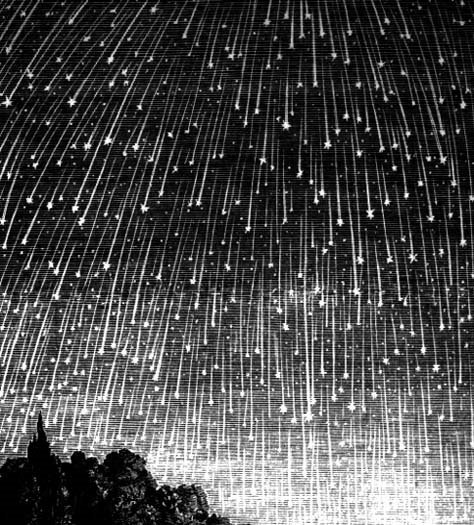
It won't look like this
The predicted Zenith Hourly Rate (see my previous post about ZHR and what it actually means here) is around 120. Although the peak is predicted to occur around 1100 on 14 December, it should happen some time between 1840 on 13 December and 1600 on 14 December 2010. The best time for the peak to occur for stargazers in the UK would be between 0030 and 0600 on 14 December, after the Moon sets but before twilight begins.
The radiant for this shower is actually quite favourable, and if you wait till the Moon sets at around 0030 on 14 December then the only light pollution limiting your view will be man-made. If you observe before the Moon sets then you will lose a few of the fainter Geminids in its glow, but it’s only a first quarter moon, and so will only really have an impact if you’re observing from very dark skies.
Let’s use the equation relating ZHR to actual observations of meteors to work out how many you might see:
Actual Hourly Rate = (ZHR x sin(h))/((1/(1-k)) x 2^(6.5-m)) where
h = the height of the radiant above the horizon
k = fraction of the sky covered in cloud
m = limiting magnitude
In the case of the 2010 Geminids, if observed from the UK, h = 45 degrees. Let’s assume you have clear skies (haha) with k = 0.
The number of Geminids you can expect to see from a variety of observing sites is as follows:
For very light polluted sites, such as city centres m = 3, and therefore you can expect to see only around 8 meteors per hour.
In suburban skies near a city or town centre m = 4, and you’ll see around 15 meteors per hour.
In rural skies where m = 5, you’ll see 30 meteors per hour.
Under very dark skies, where m = 6.5 (i.e. where there is no or negligible effect of light pollution, like in Galloway Forest Dark Sky Park) you’ll see up to 85 meteors per hour, once the Moon sets. A first quarter moon will impose a limiting magnitude, even at a very dark site, of around 6, in which case you’ll see a slightly reduced 60 meteors per hour.
Remember, all of these numbers assume perfectly clear skies. If half your sky is cloudy, cut these numbers in half!
How many Geminid meteors will I see?
| Where are you observing from? |
Limiting magnitude |
Number of Geminids per hour |
| A very light polluted city centre |
3 |
7 or 8 |
| Suburban Site |
4 |
15 |
| Rural Site |
5 |
30 |
| Dark Sky Site |
6.5 |
85 (after the Moon sets at 0030) |
If you fancy a good view of this spectacular meteor shower, then head to Galloway Forest Dark Sky Park, where we have an evening of talks and meteorwatching planned, weather permitting!
Originally posted by Steve Owens (@darkskyman) on his blog Dark Sky Diary Pursuing darkness in an increasingly bright world