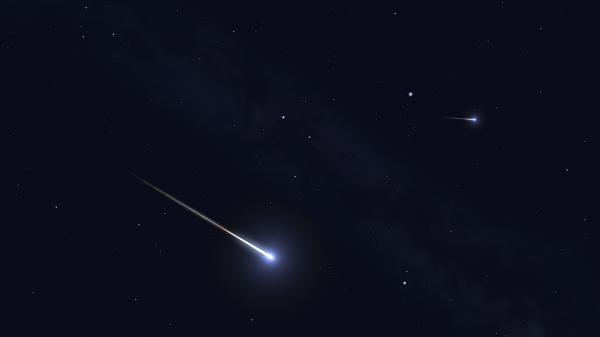
The Geminid Meteor Shower peaks on the night of December 13 and 14 and is one of the most anticipated and reliable meteor showers of the year.
Under good observing conditions, up to 100 or more meteors can be seen per hour. For information on how to spot the meteors please see How to Observe Meteors. (more…)
Long Exposure photo of a visible ISS pass Credit: Mark Humpage
The International Space Station (ISS) is back over UK skies with some great passes during October 2013. The ISS is the largest Space Station/ laboratory ever built orbiting the Earth, it can be spotted with the naked eye at certain times as it orbits the planet at 17500mph at an altitude of roughly 200 miles.
Spotting the station is very easy and you don’t need any special equipment, only your eyes. (more…)
Perseid Meteorwatch – Saturday 10th to Monday 12th of August 2013
Artists Illustration of perseid Meteors Credit: Meteorwatch
The Perseid meteorwatch 2013
The Perseid meteorwatch 2013 starts on Saturday 10th and runs each evening until Monday 12th of August 2013 @VirtualAstro with the help of many more people, will be holding a Twitter #Meteorwatchfor the Perseid Meteor Shower.
Everyone is welcome to join in, whether they are an astronomer, have a slight interest in the night sky or have a passing interest and just wonder?
The Perseids are the highlight of the astronomical calendar and a must see! They are ideal for those who want to see a meteor/ shooting star for the first time.
Long Exposure photo of a visible ISS pass Credit: Mark Humpage
The International Space Station (ISS) is back over UK skies with some great passes during August 2013. There is a special bonus this time as the passes take place during the Perseid Meteor Shower – you may see shooting stars too!
The ISS is the largest Space Station/ laboratory ever built orbiting the Earth, it can be spotted with the naked eye at certain times as it orbits the planet at 17500mph at an altitude of roughly 200 miles.
Spotting the station is very easy and you don’t need any special equipment, only your eyes. (more…)
Comet panSTARRS and the Moon March 12th 2013 (comet shape for illustration only) Credit: Meteorwatch
From the 7th of March 2013 and for the rest of the month, comet panSTARRS will be in the early evening skies of Northern hemisphere.
The comet has been visible to the naked eye in the Southern hemisphere and was bright enough to be seen in twilight skies from places such as New Zealand.
Hopefully Northern hemisphere countries such as the USA, Europe and Asia will get a chance to see one of this year’s bright comets. (more…)