The international space station (ISS) is a habitable artificial satellite in low Earth orbit. It is the latest and largest in a line of previous space stations such as Skylab and Mir.
The ISS is a modular structure and the first module was launched in 1998 and many more modules, trusses, solar arrays and other elements have been added since.
The station is just over 72 m long by just over 108 m wide and 20 m high; it is maintained at an orbital altitude of between 330 km (205 mi) and 410 km (255 mi) it travels at an average speed of 27,724 kilometres (17,227 mi) per hour and completes 15.7 orbits per day. (more…)
Watch the first Soyuz launch from Guiana Space Center (CSG) in French Guiana
A new countdown for Soyuz’ first flight from the Spaceport
October 20, 2011 10:30:26 a.m. UT – Soyuz Flight VS01
The countdown to Soyuz’ maiden flight from French Guiana will resume for a liftoff tomorrow morning after work on the launch pad resolved a ground support system anomaly that postponed the historic mission for 24 hours.
This anomaly was identified as a leak in a launch pad pneumatic system responsible for the programmed disconnection of Soyuz’ third stage fueling lines before the vehicle lifts off.
With the issue resolved, the liftoff is now set for October 21 at 7:30:26 a.m. local time in French Guiana – a precise moment that enables the payload of two Galileo satellites to be injected into their proper orbital plane.
Soyuz’ 3-hr. 49-min. flight from the Spaceport will inject the In-Orbit Validation (IOV) spacecraft for Europe’s Galileo satellite navigation system into a 23,222-km. circular medium-Earth orbit, inclined 54.7 degrees.
Weighing approximately 700 kg. each, these satellites – along with two others to be lofted by Soyuz in 2012 – will form the operational nucleus of Europe’s full 30-satellite Galileo navigation constellation, which is being developed in a collaborative program involving the European Space Agency and European Union
With the Soyuz launcher operating out of the Guiana Space Center (CSG) in French Guiana, Arianespace is the only launch services provider in the world capable of launching all types of payloads to all orbits.
The “Soyuz in French Guiana” project covers three main aspects:
– Construction of launch facilities, including a launch pad identical to those used in Kazakhstan and Russia.
– Launcher modifications needed for operation from the Guiana Space Center (CSG), primarily ensuring compliance with the range safety rules at CSG and adaptation to the requirements of the launcher tracking network.
– Verification of compatibility of the Soyuz launcher with the environmental conditions in French Guiana (in particular the weather and wind conditions).
The Soyuz at CSG launch system, combining the new launch pad with a launcher that has been slightly modified in relation to the version launched from Baikonur, will be validated during the inaugural flight :
– The final countdown and actual flight through the end of the mission will enable validating the operation of all ground and launcher systems and equipment.
– This flight will also enable identifying any improvements that may be needed for the commercial operation of this new launch system.
A blog for us AMATEUR amateur astronomers. By @RadioVicky.
Bio:
I’m 33, I live in Bristol and I like astronomy. However, I don’t have a telescope and even if you did give me one, I’d be uncertain where to put my eye. I write comedy and I’m a professional blogger. My favourite colours are beer and dark skies.
Telescopes scare me. Not in the way a stranger in my bedroom or a spider in my knickers would scare me, but they do fill me with a certain fear.
I mean, I absolutely love things that go *shine* in the night, and have since I was a little girl, but the prospect of going out and buying a scope – something I know NOTHING about — is fairly petrifying. It even makes me feel a bit of a fraud. How can I be in to astronomy when I don’t even know my azimuth from my elbow? And also, I’m not too hot on my constellations either – sure, I know the main ones they teach you at school, but ask me to point out Lyra? Pegasus? Lucky Jim’s Pirate Ship?
OK, I admit it, I’m an AMATEUR amateur astronomer, but so is 99.9999999999999999999999% (possibly more nines than that, I didn’t have time to conduct a survey) of the world’s population, so it’s a cool club to be in.
Before I got friendly with astronomers on Twitter, I always fancied one of those thin tubular ones they sell for £90 in Argos. Surely I would be able to see the storms on Jupiter, the arms of Andromeda, and the Bristol football team practicing from 10 miles away? Turns out I’d be better off peering through a toilet roll tube with some cling film on the end of it – I’ve been told that cheap telescopes merely turn unimpressive white dots into marginally less impressive WOBBLY white dots, so I’m saving the cash for a Virgin Galactic space holiday instead. I hear the weather’s quite exceptional on Mercury…
But something happened this weekend that made me feel better about scope envy. I’ve been getting friendly with our very own @virtualastro on Twitter, and when I discovered I had 900 free minutes to use before the end of the month, I thought it was nigh on time we spoke to each other.
So, I called him up, and we spent a total of FIVE HOURS on the phone over the course of Saturday and Sunday night. Rest assured Twitter, we have plotted and planned some very exciting things together which will be blazing your way like a comet made of ideas instead of muddy ice soon …but the best, most wonderful, amazing, magical thing we did was…GO STAR HOPPING TOGETHER. Without a freakin’ telescope!
Even though we are about 70 miles apart (I live in Bristol, he lives in Oxfordish somewhere) we were both able to look up at the same sky, see the same ISS passes, and the same meteors. It was remarkable to be on the phone to someone with such an incredible knowledge of the skies. I sat gob smacked, mouth and ears open, as he talked me through constellations, clusters, satellites and gory Greek myths. I had no idea Cassiopeia had been a naughty girl and was sentenced to dangle upside down on a chair for eternity. I’d never heard of the Cygnus Rift — an ominously dark patch of sky in our milky way. I couldn’t even pick out the summer triangle, but now I know where it lives I will undoubtedly point it out to people in the pub, spilling cider as I leap around, trying to remember which stars make it up.
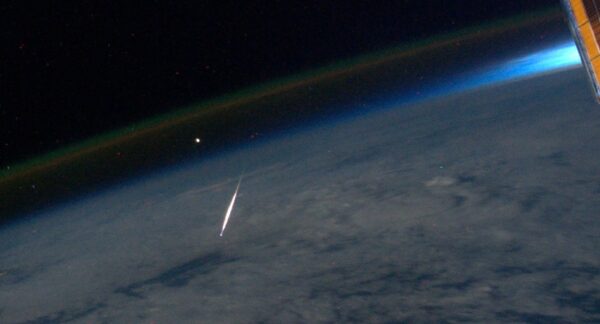
The best part was a dazzling ISS pass with a Perseid meteor streaking past like an arrow through a love heart. @VirtualAstro even had to put the phone down to deal with the deluge of tweets, and it felt amazing to be part of something so communal, so magical, yet so fleeting.
He also reassured me I didn’t need a telescope to enjoy the skies – which is fabulous because I was getting a bit sick of wishing for one on every meteor I saw. He said ‘if you look up at the sky…then you’re already an astronomer,’ a line which neatly castrated the last traces of my scope envy.
As I lay back and looked at the star-flecked sky, with crickets singing in the hedge, fired up with a guided tour of our resplendent heavens, it dawned on me. This was better than any naughty phone chat line. He could quite easily wire up a premium-rate number to his phone and charge £1.50 a minute for the pleasure of his knowledge.
Yep, I had a great time star-gazing without a scope last night. To the point of rubbing my thighs and drooling a bit. And how was it for you, darling?
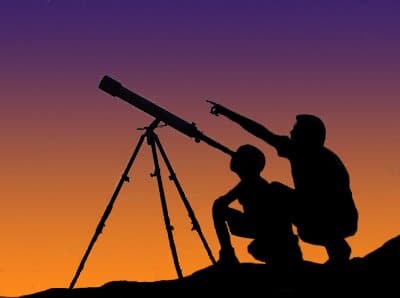
Vicky pretended she was having fun looking through the telescope, but the view was better with just her eyes.
What is it? – The International Space Station or ISS is a large spacecraft which orbits around Earth. This orbit allows the ISS to be reached by launch vehicles (such as the Space Shuttle) of all the international partners for the delivery of crews and supplies. It is the largest and most complex international scientific project in history. The ISS is the size of a football pitch fitted with almost an acre of solar panels that provide electrical power to six state-of-the-art laboratories.
Can the ISS be seen from Earth? – Yes, it travels at an amazing 17,000 mph and orbits earth at an altitude of approximately 250 miles. The sheer size of the structure and array of solar panels reflect sunlight, making it the biggest, brightest object orbiting earth. Only the sun and moon are brighter. It can easily be seen moving across the night sky, at certain times, almost resembling a slow moving fireball.
How do you capture it on camera? – With a bit of planning and the right equipment it can easily be captured on camera:-
Planning – Firstly, one needs to calculate at what time the ISS will pass over the skies above. This can easily be found by visiting a website: www.heavens-above.com which will identify the exact days and times at when the ISS will pass directly above one’s location, and which part of the sky to look. There are also a number of excellent mobile applications such as ‘GoSatWatch’ and ‘Flyby’ which allow this to be done remotely.
Credit: Mark Humpage
Execution – A good ISS capture will require a long exposure. A tripod is therefore required to keep the camera nice and steady. A wide angle lens will ensure maximising as much of the ISS flyby which can travel across the entire horizon. Personally, I use the Olympus 7-14mm or 8mm fisheye which are ideal lenses. Try to locate a foreground object of interest within the frame, a line of trees or buildings in order to give the image perspective and scale. Set the camera to manual and use long exposure times of anything between 15 and 30 seconds. With camera primed and in position all that is left now is to wait for the ISS to enter the field of view. By capturing a single or number of continuous exposures the resulting image(s) will reveal a long trail across the frame. Capturing numerous and continuous images will allow you to stack and produce a composite, which can produce stunning results.
ISS Double flyby photo (bottom) – For this ISS double flyby image I chose a location that offered a good foreground subject (water) and scope to cover the entire east/west horizon. Planning involved choosing an evening where the ISS would fly over my location numerous times (in one night) and a look at the weather forecast to ensure clear skies. Armed with a one man tent and all my camera gear I headed off and arrived on site late evening on June 11th. The first ISS pass was due at 2300hrs and subsequent passes every 90 mins. The plan was twofold 1) Set up one camera waterside and take continuous 15sec exposures for the entire night 2) Use a second camera for each ISS pass in different locations at the site. In between passes I would grab a short power nap huddled in the tent. Not a very comfortable evening but the resulting images made up for it. Using stacking software I produced two composite images, one detailing the ISS passes alone and the other including a star trail from the entire evening.
The star trails and bright light (moon) is the resulting visible effect of earth’s rotation. The location choice was also perfect as the morning mist makes for an eerie scene, perfectly complementing the ISS pass. The images made the national press the following day, which was very pleasing. One final word about capturing the ISS – it is due to be decommissioned (crashed into the sea) in 2020, so be quick!
Captured with Olympus E5 & 8mm fisheye – 2 ISS flybys, each comprising approx 12 images. Final stacked composite Credit: Mark Humpage