by VirtualAstro | Mar 8, 2011
Originally Posted on Universe Today by meteorwatch (@VirtualAstro)
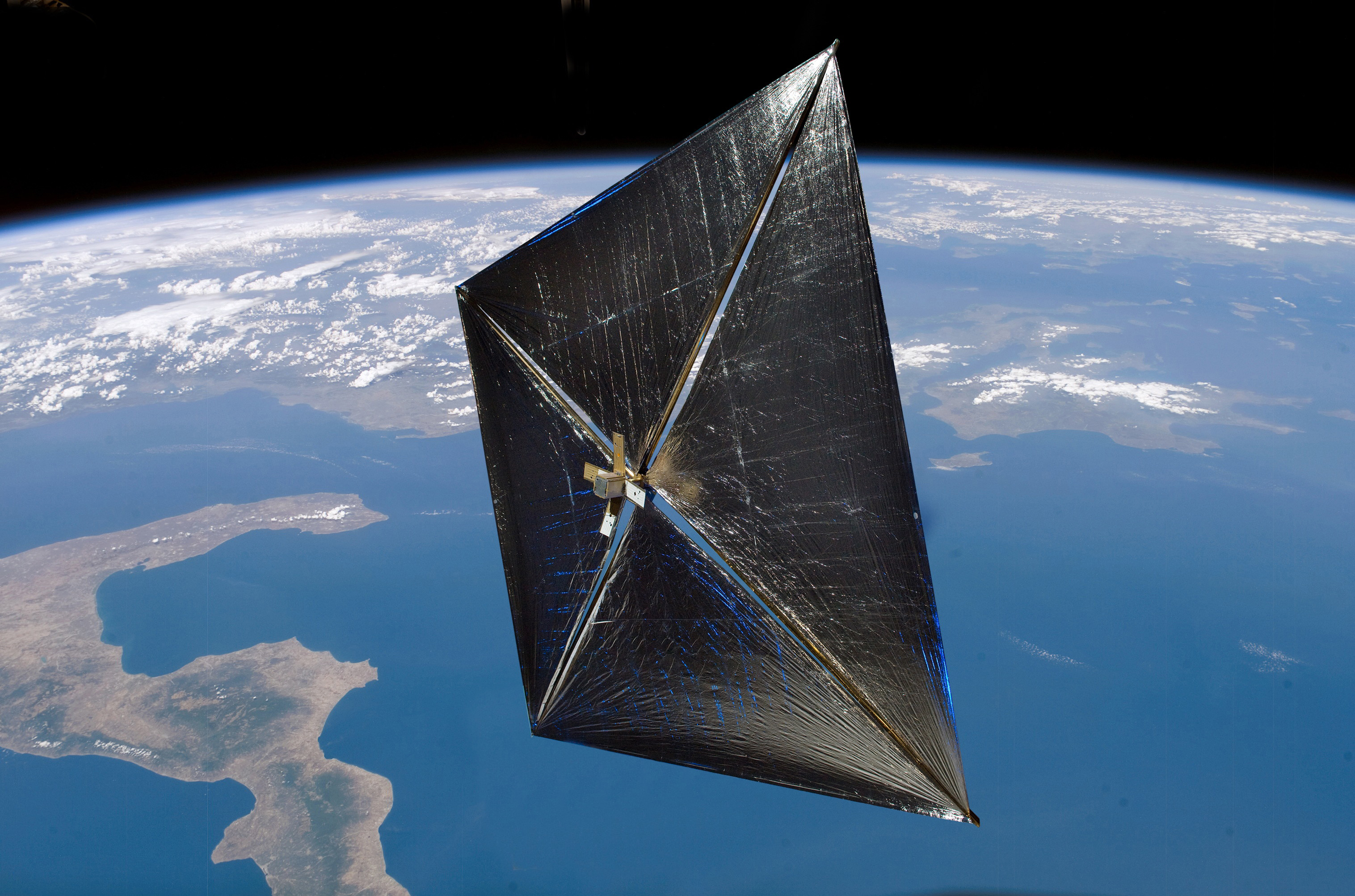
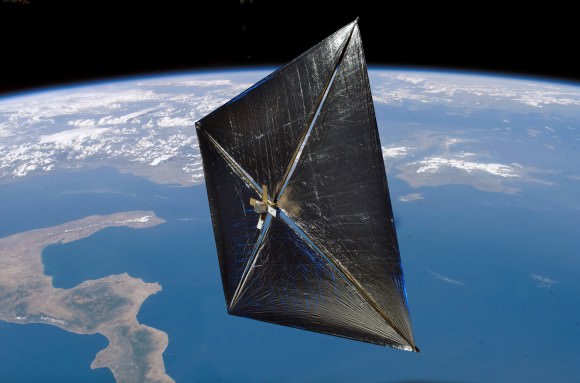
Artist concept of Nanosail-D in Earth orbit. Credit: NASA
The night sky has many wonderful objects to look at on a clear evening, including many man-made satellites, and the always impressive International Space Station (ISS). Now there’s a new addition to these artificial delights: the first ever solar sail to orbit the Earth, NASA’s Nanaosail-D Satellite. Want to know how you can see it?
The 10m x 10m reflective sail is designed to act like a brake and gradually create drag in the upper atmosphere, slowly pulling a satellite down and de-orbiting it at the end of its working life. Nanosail-D is testing the potential of this technology to reduce space junk and debris.
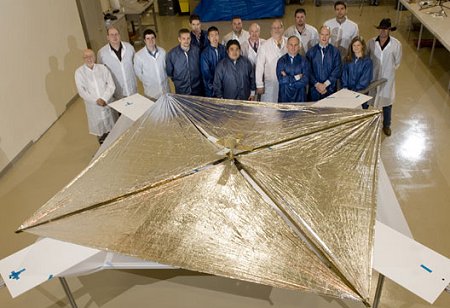
NanoSail D. Image credit NASA
The satellite has a huge reflective sail and could potentially be many times brighter than the planet Venus when it catches a glint from the Sun. Unlike the International Space Station (ISS) and other satellites, the sail will not be visible when it is directly above us as we will be looking at it edge on, It will be more visible when closer to the horizon.
The Nanosail-D satellite will be visible from now and for the next few months. To see it you will need to know exactly when it will be visible from your location. To do this, go to heavens-above.com or spaceweather.com where star charts with times and pass details will be displayed after you enter your observing site.
Once you know the time and location in the sky of the pass of the satellite, make sure you are able to get a good view of the horizon, or part of the sky where the satellite due to appear. Give yourself plenty of time, go outside and get ready. I always set a 30 second reminder on my watch or cell phone, so I don’t have to fumble around or guess the time.
Unlike the ISS and most other satellites, Nanosail-D passes may only last a few, or a few tens of seconds, so make sure you are looking in the right place at the right time. You will see an amazingly bright star-like object rise up, get brighter and then suddenly disappear. When it “disappears” it is still passing over, it’s just no longer at the right angle or is no longer being illuminated by the sun. NanoSail-D has few reflective surfaces compared to many on the ISS.
To enjoy the Nanosail-D passes:
• Make sure you know the right place in the sky and the time of the pass, by checking on the web.
• Make sure you will be able to get a clear view of it from your viewing location.
• Set an alarm or get ready for the pass as it only lasts a few seconds.
• NASA expects NanoSail-D to stay in orbit until April or May 2011.
• If you are an astrophotographer, don’t forget, NASA and SpaceWeather.com are having an imaging contest of NanoSail-D. Find out more here.
• Most of all, get your friends and family outside with you to watch Nanosail-D and enjoy!
by VirtualAstro | Dec 23, 2010
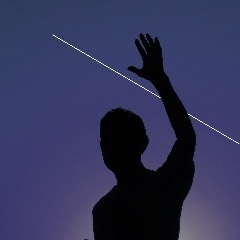
A round-the-world wave to the humans aboard the International Space Station by their fellow humans on the Earth – choreographed by a grassroots Twitter campaign (@ISSwave).
24-31 DECEMBER, 2010
A celebration of human solidarity during the holiday season
For one week beginning Friday, 24 December, humans around the world will show their solidarity with their fellow humans in space (and on Earth) by waving at the International Space Station (ISS) as she passes overhead at 17,500 mph (28,000 kmph).
Participants, recruited through Twitter, are encouraged to share their waves — either alone or as part of an ISSwave tweetup (a physical gathering of twitterers, or tweeps) — by tweeting their zip/postal code and the hashtag “#ISSwave” along with photos and videos of their waves, thoughts, holiday wishes for the astronauts and cosmonauts, etc. Participants’ waves will be registered in real-time at www.isswave.org.
Astronauts and cosmonauts aboard the International Space Station may even film themselves waving back at ISSwave participants. At least two astronauts, including Ron Garan, have voiced their support for ISSwave in emails and tweets.
The idea for the wave emerged through a serendipitous twitter exchange among Twitter acquaintances and regular ISS watchers Lucy Rogers (@DrLucyRogers), Richard P. Grant (@rpg7twit) and Karen James (@kejames). They discovered that watching ISS passes is even more exciting when done together with other humans, whether they are standing right next to you or watching from afar. To know that you are not the only one looking up in awe at this spectacle of human ingenuity and cooperation speeding across the night sky creates a special connection between us.
“The first time I watched an ISS pass I was surprised by how much it affected me,” said Karen James. “‘We made that’, I thought, ‘there are humans up there!’ All of my worries just seemed so tiny in the face of this symbol of human achievement and cooperation. I want to share that experience with other humans and also show my support to the ones living and working aboard the station.”
‘“I’d always wave up at the ISS if I saw it pass overhead,” says Lucy Rogers. “Someone laughed and said the astronauts wouldn’t see me.” So she asked on Twitter if anyone else waved – a lot of people did – and the communal ISS waving began. “When Karen moved to the USA she saw the ISS at a different time to us in Europe – which prompted the idea of a round-the-world wave,” she says.
We see the ISS because it is lit by the Sun. Sunlight reflects off it’s solar panels in the same way it glints off windows here on Earth. As the ISS travels round the world, the reflection can be seen in a broad sweep across the Earth. Due to the angles involved between the Sun, ISS and our location on Earth, sometimes we see bright, high passes and sometimes we can’t see it at all. During the week 24th – 31st December, most places on the Earth should get a good view of it at some point.
The three formed the Twitter account @ISSwave to coordinate, promote and provide updates on the event. Their hope is that seasoned and novice ISS watchers alike will experience the startlingly emotional experience of an ISS pass, amplified by solidarity with thousands of others watching around the world.
Additionally, the team hopes the buzz around ISSwave will persuade those who have never watched an ISS pass to participate, marking an increase in awareness about the International Space Station and the existence of a community of space enthusiasts on Twitter (“spacetweeps”).
The wave also celebrates the 10th anniversary of continuous human presence in space (ISS10years) on 2 November 2010 and the 50th anniversary of Yuri Gagarin’s flight into space — the first human spaceflight — on April 12th 2011 (www.YuriGagarin50.org).
ISS Wave Info:
- The International Space Station has been orbiting the Earth over 15 times a day for more than ten years.
- Although it is about 390 km (~240 miles) high, we can still see it from the Earth, thanks to the Sun reflecting off the solar arrays. The solar array wingspan is 240 feet (73 meters). This is longer than that of a Boeing 777 model at 212 feet (65 meters).
- Currently on the ISS are Oleg Skripochka, Alexander Kaleri, Dmitry Kndratyev, Paolo Nespoli, Catherine Coleman and Scott Kelly (Commander).
- Photos of the ISS passing overhead are available at http://www.isswave.org/ISSWave/Media_Photos.html
- There are various ways you can work out when it will be possible to see it from where you are, including Heavens Above, Twisst, NASA, ESA and Orbiting Frog.
- As of 19 December, @ISSwave had over 600 followers from across all continents.
- Dr Karen James (@kejames) is Director of Science for The HMS Beagle Trust, a UK charity aiming to rebuild the famous ship that carried Charles Darwin around the word on his seminal voyage of discovery. Through the Beagle Project she collaborates with NASA Astronaut Michael Barratt a long-duration spaceflight veteran and member of the crew of the upcoming STS-133 mission to the ISS aboard Space Shuttle Discovery. She is a former postdoctoral researcher at the Natural History Museum in London and has recently repatriated to the United States. For more information visit http://kejames.com/.
- Dr Lucy Rogers (@DrLucyRogers) a Chartered Mechanical Engineer and Fellow of the Royal Astronomical Society, aims to infiltrate the public’s consciousness by writing scientific stuff in plain English. She has published a book about space flight, “It’s ONLY Rocket Science”, which doesn’t contain any equations. She lives on the Isle of Wight where she can see the Milky Way from her back garden. For more information visit http://lucyrogers.com.
- Dr Richard P. Grant (@rpg7twit) is a biological scientist turned writer, editor and poet. He currently lives and works in London, and has a habit of taking on far too many projects. For more information visit http://rg-d.com/rpg, or his blog at Occam’s Typewriter.

PRESS CONTACT:
For more information or to arrange an interview:
UK: Dr Lucy Rogers
Twitter: @DrLucyRogers
Skype: dr.lucy.rogers
Phone: +44 1983 731 759
Email: [email protected]
USA: Dr Karen James
Twitter: @kejames
Skype: karenejames
Phone: +1 207 669 2663
Email: [email protected]