Slooh Space Camera to Track near-Earth Asteroid Apophis as it Passes by Earth
Please visit Slooh.com for live images of the asteroid, if the video is on a loop
Credit: Slooh.com Apophis, Named after an ancient Egyptian mythological demon, is a near-Earth asteroid with an estimated diameter of almost three football fields (270m), will make its close approach to Earth this week. Slooh Space Camera will cover its near-approach on Wednesday, January 9th, with several live shows on Slooh.com, free to the public, starting at 4 PM PST / 7 PM EST / 00:00 UTC (1/10) – International times here: http://goo.gl/ud5UL – accompanied by real-time discussions with Slooh President, Patrick Paolucci, Slooh Outreach Coordinator and Engineer, Paul Cox, and Documentary Filmmaker, Duncan Copp. Viewers can watch live on their PC or IOS/Android mobile device. (more…)
Professor Brian Cox and Dara O Briain host three nights of stargazing and discussion, live from Jodrell Bank. Featuring guest experts and link-ups to observatories around the world. Credit: BBC[/caption]
Stargazing LIVE returns for a third three-night series from 8-10 January 2013 to encourage everyone – from the complete beginner to the enthusiastic amateur – to make the most of the night sky.
The Quadrantid Meteor Shower ushers in 2013 with its peak in the early hours of the 3rd of January.
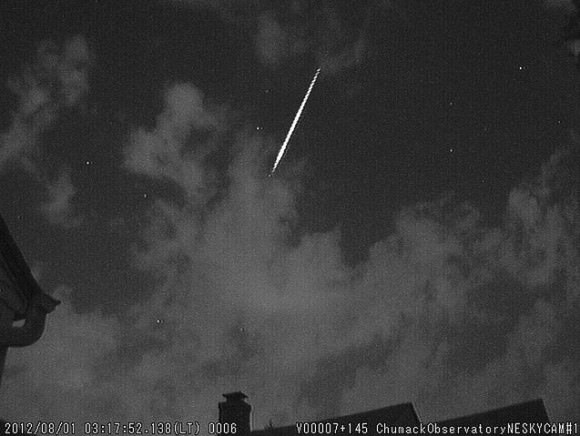
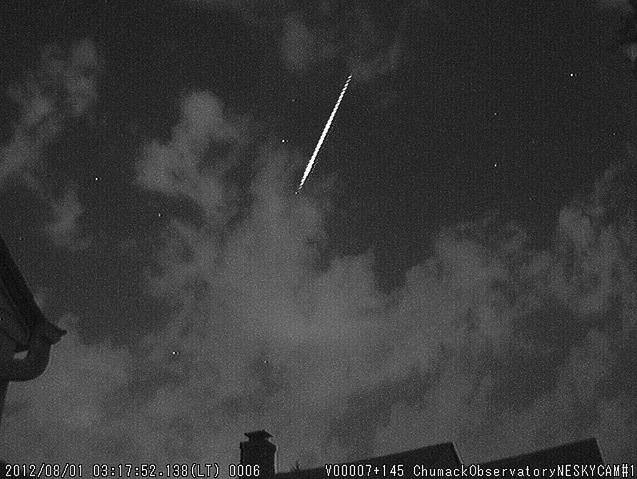
The Quadrantids can be an impressive meteor shower with rates of up to 120 meteors per hour at its peak (under perfect conditions) and have been known to produce rates of up to 200 meteors per hour. The peak is quite narrow lasting only a few hours, however there will be plenty of meteors to look out for either side of maximum. (more…)
The Geminid meteor shower is the grand finale of astronomical events in 2012 and is the most reliable and prolific of the annual meteor showers.
This year we are in for a special treat as the Moon will be absent when the Geminids are at their peak on the evening of the 12th/ 13th of December. This means that the sky should be at its darkest when the shower is expected and many more of the fainter meteors may be seen. (more…)
A composite image of every meteor captured in a viewing session for the 2011 Orionid Meteor shower at Middle Falls, near Mount Shasta in California. Credit: Brad Goldpaint/Goldpaint Photography. Used by permission Universe Today.
The Earth will soon be traveling through the stream of debris left behind by Halley’s Comet, providing the annual sky show called the Orionid Meteor Shower. This usually reliable meteor shower is expected to peak this coming weekend, October 20-21, 2012, and should produce about 25 meteors per hour, according to the McDonald Observatory at The University of Texas in Austin.
Red Bull Stratos is a mission to the edge of space that will try to surpass human limits that have existed for more than 50 years. Supported by a team of experts, Felix Baumgartner will undertake a stratospheric balloon flight to more than 120,000 feet / 36,576 meters and make a record-breaking freefall jump in the attempt to become the first man to break the speed of sound in freefall (an estimated 690 miles / 1,110 kilometers per hour), while delivering valuable data for medical and scientific advancement.
This will probably be the most simple and easiest guide to viewing the Perseids and other meteor showers you may possibly ever read. The reason why it is so simple is when you are outside you want to concentrate on looking for meteors and not worrying about technical details, which are unnecessary for the casual observer.