by Steve Owens | Mar 10, 2011
Originally posted on Dark Sky Diary by Sreve Owens @Darkskyman
I’ll make a prediction: on or around 19 March, when the so-called “Supermoon” occurs, at its closest approach to Earth in two decades, people will indeed report that the Moon looks much bigger than normal. But it won’t really be much bigger in the sky at all. It’s all in our heads!

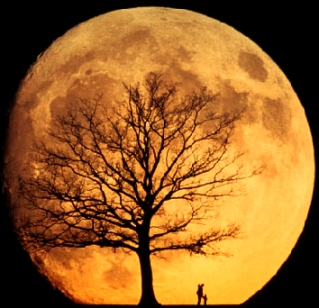
"Wow, the Moon's even bigger than that tree!"
You’ve probably all seen it before, a huge Full Moon sitting on the horizon. Time and again I have had people ask me why the Moon is so much bigger some times than others, and the answer is: it isn’t, really.
The Moon orbits the Earth in an elliptical orbit, meaning that it is not always the same distance from the Earth. The closest the Moon ever gets to Earth (called apogee) is 364,000km, and the furthest is ever gets (perigee) is around 406,000km (these figures vary, and in fact this Full Moon on 19 March 2011 will see a slightly closer approach of 357,000km).
So the percentage difference in distance between the average perigee and the average apogee is ~10%. That is, if the Full Moon occurs at perigee it can be up to 10% closer (and therefore larger) than if it occurred at apogee.
This is quite a significant difference, and so it is worth pointing out that the Moon does appear to be different sizes at different times throughout the year.
But that’s NOT what causes the Moon to look huge on the horizon. Such a measly 10% difference in size cannot account for the fact that people describe the Moon as “huge” when they see it low on the horizon.
What’s really causing the Moon to look huge on such occasions is the circuitry in your brain. It’s an optical illusion, so well known that it has its own name: the Moon Illusion.
If you measure the angular size of the Full Moon in the sky it varies between 36 arc minutes (0.6 degrees) at perigee, and 30 arc minutes (0.5 degrees) at apogee, but this difference will occur within a number of lunar orbits (months), not over the course of the night as the Moon rises. In fact if you measure the angular size of the Full Moon just after it rises, when it’s near the horizon, and then again hours later once it’s high in the sky, these two numbers are identical: it doesn’t change size at all.
So why does your brain think it has? There’s no clear consensus on this, but the two most reasonable explanations are as follows:
1. When the Moon is low on the horizon there are lots of objects (hills, houses, trees etc) against which you can compare its size. When it’s high in the sky it’s there in isolation. This might create something akin to the Ebbinghaus Illusion, where identically sized objects appear to be different sizes when placed in different surroundings.

Ebbinghaus Illusion – the two orange circles are exactly the same size
2. When seen against nearer foreground objects which we know to be far away from us, our brain thinks something like this: “wow, that Moon is even further than those trees, and they’re really far away. And despite how far away it is, it still looks pretty big. That must mean the Moon is huge!”.
These two factors combine to fool our brains into “seeing” a larger Moon when it’s near the horizon compared with when its overhead, even when our eyes – and our instruments – see it as exactly the same size.
by VirtualAstro | Feb 24, 2011
Originally posted on Dark Sky Diary by Steve Owens (@darkskydman)
The BBC news website today has a feature on Double Summertime (DST), the proposal to set all UK clocks forward by one hour throughout the year, so that we might all benefit from longer evenings. The argument is that this will boost tourism, reduce road traffic accidents, and give us more time to enjoy outdoor activities in the evening.
UK amateur astronomers would lose 25% of their dark evening observing hours under Double Summertime
The main argument normally put up against Double Summertime is that there will be an increase in road traffic accidents due to darker mornings. This is technically true, although it is more than offset by the reduction in RTAs as a result of the brighter evenings, and therefore overall it’s safer, saving an estimated 80-100 lives per year. (See section 4.6, pp. 49-50 in the report Road Safety Beyond 2010 for the estimates in detail).
The extra hour of daylight each evening could be worth £3.5 billion through increased tourism, as well as creating around 8000 new jobs.
And finally, the reduced use of lights at night might save an estimated 2% of our daily electricity use, or 1.2 million tonnes of carbon.
So what’s not to like?
Well, not everyone would welcome brighter evenings. It is definitely a minority interest when set against the pro-safety, pro-business, pro-environment arguments above, but the UK amateur astronomy community would be more than a little put out by the change, losing an hour of stargazing each night. Of course, that hour won’t be lost, they’ll simply have to stay up later to observe, but the fact is many won’t. Staying up until midnight on a weeknight when you have got work the next day is very different from staying up till 1am. In addition public star parties will have to start later, therefore attracting fewer people throughout the year. Small concerns maybe, but it’s worth recognising that not everyone in the country would welcome brighter evenings.
| City |
Annual # of hours of darkness*
before midnight under present system |
Annual # of hours of darkness*
before midnight under DST |
% decrease |
| Glasgow |
977 |
731 |
25% |
| London |
1110 |
830 |
25% |
* darkness = after the end of astronomical twilight
As you can see from the table above, amateur astronomers around the country would lose 25% of their dark evening observing hours throughout the year. Of course these “missing” hours could be made up by staying up an hour later, but that’s not always practical.
Just at the point where astronomy is starting to dramatically increase in popularity, with a surge in telescope sales due to projects like the International Year of Astronomy 2009 and BBC Stargazing Live, a switch to DST would put a serious dent in that enthusiasm. The table below is similar to the one above except that it shows the number of hours of darkness before 10pm, the time that an enthusiastic newcomer might stay up doing simple observing, or the latest that a public star party might run. As you can see the % decrease is even more dramatic here, with reductions of more than 1/3.
| City |
Annual # of hours of darkness*
before 10pm under present system |
Annual # of hours of darkness*
before 10pm under DST |
% decrease |
| Glasgow |
515 |
328 |
36% |
| London |
584 |
379 |
35% |
I’m not necessarily arguing against DST, given how many lives it could save, how much money it would bring in through tourism (although the change could seriously hamper an area that is developing its astronomy tourism), and how much it would benefit the

by Steve Owens | Jan 27, 2011
Galloway Forest Park’s recreation ranger Lucy Hadley has put together a great podcast from recordings she took during the Geminids Meteorwatch event we ran in the Dark Sky Park on 13 December 2010.
You can listen to it here
On the podcast you’ll hear me, Dr Martin Henrdy from the Astronomy Dept of Glasgow University, and Dr Marek Kukula, public astronomer at the Royal Observatory Greenwich, as we lead the group of meteorwatchers in a tour of the sky. Mainly what you’ll hear though are whoops and squeals of delight as the crowd sees meteor after meteor streaking overhead. A great night!
by VirtualAstro | Jan 10, 2011
Originally posted on Sky and Telescope by by Kelly Beatty, October 6, 2010
Everyone enjoys a great meteor shower, those special times each year when a profusion of shooting stars zip across the sky. So here's a head's up: all of you should circle October 8th on next year's calendar.
This is the yearly date when Earth plows through a tenuous band of space dust created by Comet Giacobini-Zinner along its orbit. Ordinarily, the Draconid shower (formerly called the Giacobinids) puts on a so-so celestial show, delivering about 20 meteors per hour if you can view them under a moonless, pitch-black sky. That's hardly worth staying up for: after all, from a similarly clear, dark site you'll see six or seven random ("sporadic") meteors per hour.
However, this shower has a Jekyll-and-Hyde personality. In 1933 and 1946 the Draconids dazzled skywatchers with astounding meteor "storms" — delivering shooting stars at rates that briefly topped 10,000 per hour! — because Earth crossed through a particularly dense ribbon of debris shed by the comet in 1900. The shower hasn't put on that kind of performance in the years since, though in 2005 it surged unexpectedly to double or triple the usual rate.
If celestial prognosticators are right, we're in for a treat next year, when Draconid rates could top 600 per hour — that's 10 per minute — under ideal viewing conditions. That surge is in the cards because we'll likely clip the stream of particles ejected in 1900. Odds are that it's still largely intact, even though the comet's 6½-year-long orbit periodically puts it in Jupiter's disruptive vicinity.
On October 8, 2011, Earth will pass through several streams of particles ejected over the past 200 years by Comet Giacobini-Zinner.
J. Vaubaillon & others
At a meeting of planetary scientists now under way in Pasadena, California, meteor dynamicist Jérémie Vaubaillon (IMCEE, France) put forth predictions that he'd calculated with colleagues Mikiya Sato and Jun-ichi Watanabe (NAOJ, Japan). If they're right, next October 8th Earth crosses some cometary debris shed by Comet G-Z between 1873 and 1894, peaking at perhaps 60 meteors per hour centered at 17:09 Universal Time, followed at 19:57 UT by a much stronger, 600-per-hour pulse from the 1900 stream.
The rate is very uncertain, Vaubaillon admits, because there's no way to know whether those earlier streams are still densely packed or have been spread thin. Meteor observing wasn't as rigorous back then as it is now. But next year's results should help disentangle which streams are still contributing to the overall rates.
Other meteor specialists are also struggling to come up with firm rates. In 2008 Sato and Watanabe independently estimated a maximum of 500 per hour (at 20:36 UT), whereas NASA researchers Danielle Moser and William Cooke have offered a more optimistic 800 per hour (at 19:11).
These times favor observers in Europe, but don't rush out to book a plane just yet. First, the Draconid shower tends to produce many faint meteors that'll be obliterated by a nearly full Moon that night.
Although Europe is favored for watching the 2011 Draconid meteor shower, this map of average cloud cover during October suggests finding clear skies might prove challenging. (Bluer hues denote more frequent clouds.) Click on the image for a larger view.
Jay Anderson
Second, because the shower's radiant is way up near the head of Draco (declination +54°), the best observing sites would likewise be geographically north. But there's a reason that so few people book vacations to Scandinavia in October: "Weather in Northern Europe is not very pretty," notes Canadian meteorologist Jay Anderson. "October can be very nice, but usually it is the time when the winter cloudiness begins to encroach on the daily weather."
Instead, Anderson's cloud-cover map (at right) suggests that the northernmost "good weather" spot is in the Greek Islands. "Santorini — a favorite place of mine — has clear/few/scattered cloud cover 74% of the time. I know where I'd go."
by Steve Owens | Jan 4, 2011
Originally posted on Dark Sky Diaries by Steve Owens (@darkskyman on Twitter)
With the Quadrantids meteor shower that has just past yielding around 100 meteors per hour in near-perfect New Moon conditions, which showers of the next two years will give us as good a display?
Meteor Shower
There are a few regular, dependable showers that can be relied on to put on a good show year after year, given a good Moon phases, so let’s concentrate on those:
Lyrids 2011
The Lyrids peak this year on April 21/22, only three days after the Full Moon, making conditions far from ideal. The ZHR is around 20, but under bright Moon conditions this will be much reduced, so that from the UK you might only see a few Lyrids per hour.
Persieds 2011
The Perseids peak on 12/13 August 2011 coincides exactly with a Full Moon, making this shower pretty much a write-off in 2011.
Orionids 2011
The Orionids peak occurs on 21/22 October 2011 just after the last quarter Moon, with the Moon rising a little after midnight, just as the meteor shower radiant is gaining height. Again, far from ideal.
Leonids 2011
The Leonids peak on 17/18 November occurs during a last quarter Moon, which unfortunately is smack bang in the direction of Leo, and so will obscure many of the Leonids in 2011
Geminids 2011
The Geminids peak on 13/14 December 2011 will likewise be completely obscured by an almost-full Moon in Gemini.
Quadrantids 2012
The Quadrantids peak on 3/4 January 2012 will feature a waxing gibbous Moon which won’t set until 0400.
Lyrids 2012
The Lyrids peak on 21/22 April 2012 is the first major shower peak in 15 months where the Moon is absent, meaning that you should get good views of this shower which has a ZHR of only around 20.
Persieds 2012
The Perseids peak of 12/13 August 2012 will feature a thin waning crescent moon that’s visible in the sky from midnight, obscuring some of the Perseids.
Orionids 2012
The Orionids peak on 21/22 October 2012 is pretty much Moon-free from around 2330, as the Moon sets.
Leonids 2012
The Leonids peak on 17/18 November 2012 will also be Moon free from early evening, and so presents an opportunity to see a few Leonids.
Geminids 2012
Rounding off this two year run of poor Moon conditions for meteor showers, we end with the Geminids on 13/14 December, coinciding wonderfully with a New Moon on 13 December, meaning conditions will be near perfect.

by VirtualAstro | Jan 3, 2011
Professor Brian Cox and Dara O Briain host three days of live stargazing on BBC 2 featuring epic images from astronomers and observatories from around the globe.
There will be hundreds of free events up and down the country and many useful videos and guides on the Stargazing web page.
Stargazing Live is all about people doing astronomy and witnessing some of the most spectacular astronomical events, including the conjunction of the planets Jupiter and Uranus, the Quadrantid meteor shower and other wonders of the night sky.
In the spirit of getting everyone to look up and share all of the fantastic things going on as well as the BBC 2 program, meteorwatch.org will be doing a twitter meteorwatch for the quadrantids meteor shower, headed up by meteorwatch (@VirtualAstro on Twitter).
As well as all the useful information for beginners on this site and tweets from many people joining in on twitter, meteorwatch.org will have the Meteormap.
Tweet #bbcstargazing or #meteorwatch – first part of your postcode – Country e.g UK – and how many meteors you just saw, e.g 3 to see your meteor results appear on the map.
Your tweet should look like this #bbcstargazing SE1 UK 2 or #meteorwatch PL4 UK 1
Enjoy BBC Stargazing Live, the many events and Twitter Meteorwatch, but most of all, tell your family, tell your friends and tell everyone to look up and enjoy the majesty and wonders of the night sky!
The BBC is not moderating/ overseeing or is responsible for the content on this post, meteorwatch.org or the Twitter Meteorwatch.