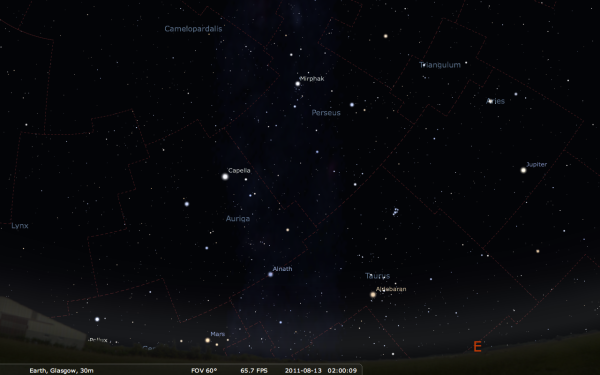
This is one of the most prolific meteor showers and is associated with the comet Swift-Tuttle. During the peak of the perseids, the radiant (the place the meteors appear to come from) often seems to be the ‘sword handle’ within the constellation of Perseus.
(the above image was taken using the iPhone app Star Walk)
The Perseid meteor shower peaks on 12/13 August every year and can have anything from 80 to 140 meteors an hour. Observers have been known to describe Perseid meteors as being fast and bright in appearance. Often a large number of them leave a trail behind them as they enter the Earths atmosphere and in the past many of them have turned into fireballs.
It wasn’t until 1866 that the association with Comet 109P/Swift-Tuttle was proved by Giovanni Schiaparelli. The Perseid meteor shower itself has been known and observed for a long time. The first known recorded accounts were by the Chinese in AD36. Both the Japanese and Koreans also have documentation of observing the Perseids from the 8th century onwards. Western observations seem to start during the 19th century, or at least the ones that were documented.
Now with advances in technology we can watch the meteor shower (Moon dependent of course this year) from the comfort and warmth of our own living rooms. We can track who has seen meteor showers by using a twitter map and discuss in real time if any of our online friends spot a fireball. Modern technology gives us new ways to interact with other astronomers, and not just locally, it allows us to encourage others to get out in the back garden and just look up.
Originally posted on Dark Sky Diary as “Perseids Meteor Shower 2011” by Steve Owens @darkskyman on twitter
This month sees the most reliable meteor shower of the year; the Perseids. You can begin watching for Perseid meteors now, and the shower will last until mid-August, but the peak of the shower occurs in the small hours of Saturday 13 August 2011.
Perseus under dark skies
Perseus under moonlit skies
Unfortunately this year’s shower will be obscured by the full Moon which occurs on the same day, and so it won’t present its usual excellent display.
The number of meteors that you will observe every hour depends on a number of factors:
the density of the cloud of dust that the Earth is moving through, that is causing the shower in the first place;
the height above the horizon of the radiant of the shower, the point from which the meteors appear to radiate;
the fraction of your sky that is obscured by cloud;
the naked-eye limiting magnitude of the sky, that is a measure of the faintest object you can see.
Please visit Dark Sky Diary for the rest of this article………..
Everyone is welcome to join in, whether they are an astronomer, have a slight interest in the night sky or just wonder?
As well as looking up, enjoying the night sky with us and seeing meteors, maybe for the first time? You will have the opportunity to contribute for fun with images and online, or to Scienceif you wish, by tweeting and seeing your results on a map, or by submitting Observing Forms if you are a more serious observer.
This event follows on from the popular Twitter Meteorwatchheld in August and December of 2009 and 2010 “Meteorwatch 2009”
Use the hash tag: #Meteorwatch and get involved, ask questions, do some science, follow the event and enjoy the wonders of the night sky with us. Images and other information will be tweeted as it happens. Live!
The highlight of the summer meteor showers: The Perseids reach maximum around the 12th/ 13th of August and may put on a display of approximately 80 to 100 meteors per hour under ideal viewing conditions.
Conditions this year aren’t ideal due to there being a full moon, but the brighter meteors will be seen. Let’s hope the skies stay clear.
Perseid meteors are often bright with persistent trails which can linger for a while after the meteor has burned up. Further information on the Perseid meteor shower and how to view it, can be found here.
While you are looking formeteors, there will be other objects to look out for such as the Planet Jupiter late in the evening, the Milky Way, Summer Triangle, manmade Satellites and more.
The Twitter Meteorwatch will start at 21.00 BST on the 11th of August and will continue through to the evening of the 13th. Amateur and professional astronomers and stargazers from the US and other countries are invited to join in and take over from the UK, when the sun comes up here, helping make the event run continuously and be truly international.
Over the next couple of months ESA’s Cluster spacecraft are going to get very close to Earth, with the orbit of one of the four satellites dropping as low as 200-300km from the Earth’s surface. This is low enough that you may indeed be able to spot – and if you’re skilled enough, take pictures of – the spacecraft.
ESA's Cluster Spacecraft
The four satellites – named Rumba, Salsa, Samba and Tango – were launched in 2000 to study the interaction between the Earth’s magnetic field and the Sun’s solar wind, and because there are four of these satellites, orbiting Earth in a tetrahedral configuration (i.e. one satellite at each of the apexes of a triangular pyramid) the Earth’s magnetosphere can be mapped in 3D.
The solar wind interacts with the Earth's magnetosphere
During June and July 2011 one of the Satellites, Cluster II (Salsa), will come within 200-300km of the surface of the Earth, which means there is a chance you might see it.
They might not be visible from the UK – in fact the British Astronomical Association suggest that the best chance of seeing these satellites is from latitude 20-30 N, so for anyone holidaying in the Canary Islands this summer there’s a chance you’ll catch a glimpse. There is a chance they’ll be visible further north too, from Europe. In any event, the brightness of the satellites is unknown at this stage, and so we can’t tell how easy it will be to spot, even if it’s visible from where you are.
The best way of checking whether the satellites are visible from where you are is to use the excellent Heavens Above website. Enter your observing location and then under “Satellites” click “select another satellite”, then in the “Satellite Name” box type “Cluster%” (the % is important). You can then select each of the four Cluster satellites and in the upper right corner of the information panel you can click “Passes (visible)” to see if there are any passes worth watching for from your location.
This will give you five crucial bits of information:
date of passes
magnitude (brightness) of the satellite (it is currently showing ?)
the time, altitude, and direction of when the visible pass starts
the time, altitude, and direction of when the satellite at its highest in the sky
the time, altitude, and direction of when the visible pass ends
ESA have even announced a competition on Facebook, where they are encouraging people to try and image the satellites! This is no mean feat, but not without precedent. In fact a number of very experienced astrophotographers have caught images of the International Space Station as it orbits about 360km overhead. One of my favourites is this one by Thierry Legault, of the space shuttle Atlantis approaching the International Space Station where both were silhouetted in front of the Sun.
Thierry Legault's incredible image of Atlantis and the ISS taken from Earth
Happy satellites hunting, and let me know if you catch a glimpse!
(HT to the BAA for bringing this to my attention).
Today, Friday 18 March 2011, it is the Spring Equilux throughout the UK (and possibly elsewhere too*) meaning that there are almost exactly 12 hours between sunrise and sunset.
Sunrise
This date differs from the Spring, or Vernal, Equinox (2321 GMT on Sunday 20 March 2011) for a variety of reasons, which I explain in a previous post but here is a list of sunrise / sunset times for a variety of towns and cities throughout the UK:
Town / City
Sunrise
Sunset
Aberdeen
0617
1817
Glasgow
0626
1826
Belfast
0632
1833
Newcastle
0615
1815
Manchester
0617
1818
Birmingham
0616
1817
Cardiff
0621
1822
London
0609
1809
As you can see the time between sunrise and sunset is not exactly 12 hours everywhere but this is the day of the year when that is closest to being true everywhere*. Yesterday the sun rose a couple of minutes later and set a couple of minutes earlier, and tomorrow the sun will rise a couple of minutes earlier and set a couple of minutes later, as the days lengthen.
Also, the reason that sunrise and sunset does not occur at the same time everywhere* is due mainly to the longitude of the town, the further east a town is the earlier it sees the sun in the morning, and the earlier it loses it again at night.
So happy Equilux everyone*!
* interestingly, the equilux does not occur on the same same day for everyone, it depends on your latitude. The closer you are to the equator the earlier the date of your equilux. For example the equilux in most US cities occurred yesterday, 17 March, and in cities near the equator there is never a day with exactly twelve hours between sunrise and sunset! Take Quito, the capital city of Ecuador (latitude 0 degrees 14 minutes south) for instance. The length of day there only ever varies between 12 hours and 6 minutes long and 12 hours and 8 minutes long!
I am often asked or hear about bright fireballs in the sky, often reported by non astronomy minded people, so when you ask where was it and what direction it was travelling etc, you get very sketchy information back like: It was over my house and headed towards town, I think?
Only if you have many sightings of the same fireball can you interpolate where it was and what direction etc it was travelling? Things are going to be made a lot easier if you live in some parts of the United States.
NASA is building a network of "Meteor Cameras" in a few of States in the US called the "All-sky Fireball Network". This is a network of cameras set up by the NASA Meteoroid Environment Office (MEO) with the goal of observing meteors brighter than the planet Venus, which are called fireballs. The collected data will be used by the MEO in constructing models of the meteoroid environment, which are important to spacecraft designers.
The Network will eventually consist of up to 15 overlapping cameras in north Alabama, northwest Georgia, and southern Tennessee, placed on public buildings and schools. The network will use sensitive black and white cameras which are able to see the whole of the sky (All Sky).
Because the cameras have overlapping fields of view, more than one camera can see the same meteor at the same time, helping in getting data about its trajectory and with clever data collection software, ascertain if the meteor came from a comet or an asteroid.
NASA’s All-sky Fireball Network uses ASGARD (All Sky and Guided Automatic Realtime Detection). ASGARD not only handles all the data processing (which is considerable) it also automatically pushes the results to the web. See the results here: http://fireballs.ndc.nasa.gov