by Astroguyz David Dickinsen | Sep 30, 2011
2011 Perseid+Jupiter Credit: David Dickinsen
Sure, you’ve heard of the August Perseids that come blazing across the sky and are invariably trumpeted by the news as the “Meteor Shower of the Millennium!” on a yearly basis. Perhaps you’ve even heard of the Leonids, normally a feeble November shower prone to legendary outbursts roughly every 33 years. But have you ever heard of the October Draconids?
I’ll admit I hadn’t until the October 1998 issue of Sky & Telescope arrived on my doorstep. Or should I say tent-flap? You see, the last half of 1998 found me deployed with my U.S. Air Force squadron to Al Jaber, Kuwait. In those days, email (and spam) were still a hip “new thing,” giant washing-machine-like CRT monitors adorned many office desks, and we were involved with a cat-and-mouse game between Saddam and the U.N. Inspectors that eventually became the shooting war of Operation Desert Fox. A military base in the desert was also a fine place to do some causal astronomy. The Leonids put on a fine show that year approaching storm levels of 1,000 per hour from our longitude. I remember mentioning the Leonid meteors to one of our F-16 pilots, and they later briefed not to mistake the fireball flashes for Iraqi AAA (an important distinction!) (more…)

by VirtualAstro | Sep 26, 2011
AURORA UPDATE! New Auroral oval predictions for the UK and North America! We are definitely going to see Aurora tonight
Europe Aurora Oval Prediction Credit: alaska.edu
A strong-to-severe geomagnetic storm is in progress following the impact of a coronal mass ejection (CME) at approximately 12:15 UT on Sept. 26th. The Goddard Space Weather Lab reports a “strong compression of Earth’s magnetosphere. Simulations indicate that solar wind plasma [has penetrated] close to geosynchronous orbit starting at 13:00UT.” Geosynchronous satellites could therefore be directly exposed to solar wind plasma and magnetic fields. High-latitude sky watchers should be alert for aurors after nightfall. (Credit: Spaceweather.com)
The best time to try and spot Aurora (The Northern lights) is around midnight, but this could be soon er or later.
You don’t need a telescope or binoculars to see the show (if it happens from your location) just your eyes.
Find a dark spot away from street lights and other light sources and look North. You should see Aurora very close to the horizon or higher, depending on your location, current conditions and intensity of the geomagnetic storm.
Good luck.

Predicted Auroras Over North America Credit: alaska.edu

by Mark Humpage | Aug 15, 2011
Credit: Mark Humpage
What is it? – The International Space Station or ISS is a large spacecraft which orbits around Earth. This orbit allows the ISS to be reached by launch vehicles (such as the Space Shuttle) of all the international partners for the delivery of crews and supplies. It is the largest and most complex international scientific project in history. The ISS is the size of a football pitch fitted with almost an acre of solar panels that provide electrical power to six state-of-the-art laboratories.
Can the ISS be seen from Earth? – Yes, it travels at an amazing 17,000 mph and orbits earth at an altitude of approximately 250 miles. The sheer size of the structure and array of solar panels reflect sunlight, making it the biggest, brightest object orbiting earth. Only the sun and moon are brighter. It can easily be seen moving across the night sky, at certain times, almost resembling a slow moving fireball.
How do you capture it on camera? – With a bit of planning and the right equipment it can easily be captured on camera:-
Planning – Firstly, one needs to calculate at what time the ISS will pass over the skies above. This can easily be found by visiting a website: www.heavens-above.com which will identify the exact days and times at when the ISS will pass directly above one’s location, and which part of the sky to look. There are also a number of excellent mobile applications such as ‘GoSatWatch’ and ‘Flyby’ which allow this to be done remotely.

Credit: Mark Humpage
Execution – A good ISS capture will require a long exposure. A tripod is therefore required to keep the camera nice and steady. A wide angle lens will ensure maximising as much of the ISS flyby which can travel across the entire horizon. Personally, I use the Olympus 7-14mm or 8mm fisheye which are ideal lenses. Try to locate a foreground object of interest within the frame, a line of trees or buildings in order to give the image perspective and scale. Set the camera to manual and use long exposure times of anything between 15 and 30 seconds. With camera primed and in position all that is left now is to wait for the ISS to enter the field of view. By capturing a single or number of continuous exposures the resulting image(s) will reveal a long trail across the frame. Capturing numerous and continuous images will allow you to stack and produce a composite, which can produce stunning results.
ISS Double flyby photo (bottom) – For this ISS double flyby image I chose a location that offered a good foreground subject (water) and scope to cover the entire east/west horizon. Planning involved choosing an evening where the ISS would fly over my location numerous times (in one night) and a look at the weather forecast to ensure clear skies. Armed with a one man tent and all my camera gear I headed off and arrived on site late evening on June 11th. The first ISS pass was due at 2300hrs and subsequent passes every 90 mins. The plan was twofold 1) Set up one camera waterside and take continuous 15sec exposures for the entire night 2) Use a second camera for each ISS pass in different locations at the site. In between passes I would grab a short power nap huddled in the tent. Not a very comfortable evening but the resulting images made up for it. Using stacking software I produced two composite images, one detailing the ISS passes alone and the other including a star trail from the entire evening.
The star trails and bright light (moon) is the resulting visible effect of earth’s rotation. The location choice was also perfect as the morning mist makes for an eerie scene, perfectly complementing the ISS pass. The images made the national press the following day, which was very pleasing. One final word about capturing the ISS – it is due to be decommissioned (crashed into the sea) in 2020, so be quick!

Captured with Olympus E5 & 8mm fisheye – 2 ISS flybys, each comprising approx 12 images. Final stacked composite Credit: Mark Humpage
by VirtualAstro | Aug 14, 2011
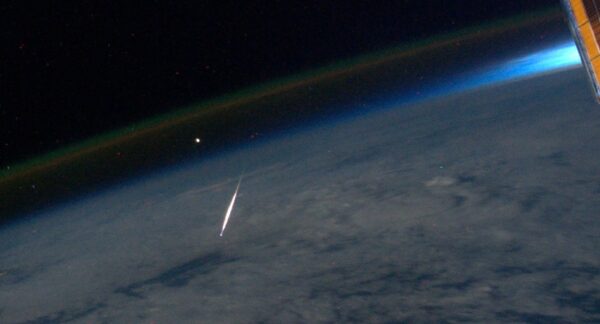
Credit: NASA @Astro_Ron
What a “Shooting Star” looks like from space Taken yesterday during Perseid Meteor Shower by @Astro_ron on board the International Space Station
by VirtualAstro | Aug 12, 2011
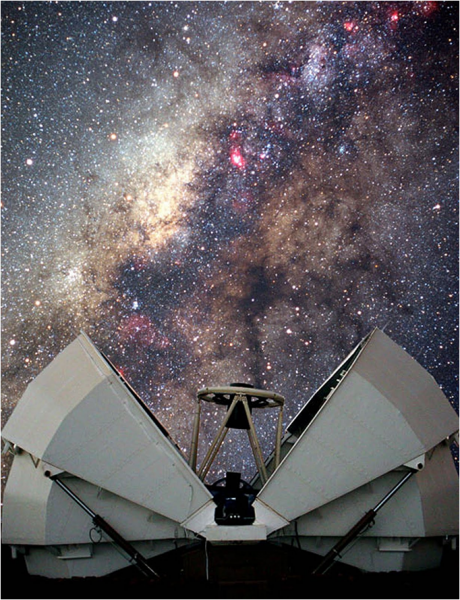
Faulkes Telescope
WINNER @bethlovescake
Win a chance to have Nick Howes (@NickAstronomer on twitter) equipment consultant for Astronomy now image your favorite object using the almost Hubble sized mirror of the amazing Faulkes Telescopes. One in Hawaii one in Asutralia…the choice is yours?
He will even process the image and submit it to the Astronomy Now magazine gallery.
For every Perseid meteor spotted and tweeted over the next two nights for the Meteor Map, each tweet will be entered into the #meteorwatch competition and the winner randomly selected.
So don’t forget to tweet #meteorwatch, 1st part of your postcode, Country code and how many meteors you just saw.
Share your #meteorwatch experience and have fun 🙂
Robotic Telescopes
Faulkes Telescope operates a network of research class robotic telescopes. Currently there are two telescopes, one in Hawaii and the other in Australia each with mirrors nearly the same size as Hubble costing £5,000,000
2011 © Copyright Faulkes Telescope Project, official partner of Las Cumbres Observatory Global Telescope Network
by VirtualAstro | Aug 12, 2011
Discover the wonders of our dark skies from National Trust on Vimeo.
Discover the wonders of our dark skies with Dr Marek Kukula, Public Astronomer at the Royal Observatory, Greenwich. (Special Guest appearance by meteorwatch.org)