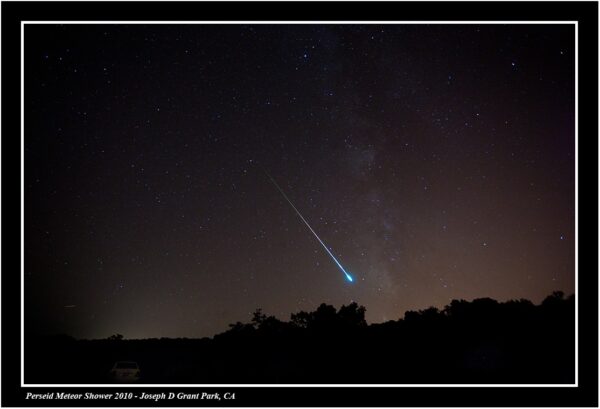
Doubtless you’ve heard astronomers and meteor shower observers kick around terms such as “bolide,” “sporadic” and “Zenithal Hourly Rate” when it comes to showers like this weekend’s Perseids. Like any field of endeavor, these terms and phrases and help to describe what we see (or expect to see) and aren’t just designed to make us unpopular at cocktail parties. Here’s a quick rundown on terms that should be in your meteor watcher’s lexicon; use em’ to impress (or annoy) your friends while you watch for this weekend’s Perseids; (more…)
The Perseids are one of the most prolific and best-known of the meteor showers and can be seen in late July and through August each year, with the maximum activity on or around 12/13 August. One advantage of the Perseids shower is that it happens in the warmer weather of Summer, which makes it ideal for anyone interested in seeing their first meteor. You can see a meteor at any time of year but, for a day or so around the date of maximum, there may be a ten times better chance of seeing one. (more…)
Constellations, deep-sky objects, planets and events, Tonight’s Sky
Highlights of the April Sky Transcript:
Evening Planets
In early April, four planets grace the sky at nightfall.
In the west, Jupiter hangs low on the horizon. Around mid-month, the planet disappears into the sunset.
Venus blazes just above Jupiter in the west. Use a telescope to see its crescent phase.
In the south, Mars is already climbing high. It will remain visible into the early morning.
Saturn will shine low in the east in the evening but climb higher during the night. On April 15th, Saturn reaches opposition, meaning it is opposite the Sun in Earth’s sky. It is also closer to Earth than it’ll be the rest of the year, making it
appear slightly bigger and brighter.
Constellations and Deep-Sky Objects
Late in the evening, high in the northern sky lies the Great Bear, Ursa Major.
The constellation of Ursa Major contains the well-known star pattern, the Big Dipper. It resembles a large drinking cup with a handle.
The two stars that make up the front side of the cup are called “pointer stars” because they point toward the star Polaris, also known as the North Star. The Big Dipper overflows with interesting stars and deep-sky objects.
The stars Mizar and Alcor make up a double-star system that can be seenwithout a telescope. In ancient times, when Mizar and Alcor were even closer together, they were used as a test of keen eyesight.
M81 and M82 are a magnificent pair of galaxies, showpieces of the northern night sky. M82 has an irregular shape, bestowed by a collision with its larger neighbor, M81.
Turning to the south, we see Leo, the Lion, heralding the coming of spring. In Greek mythology, Leo is the great beast slain by Hercules.
The star Denebola, which in Arabic means “tail,” represents exactly that. The bright star Regulus is the heart of the Lion.
Leo has several galaxies in his belly. M65, M66, and NGC 3628 make up the “Leo Triplet,” a lovely grouping of galaxies easily seen with a telescope. Close by is another group. M95 and M96 are large spiral galaxies.
Between the Big Dipper and the head of Leo are three pairs of bright stars known to ancient Arab astronomers as “The Three Leaps of the Gazelle.”
Events
The Lyrid meteor shower will be best seen in the early morning hours of April 22nd. Under a dark sky, you can expect to see up to 20 bright meteors per hour.
The night sky is always a celestial showcase. Explore its wonders from your own backyard.
Credits:
Produced by the Space Telescope Science Institute, Office of Public Outreach Starfield images created with Stellarium Mythological constellation forms from Firmamentum Sobiescianum sive Uranographia by Johannes Hevelius, courtesy of the United States Naval Observatory Jupiter image courtesy of Todd Gross Venus image courtesy of Mario Weigand Mars image courtesy of Matt Wedel Saturn image courtesy of John Endreson M81 and M82 image courtesy of the Digitized Sky Survey, AURA Leo Triplet image courtesy of REU program/NOAO/AURA/NSF M95 and M96 image courtesy of the Digitized Sky Survey, AURA Narrated by Nancy Calo Music written by Jonn Serrie Production: Lucy Albert, Greg Bacon, John Bintz, John Godfrey, and Vanessa Thomas
The international space station (ISS) is a habitable artificial satellite in low Earth orbit. It is the latest and largest in a line of previous space stations such as Skylab and Mir.
The ISS is a modular structure and the first module was launched in 1998 and many more modules, trusses, solar arrays and other elements have been added since.
The station is just over 72 m long by just over 108 m wide and 20 m high; it is maintained at an orbital altitude of between 330 km (205 mi) and 410 km (255 mi) it travels at an average speed of 27,724 kilometres (17,227 mi) per hour and completes 15.7 orbits per day. (more…)