by VirtualAstro | Aug 10, 2011
One of the biggest factors when observing meteor showers or not in some cases, is the weather.
Meteor showers are usually best seen a few days before and right up until their peak, so being able to plan your observing around the weather is essential.
Luckily the Met Office have developed a new interactive website: WOW Weather Observations Website, where users of the site can enter their own observations and the results will be shown on a map. Very similar to the meteorwatch meteor map.
This new tool, will be excellent for planning your meteorwatch, Astronomy, or any other weather dependent activity.
Register and start enjoying WOW.

by VirtualAstro | Aug 9, 2011
During meteorwatch and the Perseid meteor shower, many people will be having a go at imaging perseid meteors.
See here for more information on how to image and record meteors.
Once you have an image or images of the night sky, or even pictures of you and your friends at your observing site or meteorwatch party. Tweet them using the #meteorwatch hashtag and they will automatically appear on the meteorwatch photo gallery.
You can also upload your images to the meteorwatch flickr group and view them on the flickr gallery
by VirtualAstro | Aug 8, 2011
You are outside, the night sky is clear, you look up and then WOOSH! You see a shooting star!
If you see a shooting star this week will probably be a Perseid from the Perseid meteor shower.
Like most things in astronomy, you don’t need expensive telescopes or equipment to enjoy the Perseids; you just need to be comfortable and patient. Please see here on how to enjoy observing meteors.
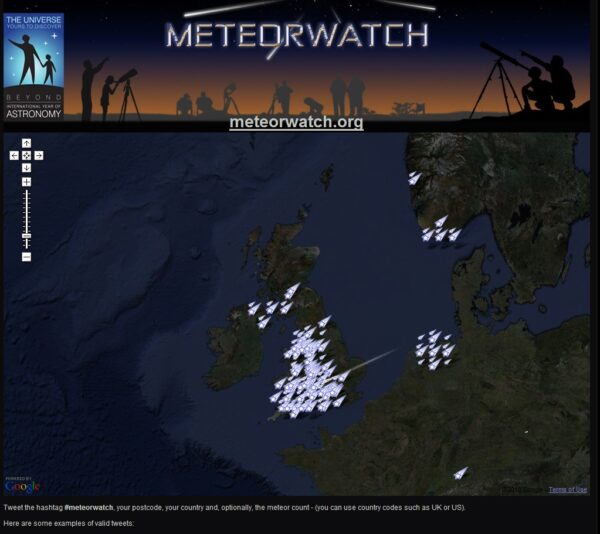
When you see a meteor, share your experience on twitter by tweeting what you saw for the meteor map.
The meteor map displays tweets of meteors seen by location and is very simple and fun to use.
Tweet the hashtag #meteorwatch then the first part of your postcode, then your country code and then optionally how many meteors you saw. Your results will then be displayed on the map shortly afterwards. Instructions can be found at the bottom of the map page.
Let’s see how many people saw a meteor or more?

by VirtualAstro | Aug 8, 2011
If you are looking for a great spot to see the shooting stars of the Perseids away from bright lights and light pollution, there are some very good National Trust sites you can go to in the UK.
These sites are ideal for all kinds of stargazing any time of the year and are set in some of the most beautiful locations in the country
The seven best National Trust sites for star gazing and see the wonders of the night sky are:
- Black Down in Sussex – Get closer to the stars on the highest point in the South Downs, just over a mile from the town of Haslemere.

Download the guide for Black Down
- Teign Valley in Devon – Discover the stars at this Trust property within Dartmoor National Park and close to Castle Drogo.

Download the guide for Teign Valley
- Penbryn Beach in Wales – Beautiful, unspoilt mile-long beach on the Ceredigion coast in west Wales, great for a bit of star gazing and a late night paddle.

Download the guide for Penbryn Beach
- Stonehenge Landscape in Wiltshire – Step back in time and discover the ancient skies of Salisbury Plain’s chalk downlands, home to the impressive prehistoric stone monument.

Download the guide for Stonehenge Landscape
- Wicken Fen National Nature Reserve in Cambridgeshire – Close to historic Ely, the wild landscape of the National Trust’s oldest nature reserve offers dark skies and a wealth of nocturnal wildlife to listen out for.

Download the guide for Wicken Fen
- Mam Tor in Derbyshire – Escape the bright city lights of Sheffield and experience the peace and tranquillity of Mam Tor’s dark skies in the Peak District.

Download the guide for Mam Tor
- Friar’s Crag in Cumbria – Surrounded by the breathtakingly beautiful scenery of the Lake District, Friar’s Crag in Keswick juts out into the spectacular lake of Derwentwater; a restful place to contemplate the world above us.

Download the guide for Friar’s Crag
More information about all of these sites is available by visiting: http://www.nationaltrust.org.uk/darkskies and enjoy stargazing and meteorwatch at these fabulous locations.

by VirtualAstro | Aug 6, 2011
Aurora over Cumbria 5/6th August 2011 Credit: Raymond Gilchrist
On the evening of the 5th of August 2011 the Aurora Borealis, Northern Lights were seen as far South as Southern England!
At approximately 18:00 Universal Time (19:00 BST) the Earth’s magnetosphere was hit by a coronal mass ejection from the sun, triggering a powerful geomagnetic storm and Aurora.
This storm measured 8 on the K index (aurora richter scale) which ranges from 0 – 9 so this was a big storm.
It is quite common to see Aurora in Northern Scotland, but at approximately midnight, aurora was seen as far south as Berkshire, Wiltshire and Hampshire in Southern England.
I was incredibly lucky to briefly see the pale greenish hue of the aurora through clouds from my back garden in West Berkshire. It is incredibly rare to see aurora this far south and the last time I remember was in 2003.
Unfortunately a lot of people in England and Scotland were under thick cloud and missed this fantastic display, but thanks to fantastic astro photographers such as Raymond Gilchrist (@RayGil on twitter) we are able to see the aurora through his images.
I am unsure of what the rest of the world witnessed, but geomagnetic activity remains high as I write this article, so I hope the sky clears and we are given another fantastic display of this rare phenomenon soon.

Aurora over Cumbria 5/6th August 2011 Credit: Raymond Gilchrist

by VirtualAstro | Aug 5, 2011
By @Bellatrixlestar on Twitter
This is one of the most prolific meteor showers and is associated with the comet Swift-Tuttle. During the peak of the perseids, the radiant (the place the meteors appear to come from) often seems to be the ‘sword handle’ within the constellation of Perseus.
(the above image was taken using the iPhone app Star Walk)
The Perseid meteor shower peaks on 12/13 August every year and can have anything from 80 to 140 meteors an hour. Observers have been known to describe Perseid meteors as being fast and bright in appearance. Often a large number of them leave a trail behind them as they enter the Earths atmosphere and in the past many of them have turned into fireballs.
It wasn’t until 1866 that the association with Comet 109P/Swift-Tuttle was proved by Giovanni Schiaparelli. The Perseid meteor shower itself has been known and observed for a long time. The first known recorded accounts were by the Chinese in AD36. Both the Japanese and Koreans also have documentation of observing the Perseids from the 8th century onwards. Western observations seem to start during the 19th century, or at least the ones that were documented.
Now with advances in technology we can watch the meteor shower (Moon dependent of course this year) from the comfort and warmth of our own living rooms. We can track who has seen meteor showers by using a twitter map and discuss in real time if any of our online friends spot a fireball. Modern technology gives us new ways to interact with other astronomers, and not just locally, it allows us to encourage others to get out in the back garden and just look up.