by Steve Owens | Jan 2, 2012
Originally Posted on Dark Sky Diary by Steve Owens @darkskyman on twitter
Quadrantid Meteor
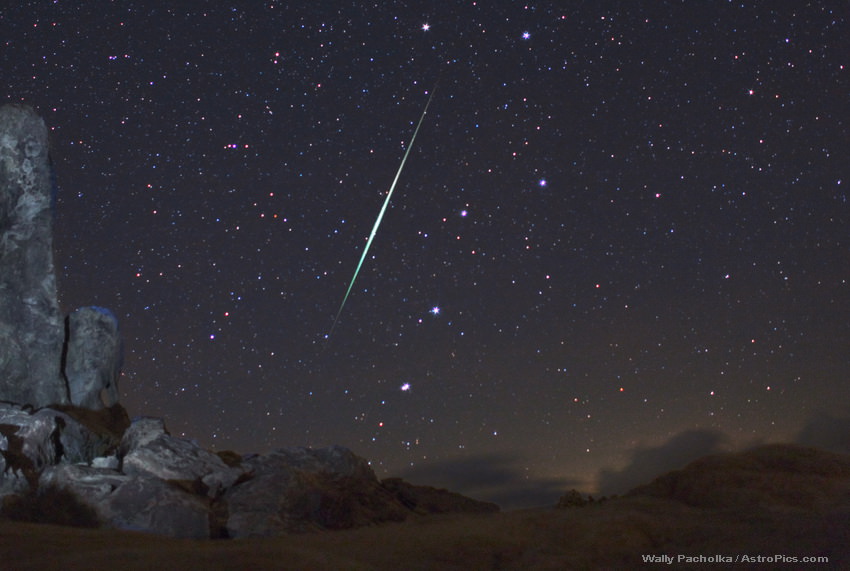
On the night of 03/04 January 2012 the first meteor shower of the year will take place, the Quadrantids. This shower ranks as one of the best performers of the year, assuming your skies aren’t clouded, as they so often are in winter. If the peak of this shower occurs under ideal conditions – i.e. perfectly clear skies, free from light pollution – then you can expect to see in excess of 100 meteors every hour. The peak for this shower is very brief though, so you’ll have to catch just the right conditions at just the right time to see a display this good. This year’s peak is estimated to occur just before dawn on 04 January 2012. (more…)

by Astroguyz David Dickinsen | Jan 2, 2012
Credit: David Dickinsen
2012 is here, and the world shows no sign of ending as the heavens spin on their appointed rounds high overhead. But the diligent observer may be rewarded with several unique an spurious sights, both natural and manmade…
1st up is everyone’s favorite meteor shower named after an obsolete constellation; the Quadrantids peak the morning of January 4th in what is the first large meteor shower of the year. The peak is very swift, only lasting about 12 hours or so and is centered this year on 2:00 AM EST/7:00 AM UTC. This favors the U.S. East Coast in 2012, as the 79% waxing gibbous Moon will set around 2AM local the morning of the 4th for observers in mid-northern latitudes. The radiant of the shower lies at a declination of 52° degrees north at the junction of the modern constellations of Draco, Bootes and Hercules, and thus activity may be visible pre-midnite local, although the setting of the Moon and the rising of the radiant will raise sighting prospects considerably. Expect swift-moving meteors headed outward from the radiant above the handle of the Big Dipper to appear anywhere in the sky. The Quadrantids have been known since the early 1800’s, but there has been much conjecture as to the source parent body. Astronomer Fred Whipple noted in 1963 that the stream bears some resemblance to the Delta Aquarids, and that the orbital path has undergone alterations by the planet Jupiter in the last few thousand years. In 2003, SETI researcher Peter Jenniskens proposed that the source may be then recently discovered asteroid 2003 EH1, which has been tentatively linked to Comet C/1490 Y1, which approached Earth at a distance of 0.52 Astronomical Units on January 12th 1491. Be sure to keep an eye out for Quadrantids on these chilly January mornings, as we commemorate Quadrans Muralis, a constellation that is no longer! (more…)

by VirtualAstro | Jan 2, 2012
Originally based on Dark Sky Diary by Steve Owens www.twitter.com/darkskyman

The first meteor shower of 2012 is the Quadrantids, the peak of which falls on the night of the 03/04 January 2012. The Quadrantids shower has one of the highest predicted hourly rates of all meteor showers, comparable to the two great annual showers, the Perseids and the Geminids, occurring in August and December respectively. However unlike the Perseids and Geminids, the Quadrantids peak is very narrow, occurring over just a few short hours.
The predicted Zenith Hourly Rate (see my previous post about ZHR and what it actually means here) for the Quadrantids is around 120. The narrow peak is predicted to occur some time between 2100 UT on 3 January and 0700 UT on 4 January 2011, however the radiant of the shower – the now-defunct constellation Quadrans Muralis – is very low in the evening hours, rising higher towards dawn, and so the best viewing times are later in this run, just before dawn. (more…)
by VirtualAstro | Dec 29, 2011
Stargazing Credit: http://twitter.com/VirtualAstro
As 2011 is drawing to a close, the festive season is here and many of us are winding down and looking forward to the holidays. But this is a great time to look ahead to 2012 and pencil into our calendar and diaries the top astronomical events we don’t want to miss next year.
2012 is going to be a great year for astronomy observing, with some rare and exciting things taking place and a good outlook with some of the regular annual events.
So what top wonders should we expect to see and what will 2012 bring? (more…)
by VirtualAstro | Dec 12, 2011
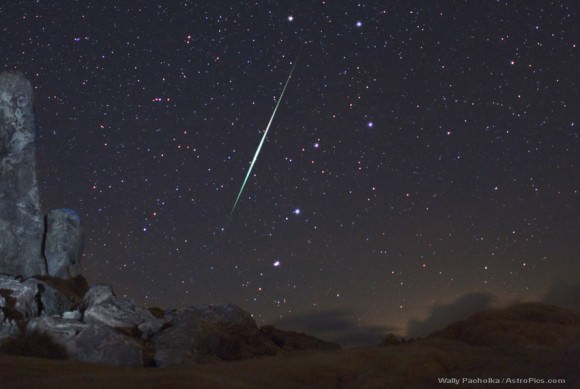
Credit: Wally Pacholka
It’s the finale of this year’s meteor showers: The Geminids will start appearing on Dec. 7 and should reach peak activity around the 13th and 14th. This shower could put on a display of up to 100+ meteors (shooting stars) per hour under good viewing conditions.
However, conditions this year are not ideal with the presence of a waning gibbous Moon (which will be up from mid-evening until morning). But seeing meteors every few minutes is quite possible. Geminid meteors are often slow and bright with persistent coloured trails which can linger for a while after the meteor has burned up.
(more…)

by Steve Owens | Dec 9, 2011
Originally posted on Dark Sky Diary by Steve Owens @Darkskyman on twitter
Astronomy tourism is a burgeoning field – luckily for me, as it’s how I make a living! – with city-folk now starting to make the effort to travel to places with darker skies, in the hope of seeing things that simply cannot be seen from the orange glare of a town sky.
Stargazers at an astronomy tourism event in Sark (image credit: Martin Taylor)
Galloway Forest Dark Sky Park, which I helped establish in 2009, has seen a lot of this dark sky tourism trade, due to its high profile in the media, but many other places around the country – Sark in the Channel Islands, and Exmoor National Park to name but two – have followed suit, hoping to attract the stargazing crowds.
And as more and more people come out of the city for a stargazing weekend under dark skies it’s becoming clear to me that there’s a real appetite for seeing the Milky Way and other elusive dark sky objects. It’s almost become something to put on your “bucket list”: see a wild lion in Africa; fly in a hot air balloon; see the Milky Way.
However there are lots of other amazing astronomical objects visible under a dark sky so here is the first installment of my top-ten “Dark Sky Bucket List”. (more…)