The international space station (ISS) is a habitable artificial satellite in low Earth orbit. It is the latest and largest in a line of previous space stations such as Skylab and Mir.
The ISS is a modular structure and the first module was launched in 1998 and many more modules, trusses, solar arrays and other elements have been added since.
The station is just over 72 m long by just over 108 m wide and 20 m high; it is maintained at an orbital altitude of between 330 km (205 mi) and 410 km (255 mi) it travels at an average speed of 27,724 kilometres (17,227 mi) per hour and completes 15.7 orbits per day. (more…)
Here is a very quick beginners guide to explaining aurora
Aurora = The Northern (or Southern) lights/ Aurora Borealis/ Australis
Usually seen near the poles of the Earth, but can be seen further South in the UK or USA.
So how and where does it come from?
“Coronal Mass Ejection” = A load of solar material hurled out of the Sun. A big one can contain billions of tons of “plasma”.
Plasma hits Earth’s “magnetosphere” causing “geomagnetic storms” = Aurora, also known as the Northern or Southern lights.
Geomagnetic storms are measured using a scale called the “Planetary Kp index” ranging from 1 to 9. 1 being low and 9 being a very heavy storm.
The higher the Kp index the higher the likelihood of Aurora and the further South it can be seen. 5 = Scotland 8+ Southern England.
Geomagnetic storms and aurora are very unpredictable and forecasts can be very vague, we don’t know the intensity or where the aurora can be seen from until it hits.
To watch the aurora, you only need your eyes, just like watching meteors or the International Space Station. Look North and low down on the horizon, it may be faint at first.
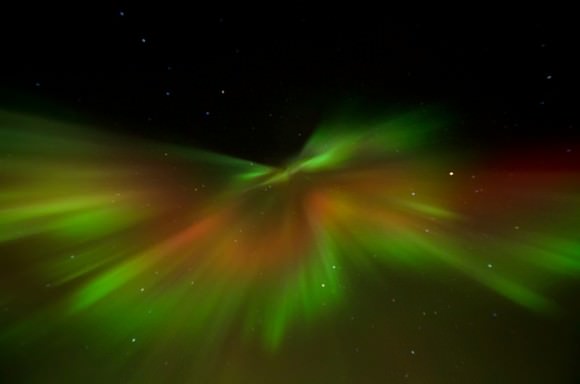
This photo was taken on January 22, 2012 in Fairbanks North Star Borough County, Alaska, US, using a Nikon D5000. The 'explodey' look is due to perspective from looking right up the magnetic field lines. The aurora in the middle of the explosion is pointing straight down at the camera. Credit: Jason Ahrns -- and 'regular' view of Jason's image of the aurora is below.
On January 22nd 2012, skywatchers in the northern hemisphere were rewarded with amazing displays of aurora. The cause of these displays was a Kp level 5.67 geomagnetic storm originating from solar activity on the 19th of January, produced visible aurorae throughout the northern hemisphere and viewers as far south as northeast England had great auroral views.
Here is a selection of aurora images and videos taken during the event.
I would like to share one of my Quadrantid meteor showers photographs with Meteorwatch.org. My name is Sarah Loughlin, I live in Oyster Bay, Ny and I have been stargazing ever since I can remember. I took this image on January, 4th at around 4:30 am with my Canon Rebel T2i & 10-22mm Canon lens in Oyster Bay, Ny. The settings were 15.0 s, f/3.5 at 10.0 mm, iso 1600. This first meteor shower of 2012 was spectacular to watch, despite the frigid temperatures. If you consider using my photograph I would be honored.
The weather over the past few days has been amazing. Lovely crisp blue skies, amazing sunsets & wonderfully clear night skies. And I’ve been using this to my advantage, taking as many photos of the stars as I can.
I had the idea to photograph the Orion Nebula (see above) for a few nights but I was waiting for the sky to become fully clear. I first photographed the nebula when the sky was hazy & the full moon was casting its glow across most of the sky. The photograph I got on that night was amazing (to me, it was amazing, obviously it’s not amazing to those with epic telescopes & satellites deep in space ;p) & it surprised me because I never expected to be able to capture a photograph like this. I thought it was reserved for people with powerful telescopes!
I made a pact with myself that I would go out there again when the moon wasn’t due to rise until 3am & when there was less haze around.
That night happened a few days later. It was -2 & there was frost on the ground so I wrapped up extra warm & took the camera out to cool (tell me if I’m wrong but letting the sensor cool on your camera helps reduce noise…I think). After a little while I started to photograph the nebula using various different settings. Now, you all know that the earth spins, this is what gives us night & day. Therefore, if you set your camera up to expose for 30 seconds, you’re going to get light trails instead of a still (for want of a better word) image. As my camera ISO goes up to 12000, I stepped it right up & I exposed for 3.2 seconds. For me, this is the best way to be able to capture a still shot without using a tracking device. I did, however, find that ISO 12000 was too noisy so I stepped it down to 5000. And that seemed to do the trick. I imported the shot into Lightroom, tweaked around with some settings & this is what I came out with.
I used a Canon 7D with a 90-300mm lens.
I’m pretty happy with it. Next step is to get a new mirror for the telescope (we accidentally knocked it over & the mirror smashed inside) & an adapter for my DSLR. Then we’ll be away! Hope you enjoyed this post, thanks for reading. If you have any questions you can either leave them in the comments box or you can join me on twitter (tweeting as @_purpleface) or facebook (facebook.com/purplefacephotography).
Stargazing LIVE (co-produced by The Open University) returns for a second three-night series on BBC Two set to encourage everyone – from the complete beginner to the enthusiastic amateur – to make the most of the night sky.
On the 16th 17th and 18th of January Professor Brian Cox and Dara O Briain will broadcast live from the control room of the Jodrell Bank Observatory, interacting live with the audience and calling on a starry collection of the country’s finest astronomical minds to explore the majestic wonders of the skies above Britain.
In their own unique style, the pair will tackle some of the most intriguing questions in astronomy, such as Why Does The Moon Cause The Tides?, How Do We Know Where Black Holes Are When They Are Impossible To See? and What Will We Actually Say If We Ever Make Contact With An Alien Race?
Closer to home, there will also be hints and tips for getting started in Stargazing and advice on navigating your way around the skies.
And there’s more, with scores of Stargazing LIVE activities across the UK – find out where at Things To Do, the BBC’s activity finder website: