. .
The Orionid Meteor Shower 2010

The Orionid Meteor Shower 2010

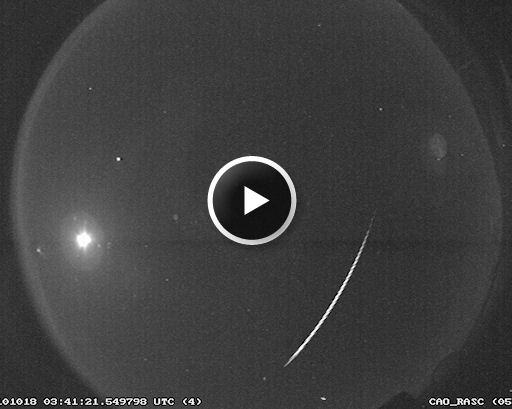
Earth is entering a broad stream of debris from Halley's Comet, and this is causing the annual Orionid meteor shower. "The best time to look is during the hours before dawn on Thursday, Oct. 21st, and again on Friday, Oct 22nd," advises Bill Cooke of NASA's Meteoroid Environment Office. "Unfortunately, we have a bright Moon this year. Even so, I'd expect some bright Orionids to shine through the moonlight." An all-sky camera at the University of Western Ontario recorded this early Orionid fireball on Oct. 18th:

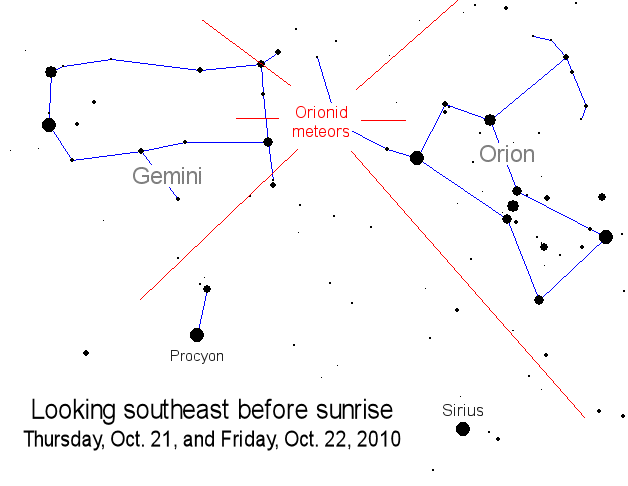
Orionid meteors stream from the elbow of Orion the Hunter: sky map. Because the shower's radiant point is close to the celestial equator, sky watchers in both hemispheres can enjoy the show. Moonlit meteor rates will probably be around a dozen per hour.

Radar rates could be much higher. The US Air Force Space Surveillance Radar in Texas is scanning the skies for satellites, space junk, and meteoroids. When an Orionid passes overhead–ping!–there is an echo. Moonlight does not interfere with this method of meteor observing, so it's perfect for this year's Orionids. Tune into Spaceweather Radio for live echoes.

Orionid images: from John Chumack of Dayton, Ohio; from Calvin Hall of Knik Valley, near Palmer Alaska; from Martin Popek of Nýdek, Czech republic

Originally posted on www.spaceweather.com

Fun Facts About the Perseids!

The Perseid meteor shower is named for the constellation Perseus, from where the meteors appear to originate. The Perseid meteor shower is one of the most prolific showers of the year, with an average peak rate of 50- 80 streaks per hour, in darker skies. Meteors are the visible paths of vaporizing space debris as it encounters our planet’s atmosphere.

This debris, known as meteoroids, ranges in size from dust particles to small pebbles, and occasionally larger stones. As a meteoroid enters the Earth’s atmosphere, it is heated by friction, which vaporizes the debris and causes the gases (both atmospheric and meteoritic) to glow. Most meteoroids disintegrate at about 30-60 miles above the surface, but become visible at about 40-75 miles.

Meteoroids orbit the Sun just like planets, comets, and asteroids. They travel at speeds of about 26 mps, but, when combined with Earth’s orbital speed of about 18 mps, enter our atmosphere at a velocity rate of about 44 mps. The meteoroids associated with the Perseid meteor shower enter the Earth’s atmosphere at about 37 mps. Our planet encounters space debris every day, thus meteors are actually visible all year long.

Occasionally, Earth passes through thicker patches of debris, known as streams or swarms, resulting in a meteor “shower.” Meteoroid streams, or swarms, have orbits similar to those of comets, thus are believed to be fields of comet debris resulting from a comet’s closing approach of the Sun.

The Perseid meteor shower has been associated with the ancient debris field of Comet 109/Swift-Tuttle. Comet Swift-Tuttle leaves new debris each time it passes our planet – every 130 years. This debris field has the appearance of several streams, each measuring millions of miles long.

The Swift-Tuttle debris streams are comprised of small widely-spaced particles. Most of the meteoroids are about the size of sand grains, but some may be as large as small pebbles. With a core diameter of about 26km, comet Swift-Tuttle is the largest known object, and one of the oldest comets, to regularly pass closely to our planet.

Comet Swift-Tuttle was originally recorded by Chinese astronomers in 69 BC and 188AD, but was formally discovered in 1862, by Lewis Swift on July 16, and by Horace Parnell Tuttle on July 19. Three others also independently discovered this comet: Dudley Observatory’s Thomas Simons; Antonio Pacinotti and Carlo Toussaint from Florence, Italy; and Danish Astronomer Hans Schjellerup. Comet Swift-Tuttle was “rediscovered” in 1992 by Tsuruhiko Kiuchi, ten years after its expected return of 1982.

That year, the comet reached 5th magnitude, making it easily visible through binoculars. Comet Swift-Tuttle will pass within 14-million-miles of our planet when it next returns in 2126. Scientists believe that the comet will be even brighter than the 1992 pass, and likely readily visible to even unaided eyes.

Astronomers once believed that comet Swift-Tuttle might, in the relatively near future, pass close enough to actually impact Earth or the Moon. While continued observations and recalculations have dispelled that concern for at least the next 2,000 years, this comet remains one of the greatest known solar system threats to our planet.

Source Material: NASA Worldbook JPL’s Solar System Dynamics Gary Kronk’s Cometography Astronomical Society of the Pacific Space.com Wikipedia

By Tavi Greiner. See more from Tavi at her site A Sky Full of Stars and follow her on Twitter @TaviGreiner

Meteorwatch is Coming

There is nothing in this world that captures the imagination the same way as a meteor.  It’s an experience that is embedded in our very psyche.  We all know to wish upon a falling star.  Think of how often you see a painting of a star with a swooping tail – it’s theme that is found in advertising, on video games, in movies, or anyplace you want to show the beauty of a star with the energy of motion.


Seeing the streak of a meteor rapidly flashing across the sky is not the same as what is usually displayed in popular culture.  A meteor can be such a quick flash that you may not be sure you really saw it, or it can be a fireball that is unmistakable and beautiful.  It is a sight that is best seen live.


I’ve looked forward to the 12th and 13th of August for years – the Perseid meteor shower peaks on those days.  Being able to predict a high number of meteors over a short period of time gives us a big advantage of having a successful night observing meteors.  My local weather tends to be nice with warm nights, and the shower is big enough you have extra chances in case one the first night is cloudy.


I want to make an invitation to everyone world wide to join me and thousands of others for Meteorwatch.  The event will officially run from the 11th through the 14th of August.  The objective of Meteorwatch is to give you the best chance possible to see a meteor in person.  If your area is clouded over, we will share our photographs and observations from around the world.


Observing meteors is very simple to do – find the darkest place you can find and be prepared to look up for a while.  No extra equipment is required, you don’t have to leave the city – although it will certainly help if you can.  If you are in a very dark area it is likely you’ll see a meteor at least every half hour or so and much more if you’re experienced or up later at night.  If you’ve never seen a meteor before, we will share plenty of tips to help you discover one live.  If you’re an experienced observer, please share your experiences, observations and photos.  You can begin as soon as it gets dark, but for best results you’ll want to be out late – I’ve had best success between 2:00 and 3:00 in the morning.  With Meteorwatch being a world wide event, there will always be someone online to help out.


Best of all, Meteorwatch is a fun event where you’ll find hundreds of people having a great time together in person and online.


Watch for more news on https://meteorwatch.org or follow http://twitter.com/VirtualAstro for more details.


Mark Zaugg is an amateur astronomer and enthusiast who has introduced dozens of people to the excitement of seeing a meteor in person.  You can find him at http://twitter.com/Zarquil

The interactive Twitter Meteor Map is Here

The interactive Twitter Meteor Map is Here

The interactive Twitter Meteor Map is Here.

Now you will be able to tweet if you have seen a meteor straight from twitter, On your computer or from your phone, just like you would for any normal tweet and see your observations appear on the “Meteor Map” in real-time.


The meteor map couldn’t be simpler to use: Just send a normal tweet with a little bit of information (More instructions at the bottom of the map page) and your results will appear on the map.

As well as looking up, enjoying the night sky with us and seeing meteors, maybe for the first time? We encourage everyone to send tweets telling us when they see meteors (shooting stars) and contribute to science and have some fun at the same time.

The results of the meteor map will be shared with organisations such as the British Astronomical Association and your results will contribute to serious science, so we can learn more about our solar system.


Adventures in Meteor Spotting


Meteor observing is a favorite sport of ours. Unlike other astronomical endeavors, observing and recording meteor showers requires minimal gear; just a good pair of eyes and an intimate knowledge of the sky. And to cap it off, a true meteor storm can be an event of a lifetime… only a total solar eclipse or a good auroral display comes close in the sheer “wow” factor department. As the Perseid meteor shower draws toward its yearly maximum on August 12th, we at Astroguyz have been invited by the organizers of #Meteorwatch to present some tips and tricks of the meteor observing trade, as well as share some personal ramblings and trivia we’ve featured over the years as well as new insights sent in by our readers.


We have a special fondness for the Perseids, as observing them was a yearly family tradition growing up in northern Maine. Our backyard skies were pristine and dark, the kind that folks today might drive over 100 miles to camp under. The Perseids occurred until warm summer skies, and we would simply lay back on lawn chairs in sleeping bags as the sky wheeled slowly above us. The Perseids are sort of an “old-faithful” of meteor showers, as they perform reliably every year. Normal rates are about 60 per hour, although these have been greatly enhanced since the perihelion passage of the progenitor comet Swift-Tuttle in 1992. The 2009 Perseids approached levels of 200 per hour, and sported multiple successive peaks. Be wary of popular news outlets that will parrot “The meteor storm of a lifetime!” as this has joined the Mars email hoax in its yearly August run. The good news for the Perseids is that this year they’re nearly exactly timed with the New Moon, which occurs on August 10th. The darker the skies that you can position yourself under, the more meteors you’ll see.


But first, some meteor observing lingo. The gold standard for determining the intensity of a meteor shower is termed the Zenithal Hourly Rate. The ZHR is an ideal number, the number of meteors you’ll see under absolutely dark skies if the radiant of the shower is directly over your viewing location and you have complete 360° all-sky coverage. This, of course, never happens in reality. Ways to maximize this number in actuality include using multiple observers to view in different directions (three is optimal) and choosing a good dark sky site. If the Moon is above the horizon, try and place it behind a building or object and view in the opposite direction.


Meteors will also occasionally approach from other directions, known as sporadics. The rates for these can vary throughout the year and tend to hover between 1-5 per hour. Some sporadics may be related to other showers, while a handful come in from the apex, antihelion (anti-sunward) and toroidal points on the celestial sphere. For example, fainter showers such as the Kappa Cygnids, Delta Aquarids, and the Alpha Capricornids may all be sighted during the Perseids. Make a careful note of the direction of travel to discern any stragglers.


Speaking of which, meteor observing is one of the last fields of endeavor that a naked eye observer can contribute useful scientific information to. Simply note your location, period of observing time, and how many meteors you spotted. Other useful bits of data include the limiting magnitude from your viewing sight (the Bortle Scale is a good way to quantify this) and method used. Some observers note the magnitude of each meteor observed and its direction of travel, their thoughts and feelings, etc… but I find a simple “where/how many/how long” method is best. Remember, you want to keep those dark adapted eyes on the sky, not entering notes. The best method is to simply record your observing session for later analysis; I’ve used a small digital recorder for this task to great effect. Smaller than a cell phone, it can record spoken impressions for hours. Just remember to mark your start time when recording. Another helpful tool to plan your observing sessions is the program Meteoracle. This runs on your desktop/laptop and forecasts what you might see based on your input location. Keep in mind, however, that this is not a live forecast, merely a projection. I’d like to see them take the next step and incorporate weather conditions and current reports of meteor activity into the mix to see how the forecast is evolving from day to day.


Organizations such as the International Meteor Observers group take and compile reports from observers around the globe. If you are lucky, you just might be the only observer reporting from your wind-swept longitude in the Arctic Tundra or the Gobi desert and manage to provide that crucial piece of data. We were lucky in this aspect to catch the Leonid meteor storm in 1998 from the deserts of Kuwait while deployed with the USAF. That particular year, most northern hemisphere longitudes were either clouded out or missed the peak as it occurred during broad daylight. Storm levels approached a ZHR of +1,000, with a bright fireball every several seconds.


The Leonids are the most infamous of all showers, with ZHR peaks approaching 10,000 every 33 years. In 1966, observers reported a distinct sense of the Earth’s forward movement through space, much like the old Star Trek “warp-drive” effect. In 1833, this same shower awoke startled villagers on the US Eastern Seaboard, convinced the apocalypse was nigh! Needless to say, the Leonids are always worth keeping an eye on every year around November 17th, and will start to gear up again in 2030.


Other showers known for this outburst style of activity include the Giacobinids, also known as the Draconids (October 8th-10th), the Ursids (December 22nd/23rd), and the Bootids (June 26th to July 2nd). Other ‘old faithful’ style annual showers include the Quadrantids (named after an obsolete constellation, Quadrans Muralis, or the mural quadrant), the Lyrids, and the Geminds. The Geminds are also unique in that their progenitor body is asteroid 3200Phaethon. This is thought to be perhaps an inactive comet nucleus. One shower, dubbed the daytime Arietids, was only discovered with the advent of radio astronomy, and would be well known if only it didn’t occur in the broad daylight. The aforementioned Giacobinids are also unique in that their radiant is high in the sky for northern hemisphere observers, and actually peaks before midnite. This usefully lackluster shower also bares careful scrutiny as it has been known to outburst on occasion, most notably on the years 1933, 1946 and 1998. There is some stir in the meteor observing community of a possible outburst in 2010 or 2011…


Some mysteries still abound surrounding all things meteor and meteorite related… for example, a hot debate exists concerning the appearance of “corkscrew” meteors. Such apparitions defy the laws of physics, and yet even seasoned observers report them. Either there is something about meteor trajectories that we do not understand, or a very clever optical illusion is occurring.


Another phenomenon that has considerable precedent is audible meteors. I once witnessed this bizarre trait during a particularly bright Perseid; it actually produced an audible hiss! This phenomenon has been dismissed as an illusion until the last few decades. Recent research has lent some credence to idea that under the right conditions, a bolide may produce very low frequency radio emissions and cause localized electrophonic sound to reflect off of wires, flag poles, or even fields of grass or trees. Popping or crackling may also occur. Particularly interesting is the fact that these sounds occur nearly simultaneously with the sighting, and thus cannot be related to sound waves traveling from the meteor. And of course, it is not completely understood why an inordinate number of meteor shower radiants occur in the northern celestial hemisphere!  


Still want more?  Conducting photography during a meteor shower is simple; simply aim your tripod mounted DSLR camera at or near the radiant, focus, lock the shutter open, and let the meteors “burn in” as they pass overhead. Some astronomers have built 360° degree all-sky cams which record the sky continuously, equipped with the same technology as low light surveillance cameras. Some observers even monitor meteor showers in the radio end of the spectrum. This can even be done with a simple FM radio; set it to an unused frequency, and you may hear a distant station fade in and out as the signal is briefly reflected off of the hot ionized trail left by a meteor.


Finally, a fascinating method of collecting micro-meteoroids has come to our attention. Some enterprising folks have managed to collect tiny specimens via magnets and rain gutters…the thinking goes that tiny ablated spherules stay suspended in the atmosphere and make their way down as cosmogenous material during rain showers. The trick is to have a huge collection area and a powerful magnet. Other metallic particles from volcanic ash or terrestrial pollution may be present, but micrometeorites reveal themselves as tiny black spheroids under a microscope. I was highly skeptical of this when I first heard it, but now have a set of rare earth magnets enroute to Astroguyz HQ to test this theory out… and here we thought we’d heard of everything


I hope this short smorgasbord of all things meteor-related has served to whet your appetite for more. Meteor shower observing is one of the simplest yet most rewarding endeavors you can pursue in astronomy, and it always seems to have the biggest wow factor with the general public. Have fun, and clear skies!              


The Great Twitter Meteorwatch

The Great Twitter Meteorwatch

Wednesday 11th to Saturday 14th of August 2010

From Wednesday 11th to Saturday 14th of August 2010 the Virtual Astronomer @VirtualAstro with the British Astronomical Association @britastro Beyond International Year of Astronomy and amateur astronomers, will be holding a Twitter Meteorwatch for the Perseid Meteor Shower.

Everyone is welcome to join in, whether they are an astronomer, have a slight interest in the night sky or just wonder?

As well as looking up, enjoying the night sky with us and seeing meteors, maybe for the first time? You will have the opportunity to contribute to Science if you wish, by tweeting and seeing your results on a map, or by submitting Observing Forms if you are a more serious observer.

This event follows on from the popular Twitter Meteorwatch held in August and December 2009 "Meteorwatch 2009"

Use the hash tag: #Meteorwatch and get involved, ask questions, do some science, follow the event and enjoy the wonders of the night sky with us. Images and other information will be tweeted as it happens. Live!

The highlight of the summer meteor showers: The Perseids, reach maximum around The 12th of August and may put on a display of aproximately 80 to 100 meteors per hour under ideal viewing conditions. Conditions this year are good due to there being no moon visible. Let’s hope the skies stay clear.

Perseid meteors are often bright with persistent trails which can linger for a while after the meteor has burned up. Further information on the Perseid meteor shower and how to view it, can be found in this site.

While you are looking for meteors, there will be other objects to look out for such as the Planet Jupiter, the Milky Way, Summer Triangle and manmade Satellites and more.

The Twitter Meteorwatch will start at 21.30 BST on the 11th of August and will continue through to the evening of the 14th of August. Amateur and professional astronomers from the US and other countries are invited to join in and take over from the UK, when the sun comes up here, helping make the event run continuously and be truly international. The event will close in the UK, in the early hours of the 15th of August 2010.

Meteorwatch Partners

Pin It on Pinterest