by VirtualAstro | Aug 10, 2011
ISS with an iphone
Between the 11th & 13th August the perseid meteor shower will once again be visible. This will peak on Friday night when you can expect to see many metors burn up in the upper atmosphere. Its an impressive sight, and one that you can not only see, but capture on your camera, in fact you can get some great shots with only an iPhone!
You’ll need an iPhone 3G along with the Slow Shutter Cam app from Cogitap Software, its 69p and well worth it. This allows the shutter to remain open for a longer period of time, and hopefully catching a meteor. Just open App Store on your phone and download! (I’m sure that there are similar apps for Android phones too)
To take full advantage of this app I would recommend getting your iPhone set up on a tripod. I have been using an adapted generic (cheap) car windscreen mobile phone holder. I sourced the correct sized nut and glued it to the holder. I can then attach it to any tripod, although normally use a jobby gorilla grip on it.
These elements are all you need to use your iPhone to shoot great shots!
The settings I have been using to catch the ISS are
Capture Mode = Light Trail
Shutter speed = B (Bulb)
This should work for the meteors..
I would also recommend you enable the Screen Shutter function that allows you to tap anywhere on the screen to take a shot..

ISS with an iphone

by VirtualAstro | Aug 10, 2011
A full Moon is set to disrupt the spectacular Perseids meteor shower when the annual display peaks on the 12 and 13 August.
The full Moon introduces natural light pollution that can be as bad the man-made glare in a city center and for the best views, star gazers are advised to escape the city lights and head out to the big open and dark skies of the countryside where the stars and meteors will be at their brightest.

Credit: Graham Bowes
The National Trust has produced a handy online guide to star gazing and listed some of its best ‘dark skies’ locations to catch a glimpse of this special and natural light show.
Dr Marek Kukula, Public Astronomer at the Royal Observatory Greenwich, said: “The Perseids are always an exciting meteor shower to watch out for. Even in large cities it’s often possible to catch site of some of the brighter Perseid meteors streaking across the sky, but from a really dark site you can sometimes see dozens per hour.
“But despite this year’s Perseid shower coinciding with the full Moon it’s still well worth going out for a look. The meteors can appear anywhere in the sky so try looking away from the bright Moon to maximise your chances of seeing one.
It always amazes me to think that what you’re seeing are tiny specks of dust from the tail of Comet Swift-Tuttle burning up high in our atmosphere. The comet left the dust behind hundreds of years ago and every August the Earth ploughs through it as it moves around the Sun. So each meteor is a little piece of evidence of the Earth’s motion through space.”
Some of the locations highlighted in the National Trust guide include the dramatic landscape around the world famous Stonehenge in Wiltshire and Mam Tor in the Peak District, high above Sheffield and only a short distance from the city of steel.
Philip Broadbent, National Trust Outdoors Programme Manager, said: “Its worth spending the time to find the perfect spot to gaze up at the stars; as once you’re there looking into the night sky it will take your breath away.
“And the best thing is that it won’t cost you a penny and this star time will always stay with you as one of those experiences that money can’t buy.”
This year the National Trust will be working with the team at meterowatch.org (twitter.com/virtualastro) to track the meteors from the Perseid shower as they appear. Tweeting the hashtag #meteorwatch on twitter, with the first part of a postcode and how many meteors seen will build an interactive map of the UK. As well as the map, meteorwatch.org is where you can find all the tips you need for observing the Perseids and lots more info.
August isn’t the only time for star gazing; its great all year round and the Trust website offers a basic introduction to astronomy, including monthly constellation guides, useful facts about the universe and where to find local astronomy groups and events.
More information can be found at http://www.nationaltrust.org.uk/darkskies or www.meteorwatch.org.

-ends-
For further information please contact Steve Field, Acting Press Officer, on 01793 817740, 07767 006167 or [email protected].
Notes to Editors:
The seven best National Trust sites for star gazing and see the wonders of the night sky are:
- Black Down in Sussex – Get closer to the stars on the highest point in the South Downs, just over a mile from the town of Haslemere.
- Teign Valley in Devon – Discover the stars at this Trust property within Dartmoor National Park and close to Castle Drogo.
- Penbryn Beach in Wales – Beautiful, unspoilt mile-long beach on the Ceredigion coast in west Wales, great for a bit of star gazing and a late night paddle.
- Stonehenge Landscape in Wiltshire – Step back in time and discover the ancient skies of Salisbury Plain’s chalk downlands, home to the impressive prehistoric stone monument.
- Wicken Fen National Nature Reserve in Cambridgeshire – Close to historic Ely, the wild landscape of the National Trust’s oldest nature reserve offers dark skies and a wealth of nocturnal wildlife to listen out for.
- Mam Tor in Derbyshire – Escape the bright city lights of Sheffield and experience the peace and tranquillity of Mam Tor’s dark skies in the Peak District.
- Friar’s Crag in Cumbria – Surrounded by the breathtakingly beautiful scenery of the Lake District, Friar’s Crag in Keswick juts out into the spectacular lake of Derwentwater; a restful place to contemplate the world above us.
More information about all of these sites is available by visiting: http://www.nationaltrust.org.uk/darkskies
Other great sites include: Flatford and the Dedham Vale on the Essex/Suffolk border, Leith Hill in Surrey, Clent Hills in Worcestershire, Buckstones in Yorkshire, Golden Cap in West Dorset, Slindon on the south Downs, South Milton Sands in south Devon, Winchelsea in East Sussex, Goldolphin Hill and Rinsey Cliff in West Cornwall, the Quantocks in Somerset, Divis Mountain above Belfast, Knole Park in Kent and Trelissick in Cornwall.
Dr Marek Kukula is the Public Astronomer at the Royal Observatory Greenwich, which is part of the National Maritime Museum. He has 15 years’ experience of astronomy research, specialising in the study of distant galaxies and supermassive black holes. Designed by Christopher Wren, the Royal Observatory, Greenwich is home of Greenwich Mean Time and the Prime Meridian and one of the most important historic scientific sites in the world. Today the galleries describe the achievements of the early astronomers, explain the history of the search for longitude at sea and tell the story of precision timekeeping, as well exploring modern astronomy. The Royal Observatory also is home to the state-of-the-art Peter Harrison Planetarium (PHP), London’s only public planetarium which has a regularly updated programme of shows.
The National Trust is Europe’s biggest conservation organisation and looks after special places across England, Wales and Northern Ireland for ever, for everyone. People and places are at the heart of everything it does. Over 3.8 million members and 61,000 volunteers help the Trust look after 300 historic houses and gardens, 1,100 kilometres of coastline and 250,000 hectares of open countryside. Find out more at: http://www.nationaltrust.org.uk/

by VirtualAstro | Aug 10, 2011
One of the biggest factors when observing meteor showers or not in some cases, is the weather.
Meteor showers are usually best seen a few days before and right up until their peak, so being able to plan your observing around the weather is essential.
Luckily the Met Office have developed a new interactive website: WOW Weather Observations Website, where users of the site can enter their own observations and the results will be shown on a map. Very similar to the meteorwatch meteor map.
This new tool, will be excellent for planning your meteorwatch, Astronomy, or any other weather dependent activity.
Register and start enjoying WOW.

by VirtualAstro | Aug 9, 2011
During meteorwatch and the Perseid meteor shower, many people will be having a go at imaging perseid meteors.
See here for more information on how to image and record meteors.
Once you have an image or images of the night sky, or even pictures of you and your friends at your observing site or meteorwatch party. Tweet them using the #meteorwatch hashtag and they will automatically appear on the meteorwatch photo gallery.
You can also upload your images to the meteorwatch flickr group and view them on the flickr gallery
by VirtualAstro | Aug 8, 2011
You are outside, the night sky is clear, you look up and then WOOSH! You see a shooting star!
If you see a shooting star this week will probably be a Perseid from the Perseid meteor shower.
Like most things in astronomy, you don’t need expensive telescopes or equipment to enjoy the Perseids; you just need to be comfortable and patient. Please see here on how to enjoy observing meteors.
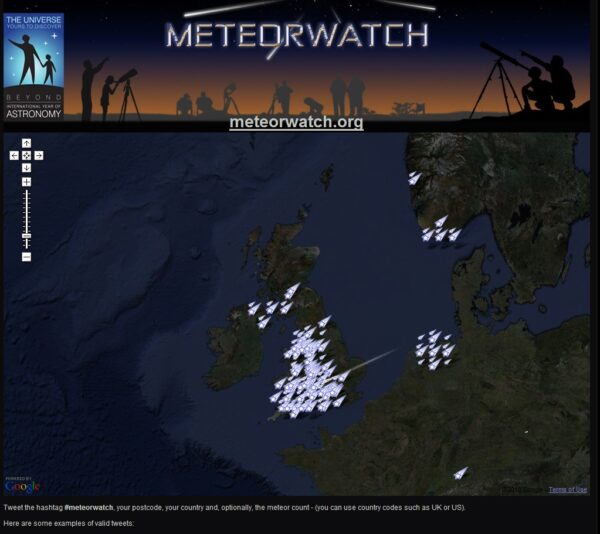
When you see a meteor, share your experience on twitter by tweeting what you saw for the meteor map.
The meteor map displays tweets of meteors seen by location and is very simple and fun to use.
Tweet the hashtag #meteorwatch then the first part of your postcode, then your country code and then optionally how many meteors you saw. Your results will then be displayed on the map shortly afterwards. Instructions can be found at the bottom of the map page.
Let’s see how many people saw a meteor or more?
by VirtualAstro | Aug 8, 2011
If you are looking for a great spot to see the shooting stars of the Perseids away from bright lights and light pollution, there are some very good National Trust sites you can go to in the UK.
These sites are ideal for all kinds of stargazing any time of the year and are set in some of the most beautiful locations in the country
The seven best National Trust sites for star gazing and see the wonders of the night sky are:
- Black Down in Sussex – Get closer to the stars on the highest point in the South Downs, just over a mile from the town of Haslemere.

Download the guide for Black Down
- Teign Valley in Devon – Discover the stars at this Trust property within Dartmoor National Park and close to Castle Drogo.

Download the guide for Teign Valley
- Penbryn Beach in Wales – Beautiful, unspoilt mile-long beach on the Ceredigion coast in west Wales, great for a bit of star gazing and a late night paddle.

Download the guide for Penbryn Beach
- Stonehenge Landscape in Wiltshire – Step back in time and discover the ancient skies of Salisbury Plain’s chalk downlands, home to the impressive prehistoric stone monument.

Download the guide for Stonehenge Landscape
- Wicken Fen National Nature Reserve in Cambridgeshire – Close to historic Ely, the wild landscape of the National Trust’s oldest nature reserve offers dark skies and a wealth of nocturnal wildlife to listen out for.

Download the guide for Wicken Fen
- Mam Tor in Derbyshire – Escape the bright city lights of Sheffield and experience the peace and tranquillity of Mam Tor’s dark skies in the Peak District.

Download the guide for Mam Tor
- Friar’s Crag in Cumbria – Surrounded by the breathtakingly beautiful scenery of the Lake District, Friar’s Crag in Keswick juts out into the spectacular lake of Derwentwater; a restful place to contemplate the world above us.

Download the guide for Friar’s Crag
More information about all of these sites is available by visiting: http://www.nationaltrust.org.uk/darkskies and enjoy stargazing and meteorwatch at these fabulous locations.

by VirtualAstro | Aug 6, 2011
Aurora over Cumbria 5/6th August 2011 Credit: Raymond Gilchrist
On the evening of the 5th of August 2011 the Aurora Borealis, Northern Lights were seen as far South as Southern England!
At approximately 18:00 Universal Time (19:00 BST) the Earth’s magnetosphere was hit by a coronal mass ejection from the sun, triggering a powerful geomagnetic storm and Aurora.
This storm measured 8 on the K index (aurora richter scale) which ranges from 0 – 9 so this was a big storm.
It is quite common to see Aurora in Northern Scotland, but at approximately midnight, aurora was seen as far south as Berkshire, Wiltshire and Hampshire in Southern England.
I was incredibly lucky to briefly see the pale greenish hue of the aurora through clouds from my back garden in West Berkshire. It is incredibly rare to see aurora this far south and the last time I remember was in 2003.
Unfortunately a lot of people in England and Scotland were under thick cloud and missed this fantastic display, but thanks to fantastic astro photographers such as Raymond Gilchrist (@RayGil on twitter) we are able to see the aurora through his images.
I am unsure of what the rest of the world witnessed, but geomagnetic activity remains high as I write this article, so I hope the sky clears and we are given another fantastic display of this rare phenomenon soon.

Aurora over Cumbria 5/6th August 2011 Credit: Raymond Gilchrist

by VirtualAstro | Aug 5, 2011
By @Bellatrixlestar on Twitter
This is one of the most prolific meteor showers and is associated with the comet Swift-Tuttle. During the peak of the perseids, the radiant (the place the meteors appear to come from) often seems to be the ‘sword handle’ within the constellation of Perseus.
(the above image was taken using the iPhone app Star Walk)
The Perseid meteor shower peaks on 12/13 August every year and can have anything from 80 to 140 meteors an hour. Observers have been known to describe Perseid meteors as being fast and bright in appearance. Often a large number of them leave a trail behind them as they enter the Earths atmosphere and in the past many of them have turned into fireballs.
It wasn’t until 1866 that the association with Comet 109P/Swift-Tuttle was proved by Giovanni Schiaparelli. The Perseid meteor shower itself has been known and observed for a long time. The first known recorded accounts were by the Chinese in AD36. Both the Japanese and Koreans also have documentation of observing the Perseids from the 8th century onwards. Western observations seem to start during the 19th century, or at least the ones that were documented.
Now with advances in technology we can watch the meteor shower (Moon dependent of course this year) from the comfort and warmth of our own living rooms. We can track who has seen meteor showers by using a twitter map and discuss in real time if any of our online friends spot a fireball. Modern technology gives us new ways to interact with other astronomers, and not just locally, it allows us to encourage others to get out in the back garden and just look up.