Some time in the small hours of Friday or Saturday morning (21-22 October 2011) the Orionids meteor shower will reach its peak activity rate. The peak occurs some time around 21 October each year, but this year it’s uncertain which day it will fall on.
The Orionid's parent Comet P/Halley as taken March 8, 1986 by W. Liller, Easter Island, part of the International Halley Watch (IHW) Large Scale Phenomena Network.
Meteor showers result from the Earth passing through the trail of dust and debris left behind by a comet. In the case of the Orionids the parent object is the most famous of all the comets – Halley’s Comet.
The peak meteor rate for the Orionids is lower than some of the more spectacular showers (the Perseids in August, the Geminids in December, and the Quadrantids in January all regularly outperform the Orionids) but it is still worth looking out for.
The meteors will appear to radiate from the constellation of Orion (hence the name) but they will streak across the sky in all directions, and so you shouldn’t confine yourself to only looking towards this one constellation.
On Thursday and Friday evenings the radiant rises in the east around 2200 BST (2100 UT) and continues to rise to its highest in the south just before the sky starts to brighten at 0600 BST (0500 UT). The higher the radiant above the horizon the more meteors you will see. However a crescent Moon will rises in the east on both mornings, the light from which will drown out some of the fainter meteors.
This shouldn’t matter much to you if you’re observing from an urban or suburban area, as the man-made light pollution in the sky will do a far better job of obscuring the meteor shower than the Moon will, but for lucky observers in dark sites (and I’ll be one of them, as I’m spending the weekend on Sark, the world’s first Dark Sky Island) the Moon may interfere.
Here’s a table with estimated hourly rates based on dark skies / suburban / urban areas, at hourly intervals throughout the night, assuming a ZHR =40 throughout this period (It may be that the peak will fall outwith this period, e.g. in daylight hours, so these are best-case-scenario numbers).
Time (BST)
Radiant
Altitude
Radiant
Direction
Hourly Rate
Urban Site
Hourly Rate
Suburban Site
Hourly Rate
Dark Sky Site (if Moon not present)
2200
rises
ENE
<1
<1
<1
2300
8°
ENE
1
2
4
0000
16°
E
1
4
8
0100
24°
ESE
2
6
16
0200
33°
ESE
2
8
22
0300
40°
SE
2
9
26*
0400
46°
SSE
3
10
29*
0500
50°
S
3
11
31*
0600
50°
S
3
11
31*
* the true rates, given that the Moon is causing natural light pollution, are probably half these values.
All of these timings and altitudes are based on an observer in central Scotland. For other UK observers the values in columns 2-4 may be slightly off, but not noticeably so.
Observing Advice: wrap up warm, head out before midnight, sit youself in a reclining lawn chair, and enjoy the spectacle. The rates may pick up around 0200 BST on Thursday or Friday and may stay high until dawn.
The View of the Porlock Vale from Porlock Hill looking over toward Bossington Hill and North Hill taken by Sean Hattersley on the 27/06/06
Exmoor Dark Sky Reserve follows in the footsteps of Galloway Forest Dark Sky Park, and Sark Dark Sky Island, both of which I helped to set up.
I first met Emma Dennis, the landscape officer for Exmoor National Park Authority who led the whole process, in 2008 when I brought the idea to her that Exmoor’s dark skies and favourable weather made it an ideal site for a dark sky reserve. (more…)
If you live in the Europe, North Africa, and the Middle East area, then keep watching the clock for 17-18:00 UTC when you may be in the right place at the right time for a burst of activity from the annual Draconid Meteor Shower. There’s a possibility you might see up to 1,000 meteors an hour! [click to continue…]
On October 8th, Earth will pass through a network of dusty filaments shed by Comet 21P/Giacobini-Zinner. Forecasters expect the encounter to produce anywhere from a few dozen to a thousand meteors per hour visible mainly over Europe, northern Africa and the Middle East. The meteors will stream from the northern constellation Draco–hence their name, the “Draconids.”
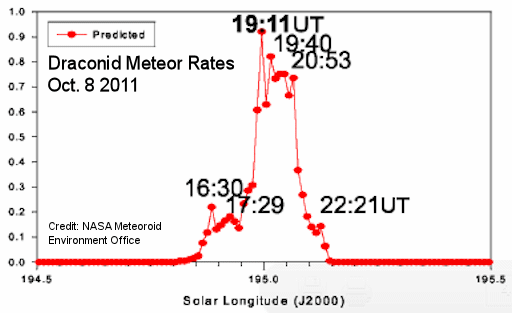
Peak rates should occur between 1600 UT and 2200 UT (noon – 6 pm EDT) as Earth grazes a series of filaments nearly intersecting our planet’s orbit. Analysts at the NASA Meteoroid Environment Office prepared this plot showing how the meteor rate is likely to vary:
If the maximum around 1900 UT reaches 1000 meteors per hour, the 2011 Draconids will be classified as a full-fledged meteor storm. The question is, will anyone see it? Bright moonlight over Europe, Africa and the Middle East will reduce the number of visible meteors 2- to 10-fold. The situation is even worse in North America where the shower occurs in broad daylight.
One way to enjoy the Draconids, no matter where you live, is to listen to them. The Air Force Space Surveillance Radar will be scanning the skies over the USA during the shower. When a Draconid passes through the radar beam–ping!–there will be an echo. Tune in to Space Weather Radio for live audio.
A similar system, still employing the radio reflection method displays meteors coming in on your computer in the form of a live graph – Meteor Live View
In Europe, an international team of scientists plans to observe the shower from airplanes flying at ~30,000 feet where the thin air reduces the impact of lunar glare. In Bishop, California, a team of high school students will launch an experimental helium balloon to higher altitudes, 100,000 feet or more, where the sky is black even at noon. Cameras in the balloon’s payload might catch some Draconid fireballs during the peak hours of the outburst.
Stay tuned for updates as Earth approaches the debris zone.
The Draconids are coming! Will this meteor shower produce a storm of observable meteors, or just a minor squall? The Draconid Meteor Show should begin on October 8, 2011 starting at dusk (roughly 19:00 BST) and continue through the evening. Peak activity of this normally minor and quiet shower is estimated to be at 21:00 BST (20:00 UT). There seems to be a wide range of predictions for this year’s shower, but some astronomers believe there could be up to 1,000 meteors per hour, making this a meteor storm! (more…)
If you ask someone to describe or draw a telescope, nine times out of ten it will be a refractor.
The refractor telescope is quite possibly the most common or easily recognized telescope. It is a very simple design, which has been around for hundreds of years.
The history of the refractor is that it was first invented in the Netherlands in 1608, and is credited to 3 individuals; Hans Lippershey, Zacharias Janssen – spectacle-makers and Jacob Metius. (more…)
On Saturday 8 October 2011 a rare event may occur – a meteor storm! The usually sedate Draconids meteor shower only produces a few shooting stars per hour in most years, but in some years we have a meteor storm, and that’s just what’s predicted for this year.
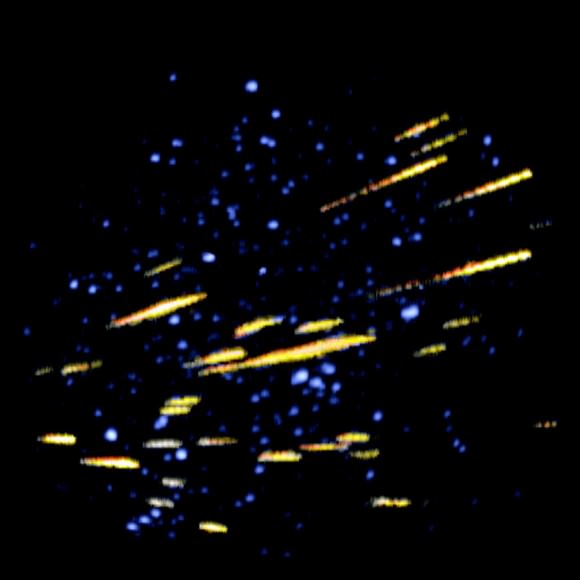
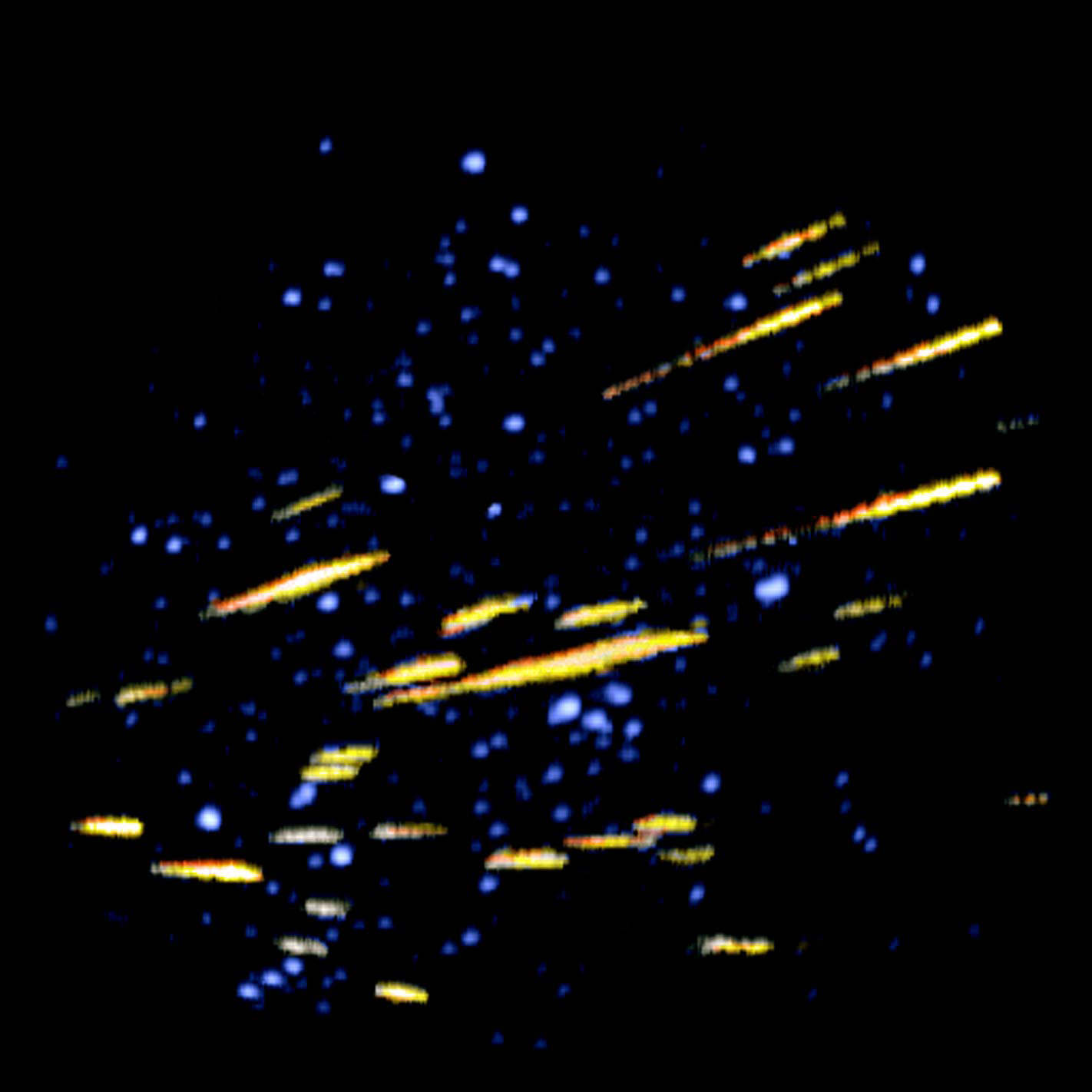
It Won't Look Like This
During a meteor storm the Earth passes through a particularly dense clump of comet dust, meaning that rates of shooting stars temporarily spike, and estimates this time suggest the possibility of up to 10 shooting stars per minute during the peak of the storm. However a nearly full Moon may spoil the view, possibly drowning out all but the brightest meteors, reducing the actual observed rate perhaps 1 per minute – still well worth looking out for.
The peak is set to occur at 2000UT (2100 BST), and is ideally placed for observers in the UK. Activity is expected to increase from 1600UT (1700 BST) but at that stage the sky will still be bright in the UK.
If you’re keen to witness this (possibly) amazing event here are some top tips:
Head out early. Start your meteorwatch once the sky gets dark enough. For most people in the UK this will be from 1900 – 1930 BST (anyone living in the north of Scotland will have to wait a bit longer). Although the peak of the storm is estimated to occur around 2100 BST there will be plenty to see in the hours leading up to the peak.
Know where to look. The Draconids all appear to originate from the constellation Draco, which will be high in the NW sky, just above and to the left of the north star, Polaris. However the meteors will streak across the entire sky so don’t just look NW.
Know what to look for. Meteors appear as bright streaks of light moving rapidly across the sky. They last for a fraction of a second, but the Draconids are unusually slow meteors. Still, blink and you might miss one.
Keep the Moon to your back. The full Moon will drown out the light from all but the brightest Draconids, and if you look at the Moon it will spoil your night vision, so keep it behind you, ideally blocked out by a building or tree.
You just need your eyes. Binoculars and telescopes, while ideal for observing faint nebulae and planets, are no good for meteorwatching. You want to take in as much of the sky as you can, and have as wide a field of view as possible, so just use your eyes.
Get comfortable. The best bit of meteorwatching kit is a reclining lawn chair. Point it towards the NW, lie back, look up and enjoy the show.
Keep warm. It will be very cold outside if it is clear, so wrap up warm. If you’re lying back on a reclining chair, wrap yourself in a blanket or sleeping back form maximum warmth.
Get away from city lights. This isn’t as important for this shower, as the Moon is flooding the sky with natural light anyway, but in general the fewer lights you have around you the better.
Get away from clouds. This hopefully goes without saying, but if your sky is cloudy you won’t see much. The UK Met Office website can tell you if there is a clear sky anywhere near you, and you should consider traveling to get clear skies. You can also check out meteor activity using the Meteor Live View.
Reusability is key to the dramatic cost savings that will enable advancements in human exploration of space. The Dragon spacecraft is a fully reusable and SpaceX is working toward the goal of delivering the world’s first fully reusable launch vehicle. Check out the animation for a sneak peek at SpaceX’s exciting plans for the future.