by Steve Owens | Jan 8, 2011
The Campaign to Protect Rural England (CPRE), in conjunction with the British Astronomical Association‘s Campaign for Dark Skies, has recently announced their 2011 Star Count Project.
Star Count Week 2011 (from CPRE website)
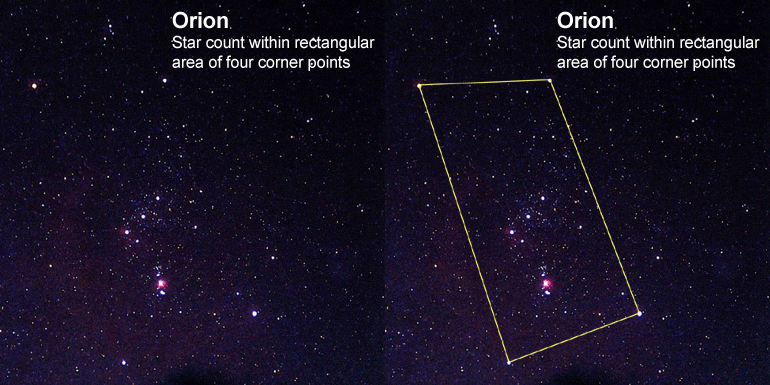
Star Count Week (Monday 31 January – Sunday 06 February 2011) aims to get you outside and looking up, specifically to assess how dark – or light – your sky is.
The technique is simple. 1. Find Orion. 2. Count all the stars you can see within the main rectangle formed by Betelgeuse, Bellatrix, Rigel and Saiph, the four stars that make up Orion’s shoulders and feet. (Don’t count the three bright belt stars). 3. Tell the CPRE.
That’s it. By counting how many you can see, astronomers can calculate your sky’s limiting magnitude, or the brightness of the faintest stars you can see. It’s a very simple – and rewarding – project to take part in.
There are other annual star count programmes, such as GLOBE at Night (March 22 – April 4 2011) which I blogged about during their 2010 event. You can also get more involved and conduct a detailed dark sky survey, or take part in local activities such as the Peak District National Park’s Orion in the Peak project
by Steve Owens | Jan 4, 2011
Originally posted on Dark Sky Diaries by Steve Owens (@darkskyman on Twitter)
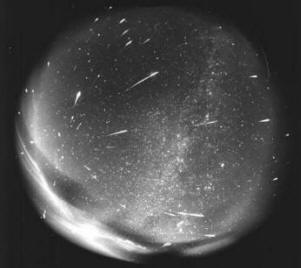
With the Quadrantids meteor shower that has just past yielding around 100 meteors per hour in near-perfect New Moon conditions, which showers of the next two years will give us as good a display?
Meteor Shower
There are a few regular, dependable showers that can be relied on to put on a good show year after year, given a good Moon phases, so let’s concentrate on those:
Lyrids 2011
The Lyrids peak this year on April 21/22, only three days after the Full Moon, making conditions far from ideal. The ZHR is around 20, but under bright Moon conditions this will be much reduced, so that from the UK you might only see a few Lyrids per hour.
Persieds 2011
The Perseids peak on 12/13 August 2011 coincides exactly with a Full Moon, making this shower pretty much a write-off in 2011.
Orionids 2011
The Orionids peak occurs on 21/22 October 2011 just after the last quarter Moon, with the Moon rising a little after midnight, just as the meteor shower radiant is gaining height. Again, far from ideal.
Leonids 2011
The Leonids peak on 17/18 November occurs during a last quarter Moon, which unfortunately is smack bang in the direction of Leo, and so will obscure many of the Leonids in 2011
Geminids 2011
The Geminids peak on 13/14 December 2011 will likewise be completely obscured by an almost-full Moon in Gemini.
Quadrantids 2012
The Quadrantids peak on 3/4 January 2012 will feature a waxing gibbous Moon which won’t set until 0400.
Lyrids 2012
The Lyrids peak on 21/22 April 2012 is the first major shower peak in 15 months where the Moon is absent, meaning that you should get good views of this shower which has a ZHR of only around 20.
Persieds 2012
The Perseids peak of 12/13 August 2012 will feature a thin waning crescent moon that’s visible in the sky from midnight, obscuring some of the Perseids.
Orionids 2012
The Orionids peak on 21/22 October 2012 is pretty much Moon-free from around 2330, as the Moon sets.
Leonids 2012
The Leonids peak on 17/18 November 2012 will also be Moon free from early evening, and so presents an opportunity to see a few Leonids.
Geminids 2012
Rounding off this two year run of poor Moon conditions for meteor showers, we end with the Geminids on 13/14 December, coinciding wonderfully with a New Moon on 13 December, meaning conditions will be near perfect.

by Steve Owens | Jan 1, 2011
Originally posted on Dark Sky Diary by Steve Owens www.twitter.com/darkskyman
At 1900 GMT on 3 January 2011 the Earth will be at perihelion, its closest approach to the Sun this year.
If that sounds confusing to you, and has you wondering why it’s so cold given that the Earth is at its closest to the Sun, then this belies (a) a northern-hemisphere-centric attitude (in the Southern Hemisphere it’s summer right now), and (b) a misunderstanding of what causes the seasons.
The Earth orbits the sun in a nearly circular orbit called an ellipse. The degree by which an orbit differs from a perfect circle is called the eccentricity, e. If e = 0 then the orbit is circular; if e = 1 then the orbit is parabolic, and therefore not gravitationally bound to the Sun. The Earth’s orbital eccentricity is 0.0167, meaning that it is very nearly circular, with the short axis of the ellipse being around 96% the length of the long axis.
Thus, during perihelion Earth is 0.983AU from the Sun, while during aphelion (its furthest distance from the Sun, occurring this year on 4 July) Earth is 1.017AU from the Sun. (1AU = 1 astronomical unit = the average distance between the Earth and the Sun = 150 million km). The seasons on Earth have really nothing to do with how close the Earth is to the Sun at different times of year. Indeed how could they, given that the difference in distance between closest and furthest approach is only a few per cent?
The seasonal differences we experience are of course caused by the tilt of the Earth’s axis, which is inclined by 23.5 degrees from the vertical. This tilt means that, as Earth orbits the Sun, for six months of the year one hemisphere tips towards the Sun, so that it experiences longer days than nights, becoming most pronounced at midsummer, at which point the Sun reaches its highest in the sky at noon. Simultaneously the other hemisphere tips away from the Sun, and experiences shorter days than nights, becoming most pronounced at midwinter, on which day the Sun is at its lowest noontime altitude.

Earth's tilted axis
The further you are from the equator the more pronounced the seasonal effects. In fact equatorial countries don’t experience seasonal variations, while the poles experience extremes with six-month-long winters and summers.
The timing of perihelion and aphelion relative to our seasons is entirely random. The fact the southern hemisphere midsummer (21 Dec) almost coincides with perihelion (3 Jan) is simply that; a coincidence. Given that fact, there is no reason to be surprised that perihelion occurs so close to northern hemisphere midwinter. it has to happen some time and it’s coincidence that it happens to occur within two weeks of midwinter / midsummer.
To take this explanation even further, we can calculate how much variation in incident sunlight (called the flux) there would be in two scenarios:
1. an imaginary scenario where the seasonal varioations in temperature are due to the tilt of the Earth’s axis but where the Earth goes round the Sun in a perfectly circular orbit
and
2. an imaginary scenario where the Earth’s axis isn’t tilted, but where it’s orbit is elliptical in the same degree as ours actually is.
1. The Sun appears at its highest point in our sky each day at noon. The highest it ever gets is at noon on midsummer. The lowest noontime altitude occurs at noon on midwinter.
In Scotland the Sun is around 55 degrees above the horizon at noon on midsummer, and only 10 degrees above it at noon on midwinter.
The amount of energy from the Sun radiant on a fixed area is proportional to the sine of the altitude, so the ratio of the solar energy radiant on a square metre of Glasgow between midsummer and midwinter is
sin(55) / sin(10) = 1.84
So here in Scotland we get 84% more energy from the Sun in summer than we do in winter, due to the tilt of the Earth’s axis.
2. If the Earth’s axis was not tilted, then we would only experience temperature differences from the Sun depending on how far or near we are from it. In this case, the amount of energy from the Sun radian of a fixed area is proportional to the square of the distance from the Sun, so the ration of the solar energy radiant on a square metre of Glasgow between perihelion and aphelion is
(1.017/0.983)^2 = 1.07
So we get 7% more energy from the Sun at perihelion than we do at aphelion., due to the differing distances to the Sun.
From this you can see that, while the distance to the Sun has some effect on how much heat we receive, it is a very small effect compared to that produced by our axial tilt.

by Steve Owens | Dec 20, 2010
This Tuesday 21 December 2010 is the Winter Solstice, and in addition there will be a total lunar eclipse, occurring at sunrise in the UK.

Total Lunar Eclipse, image by Nick James
Total Lunar Eclipses occur when the Moon passes into the shadow of the Earth. That this does not happen every 29 days (the time it takes for the Moon to orbit the Earth) is due to the fact that the Moon’s plane of orbit is not the same as the Earth’s orbital plane around the Sun, and so the Moon passes above or below the cone of the Earth’s shadow most of the time. Every so often, however, these two planes align to create the conditions for a Lunar Eclipse.
When this happens, the Moon will begin to darken in the sky, eventually turning a dark red colour. Unlike a Solar Eclipse, where the Sun’s light is totally blocked out by the Moon, in a Lunar Eclipse the Moon is still visible.
Tuesday’s Lunar Eclipse will begin at 0528 GMT when the Moon enters the Penumbra, the outer part of the Earth’s shadow. This will begin a slight darkening of the Moon, the darkness extending across the Moon’s surface slowly, taking around an hour. At 0632 GMT the Moon will enter the central, darkest part of the Earth’s shadow, form which point it will darken appreciably until, at 0740 it will be in total eclipse, with the full face of the Moon darkened red. This will last until 0854 GMT, at which point the Moon will slowly begin to darken again.
At this point, however, the Moon will have set for some UK observers, or be very low in the sky, on the western horizon, as it is about to set. The time at which it finally sets depends on where you are. In London it sets at 0812 GMT, while in Glasgow (my home town) it sets at 0857 GMT, just minutes after total eclipse ends.
This means that observers in Scotland will have the best view, and the further north you are the more you’ll see.
This lunar eclipse also has the rare distinction of being one where you can see the eclipsed Moon and the Sun in the sky at the same time, as Sun rises around 11 or 12 minutes before the Moon sets, wherever you are in the UK.
Originally posted by Steve Owens Dark Sky Diary http://darkskydiary.wordpress.com/2010/12/19/total-lunar-eclipse-on-the-winter-solstice/

by Steve Owens | Nov 23, 2010
The final meteor shower of 2010 is the Geminids, the peak of which falls on the night of the 13/14 December 2010. The Geminids is described by the IMO as “one of the finest, and probably the most reliable, of the major annual showers presently observable”, and this year’s shower is set to put on a good show. (You can read the IMO’s rather technical summary of the 2010 Geminids here: http://www.imo.net/calendar/2010#gem)

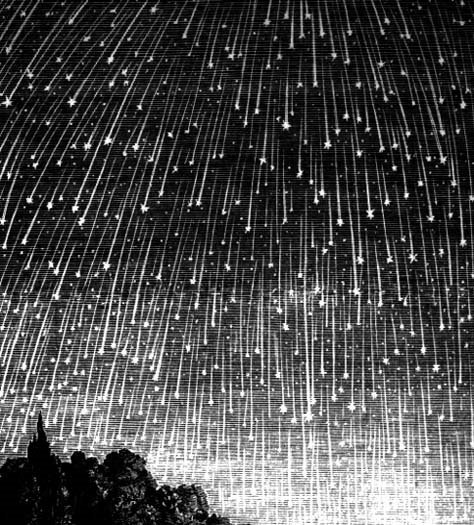
It won't look like this
The predicted Zenith Hourly Rate (see my previous post about ZHR and what it actually means here) is around 120. Although the peak is predicted to occur around 1100 on 14 December, it should happen some time between 1840 on 13 December and 1600 on 14 December 2010. The best time for the peak to occur for stargazers in the UK would be between 0030 and 0600 on 14 December, after the Moon sets but before twilight begins.
The radiant for this shower is actually quite favourable, and if you wait till the Moon sets at around 0030 on 14 December then the only light pollution limiting your view will be man-made. If you observe before the Moon sets then you will lose a few of the fainter Geminids in its glow, but it’s only a first quarter moon, and so will only really have an impact if you’re observing from very dark skies.
Let’s use the equation relating ZHR to actual observations of meteors to work out how many you might see:
Actual Hourly Rate = (ZHR x sin(h))/((1/(1-k)) x 2^(6.5-m)) where
h = the height of the radiant above the horizon
k = fraction of the sky covered in cloud
m = limiting magnitude
In the case of the 2010 Geminids, if observed from the UK, h = 45 degrees. Let’s assume you have clear skies (haha) with k = 0.
The number of Geminids you can expect to see from a variety of observing sites is as follows:
For very light polluted sites, such as city centres m = 3, and therefore you can expect to see only around 8 meteors per hour.
In suburban skies near a city or town centre m = 4, and you’ll see around 15 meteors per hour.
In rural skies where m = 5, you’ll see 30 meteors per hour.
Under very dark skies, where m = 6.5 (i.e. where there is no or negligible effect of light pollution, like in Galloway Forest Dark Sky Park) you’ll see up to 85 meteors per hour, once the Moon sets. A first quarter moon will impose a limiting magnitude, even at a very dark site, of around 6, in which case you’ll see a slightly reduced 60 meteors per hour.
Remember, all of these numbers assume perfectly clear skies. If half your sky is cloudy, cut these numbers in half!
How many Geminid meteors will I see?
| Where are you observing from? |
Limiting magnitude |
Number of Geminids per hour |
| A very light polluted city centre |
3 |
7 or 8 |
| Suburban Site |
4 |
15 |
| Rural Site |
5 |
30 |
| Dark Sky Site |
6.5 |
85 (after the Moon sets at 0030) |
If you fancy a good view of this spectacular meteor shower, then head to Galloway Forest Dark Sky Park, where we have an evening of talks and meteorwatching planned, weather permitting!
Originally posted by Steve Owens (@darkskyman) on his blog Dark Sky Diary Pursuing darkness in an increasingly bright world