by Steve Owens | Oct 18, 2011
Originally posted on Dark Sky Diary by Steve Owens @Darkskyman
Some time in the small hours of Friday or Saturday morning (21-22 October 2011) the Orionids meteor shower will reach its peak activity rate. The peak occurs some time around 21 October each year, but this year it’s uncertain which day it will fall on.
The Orionid's parent Comet P/Halley as taken March 8, 1986 by W. Liller, Easter Island, part of the International Halley Watch (IHW) Large Scale Phenomena Network.
Meteor showers result from the Earth passing through the trail of dust and debris left behind by a comet. In the case of the Orionids the parent object is the most famous of all the comets – Halley’s Comet.
The peak meteor rate for the Orionids is lower than some of the more spectacular showers (the Perseids in August, the Geminids in December, and the Quadrantids in January all regularly outperform the Orionids) but it is still worth looking out for.
The meteors will appear to radiate from the constellation of Orion (hence the name) but they will streak across the sky in all directions, and so you shouldn’t confine yourself to only looking towards this one constellation.
On Thursday and Friday evenings the radiant rises in the east around 2200 BST (2100 UT) and continues to rise to its highest in the south just before the sky starts to brighten at 0600 BST (0500 UT). The higher the radiant above the horizon the more meteors you will see. However a crescent Moon will rises in the east on both mornings, the light from which will drown out some of the fainter meteors.
This shouldn’t matter much to you if you’re observing from an urban or suburban area, as the man-made light pollution in the sky will do a far better job of obscuring the meteor shower than the Moon will, but for lucky observers in dark sites (and I’ll be one of them, as I’m spending the weekend on Sark, the world’s first Dark Sky Island) the Moon may interfere.
Here’s a table with estimated hourly rates based on dark skies / suburban / urban areas, at hourly intervals throughout the night, assuming a ZHR =40 throughout this period (It may be that the peak will fall outwith this period, e.g. in daylight hours, so these are best-case-scenario numbers).
| Time (BST) |
Radiant
Altitude |
Radiant
Direction |
|
Hourly Rate
Urban Site |
Hourly Rate
Suburban Site |
Hourly Rate
Dark Sky Site (if Moon not present) |
| 2200 |
rises |
ENE |
|
<1 |
<1 |
<1 |
| 2300 |
8° |
ENE |
|
1 |
2 |
4 |
| 0000 |
16° |
E |
|
1 |
4 |
8 |
| 0100 |
24° |
ESE |
|
2 |
6 |
16 |
| 0200 |
33° |
ESE |
|
2 |
8 |
22 |
| 0300 |
40° |
SE |
|
2 |
9 |
26* |
| 0400 |
46° |
SSE |
|
3 |
10 |
29* |
| 0500 |
50° |
S |
|
3 |
11 |
31* |
| 0600 |
50° |
S |
|
3 |
11 |
31* |
* the true rates, given that the Moon is causing natural light pollution, are probably half these values.
All of these timings and altitudes are based on an observer in central Scotland. For other UK observers the values in columns 2-4 may be slightly off, but not noticeably so.
Observing Advice: wrap up warm, head out before midnight, sit youself in a reclining lawn chair, and enjoy the spectacle. The rates may pick up around 0200 BST on Thursday or Friday and may stay high until dawn.

by Steve Owens | Oct 2, 2011
Originally posted on Dark Sky Diary by Steve Owens @Darkskyman on twitter
On Saturday 8 October 2011 a rare event may occur – a meteor storm! The usually sedate Draconids meteor shower only produces a few shooting stars per hour in most years, but in some years we have a meteor storm, and that’s just what’s predicted for this year.
It Won't Look Like This
During a meteor storm the Earth passes through a particularly dense clump of comet dust, meaning that rates of shooting stars temporarily spike, and estimates this time suggest the possibility of up to 10 shooting stars per minute during the peak of the storm. However a nearly full Moon may spoil the view, possibly drowning out all but the brightest meteors, reducing the actual observed rate perhaps 1 per minute – still well worth looking out for.
The peak is set to occur at 2000UT (2100 BST), and is ideally placed for observers in the UK. Activity is expected to increase from 1600UT (1700 BST) but at that stage the sky will still be bright in the UK.
If you’re keen to witness this (possibly) amazing event here are some top tips:
- Head out early. Start your meteorwatch once the sky gets dark enough. For most people in the UK this will be from 1900 – 1930 BST (anyone living in the north of Scotland will have to wait a bit longer). Although the peak of the storm is estimated to occur around 2100 BST there will be plenty to see in the hours leading up to the peak.
- Know where to look. The Draconids all appear to originate from the constellation Draco, which will be high in the NW sky, just above and to the left of the north star, Polaris. However the meteors will streak across the entire sky so don’t just look NW.
- Know what to look for. Meteors appear as bright streaks of light moving rapidly across the sky. They last for a fraction of a second, but the Draconids are unusually slow meteors. Still, blink and you might miss one.
- Keep the Moon to your back. The full Moon will drown out the light from all but the brightest Draconids, and if you look at the Moon it will spoil your night vision, so keep it behind you, ideally blocked out by a building or tree.
- You just need your eyes. Binoculars and telescopes, while ideal for observing faint nebulae and planets, are no good for meteorwatching. You want to take in as much of the sky as you can, and have as wide a field of view as possible, so just use your eyes.
- Get comfortable. The best bit of meteorwatching kit is a reclining lawn chair. Point it towards the NW, lie back, look up and enjoy the show.
- Keep warm. It will be very cold outside if it is clear, so wrap up warm. If you’re lying back on a reclining chair, wrap yourself in a blanket or sleeping back form maximum warmth.
- Get away from city lights. This isn’t as important for this shower, as the Moon is flooding the sky with natural light anyway, but in general the fewer lights you have around you the better.
- Get away from clouds. This hopefully goes without saying, but if your sky is cloudy you won’t see much. The UK Met Office website can tell you if there is a clear sky anywhere near you, and you should consider traveling to get clear skies. You can also check out meteor activity using the Meteor Live View.
- Record your observations. If you want to take part in a meteorwatch and submit your observations there a several ways you can do that. One fun and accessible approach is to tweet your observations with the #meteorwatch hashtag your post code and country code to see your results on the meteor map. If you want to take more detailed rigourous data you can submit an observing form to the International Meteor Organisation, the British Astronomical Association or the Society for Popular Astronomy
Make sure you tell your friends! This a great opportunity to see a very rare meteor storm, so get as many people as possible outside and looking up.
CAVEAT: This is only a predicted meteor storm; it may not occur and if it doesn’t meteor levels will be very low.
by Steve Owens | Aug 4, 2011
Originally posted on Dark Sky Diary as “Perseids Meteor Shower 2011” by Steve Owens @darkskyman on twitter
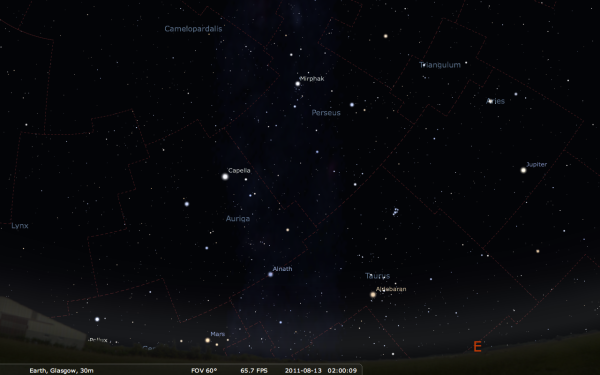
This month sees the most reliable meteor shower of the year; the Perseids. You can begin watching for Perseid meteors now, and the shower will last until mid-August, but the peak of the shower occurs in the small hours of Saturday 13 August 2011.
Perseus under dark skies

Perseus under moonlit skies
Unfortunately this year’s shower will be obscured by the full Moon which occurs on the same day, and so it won’t present its usual excellent display.
The number of meteors that you will observe every hour depends on a number of factors:
- the density of the cloud of dust that the Earth is moving through, that is causing the shower in the first place;
- the height above the horizon of the radiant of the shower, the point from which the meteors appear to radiate;
- the fraction of your sky that is obscured by cloud;
- the naked-eye limiting magnitude of the sky, that is a measure of the faintest object you can see.
Please visit Dark Sky Diary for the rest of this article………..

by Steve Owens | Jun 13, 2011
Originally posted on Dark Sky Diary by Steve Owens (@darkskyman on twitter)
Today, 13 June, is one of only four days in the year when the time as read on a sundial will be exactly correct.
Sundials usually tell the time using the shadow of the gnomon as cast by the Sun. This is possible as the Sun appears to move across the sky at an approximately constant speed, and so the shadow of the gnomon also moves at an approximately constant speed. The inconstancy of the Sun’s apparent motion in the sky – and therefore of the gnomon’s shadow on a sundial – is the subject of this article, and is calculated using the Equation of Time.
If you look at the shadow of a sundial’s gnomon it will fall onto a curve of numbers, along hour lines indicating local solar time. This is not equal to the official clock time until three important corrections are made:
Please read the rest of this article on Dark Sky Diary

by Steve Owens | Jun 13, 2011
Originally posted on Dark Sky Diary by Steve Owens (@darkskyman on twitter)
The first total eclipse of the Moon of 2011 occurs this Wednesday evening, 15 June 2011, and it will be the longest lunar eclipse in over a decade. However the views from the UK (and Europe) will be constrained by the fact that the Moon will be below the horizon for much of the eclipse, and will rise fully eclipsed, or in some cases even coming out of eclipse. It’s still worth having a look though: just try to find somewhere with a very low and clear SE horizon, as this will be the direction in which the Moon will rise, and it will be in eclipse only while it is VERY low (only a few degrees above the horizon).
A lunar eclipse occurs when the Moon, in its orbit around the Earth, passes into the Earth’s shadow, as cast by the Sun. You might imagine that this would happen once every lunar orbit, or once a month. That it does not is due to the fact that the Moon’s orbit around the Earth is tilted by around 5 degrees compared with the Earth’s orbit around the Sun. So in most orbits the Moon passes above or below the Earth’s shadow.
Please read the rest of this article on Dark Sky Diary