by VirtualAstro | Dec 23, 2010
A round-the-world wave to the humans aboard the International Space Station by their fellow humans on the Earth – choreographed by a grassroots Twitter campaign (@ISSwave).
24-31 DECEMBER, 2010
A celebration of human solidarity during the holiday season
For one week beginning Friday, 24 December, humans around the world will show their solidarity with their fellow humans in space (and on Earth) by waving at the International Space Station (ISS) as she passes overhead at 17,500 mph (28,000 kmph).
Participants, recruited through Twitter, are encouraged to share their waves — either alone or as part of an ISSwave tweetup (a physical gathering of twitterers, or tweeps) — by tweeting their zip/postal code and the hashtag “#ISSwave” along with photos and videos of their waves, thoughts, holiday wishes for the astronauts and cosmonauts, etc. Participants’ waves will be registered in real-time at www.isswave.org.
Astronauts and cosmonauts aboard the International Space Station may even film themselves waving back at ISSwave participants. At least two astronauts, including Ron Garan, have voiced their support for ISSwave in emails and tweets.
The idea for the wave emerged through a serendipitous twitter exchange among Twitter acquaintances and regular ISS watchers Lucy Rogers (@DrLucyRogers), Richard P. Grant (@rpg7twit) and Karen James (@kejames). They discovered that watching ISS passes is even more exciting when done together with other humans, whether they are standing right next to you or watching from afar. To know that you are not the only one looking up in awe at this spectacle of human ingenuity and cooperation speeding across the night sky creates a special connection between us.
“The first time I watched an ISS pass I was surprised by how much it affected me,” said Karen James. “‘We made that’, I thought, ‘there are humans up there!’ All of my worries just seemed so tiny in the face of this symbol of human achievement and cooperation. I want to share that experience with other humans and also show my support to the ones living and working aboard the station.”
‘“I’d always wave up at the ISS if I saw it pass overhead,” says Lucy Rogers. “Someone laughed and said the astronauts wouldn’t see me.” So she asked on Twitter if anyone else waved – a lot of people did – and the communal ISS waving began. “When Karen moved to the USA she saw the ISS at a different time to us in Europe – which prompted the idea of a round-the-world wave,” she says.
We see the ISS because it is lit by the Sun. Sunlight reflects off it’s solar panels in the same way it glints off windows here on Earth. As the ISS travels round the world, the reflection can be seen in a broad sweep across the Earth. Due to the angles involved between the Sun, ISS and our location on Earth, sometimes we see bright, high passes and sometimes we can’t see it at all. During the week 24th – 31st December, most places on the Earth should get a good view of it at some point.
The three formed the Twitter account @ISSwave to coordinate, promote and provide updates on the event. Their hope is that seasoned and novice ISS watchers alike will experience the startlingly emotional experience of an ISS pass, amplified by solidarity with thousands of others watching around the world.
Additionally, the team hopes the buzz around ISSwave will persuade those who have never watched an ISS pass to participate, marking an increase in awareness about the International Space Station and the existence of a community of space enthusiasts on Twitter (“spacetweeps”).
The wave also celebrates the 10th anniversary of continuous human presence in space (ISS10years) on 2 November 2010 and the 50th anniversary of Yuri Gagarin’s flight into space — the first human spaceflight — on April 12th 2011 (www.YuriGagarin50.org).
ISS Wave Info:
- The International Space Station has been orbiting the Earth over 15 times a day for more than ten years.
- Although it is about 390 km (~240 miles) high, we can still see it from the Earth, thanks to the Sun reflecting off the solar arrays. The solar array wingspan is 240 feet (73 meters). This is longer than that of a Boeing 777 model at 212 feet (65 meters).
- Currently on the ISS are Oleg Skripochka, Alexander Kaleri, Dmitry Kndratyev, Paolo Nespoli, Catherine Coleman and Scott Kelly (Commander).
- Photos of the ISS passing overhead are available at http://www.isswave.org/ISSWave/Media_Photos.html
- There are various ways you can work out when it will be possible to see it from where you are, including Heavens Above, Twisst, NASA, ESA and Orbiting Frog.
- As of 19 December, @ISSwave had over 600 followers from across all continents.
- Dr Karen James (@kejames) is Director of Science for The HMS Beagle Trust, a UK charity aiming to rebuild the famous ship that carried Charles Darwin around the word on his seminal voyage of discovery. Through the Beagle Project she collaborates with NASA Astronaut Michael Barratt a long-duration spaceflight veteran and member of the crew of the upcoming STS-133 mission to the ISS aboard Space Shuttle Discovery. She is a former postdoctoral researcher at the Natural History Museum in London and has recently repatriated to the United States. For more information visit http://kejames.com/.
- Dr Lucy Rogers (@DrLucyRogers) a Chartered Mechanical Engineer and Fellow of the Royal Astronomical Society, aims to infiltrate the public’s consciousness by writing scientific stuff in plain English. She has published a book about space flight, “It’s ONLY Rocket Science”, which doesn’t contain any equations. She lives on the Isle of Wight where she can see the Milky Way from her back garden. For more information visit http://lucyrogers.com.
- Dr Richard P. Grant (@rpg7twit) is a biological scientist turned writer, editor and poet. He currently lives and works in London, and has a habit of taking on far too many projects. For more information visit http://rg-d.com/rpg, or his blog at Occam’s Typewriter.

PRESS CONTACT:
For more information or to arrange an interview:
UK: Dr Lucy Rogers
Twitter: @DrLucyRogers
Skype: dr.lucy.rogers
Phone: +44 1983 731 759
Email: [email protected]
USA: Dr Karen James
Twitter: @kejames
Skype: karenejames
Phone: +1 207 669 2663
Email: [email protected]

by VirtualAstro | Dec 8, 2010

Reports are coming in that people from all over the UK saw a very bright object streak across the sky!
The Object was reported to be incredibly bright with a flash which lit up the ground and then the object streaked across the sky, leaving a bright green tail in its wake!
Unfortunately I missed this amazing spectacle(drat!!!) and the first I herd of it was from a call I received from the BBC. BBC Radio 5 Live have had hundreds of text messages and calls from people who saw the event, and called me to ask if i new what it was?
The object was most definately a Meteor and would be refered to as a fireball or bolide (an incredibly bright fireball). What also makes me say this was a bolide is the apparent brightness duration (over 5 seconds) and its green tail. Typical of past bolide sightings from around the world.
Many people who saw the object reported a green tail and the reason for this is, the material the meteor is composed of oxidizes as it burns up. Most meteors are metalic and composed of iron with other trace metals. In tonights meteor's case it more than likely contained copper which is green when it oxidizes.
Reports of direction are sketchy, some people say south to North and Some say East to West, so we are unsure of its point of origin at present. Could it be an early chunk of the Geminids Meteor shower which peaks in the morning of the 14th December and is best seen the night before on the 13th through to the small hours? or is it a sporadic meteor? (please see below for mor explanations on what are meteors)
Please report your sightings on twitter using the hastag #meteorwatch or #meteor and join in with the Geminid Meteorwatch on Twitter on the evening of the 13th December 2011 Will it be a shower to remember?
I may be on BBC Radio 5 live at 11 – 11:30pm and will be discussing tonights fireball live from the Astrobunker.
What are Meteors?
Meteors are usually dust or sand grain sized pieces of rock which speed through space up to tens or hundreds of kilometers a second and when they enter the Earths atmosphere they burn up, creating bright or brilliant streaks across the sky.
Often referred to as "Shooting Stars" they can be seen randomly on most clear evenings and can be few or far between, these are called "Sporadic Meteors". A sporadic meteor can appear anywhere in the sky and from any direction.
You may be lucky enough and by chance to see larger sized pieces of debris burn up in the atmosphere causing very bright and enduring meteors, often referred to as "Fire Balls" or "Bolides". These are quite a sight and can last for several seconds in some cases.
Several times a year and on specific dates we have "Meteor Showers". A meteor shower is usually the left over debris from the tail of a comet which has in the past, passed through the Earths orbit or orbital plane around the sun. Because we know where and when these encounters happened we can accurately predict when the Earth will pass through the debris trail.
Some meteor showers only produce a hand full of meteors per hour and some produce up to a hundred or more meteors per hour. This is known as a "Zenithal Hourly Rate" or ZHR. We can also predict where in the sky or from what direction the meteor shower will come from, this is called the "Radiant".
A meteor shower will get its name from the constellation of stars the radiant occurs in, e.g. Perseids (Perseus), Leonids (Leo) and Geminids (Gemini) etc. A meteor is not to be confused with a "Meteorite" which is a meteor which has struck the surface of the planet, often very small pebble or stone sized.
Meteorites in extreme cases can be large, anything from the size of a football to many hundreds of Meters or Kilometers across. The Meteorite suspected of wiping out the Dinosaurs 65 million years ago, is estimated to have been 6 kilometers in diameter!

by VirtualAstro | Nov 26, 2010
By Twitter..@Betelgeuse10
Original post http://astronomycentral.co.uk/the-night-sky-with-binoculars-tonight
Thursday 25th November, 2010
Get yourself outside tonight if it’s clear, pull up a deck chair, and scan the star clusters, nebulae, and even see another galaxy with your binoculars. They are just perfect for some objects like the larger open clusters. Just aimlessly wandering along the band of the Milky Way is also very enjoyable. If you have binoculars up to 10 x 50 then they’re ideal for the job, portable, and easy to hold. Anything over this size will usually need a tripod. All the objects listed here are at their best in dark skies, ideally with the bright Moon not around.
The Moon tonight…waning gibbous 73% full, rising in NE at 7.53 pm, and setting in NW at 11.36 am (GMT) (26th)
The Sword of Orion, and M42

Rising in the east tonight is the impressive constellation of Orion The Hunter, a sure sign of winter. It’s a striking constellation with the unmistakable, straight line of the three stars of Orion’s belt. Now look below the belt and you’ll see Orion’s Sword. To your naked eye it looks like a line of three fuzzy stars that hang down from the belt, resembling a sword. But when you look through your binos you will see that this is actually a group of star clusters, not individual stars. Notice how the middle cluster glows, especially with averted vision. What you are looking at is the famous, and probably most photographed deep sky object ever, the Orion Nebula or M42. This object is a huge and complex region of gas clouds, around 14 light years across. This place at 1,500 light years away is a vast stellar nursery, but it’s just one small part of an even larger region of gas that spans nearly the entire constellation. New stars, solar systems in formation, and even freely floating planets have all been observed in the Orion Nebula.
Tonight the Orion Nebula rises in the east at 8.01 pm, climbs highest in the south at 1.33 am (GMT), and sets in the west after sunrise.
The Orion Nebula can even be seen with the naked eye under very good skies, it is a magnitude 4.0 object
How long will it be around for? The Orion Nebula is in a winter constellation. So it will slowly and gradually move across the sky eventually sinking into the west by the end of March, when it will make way for the spring constellations rising in the east.
The Pleiades, or Seven Sisters
Rising in the north east tonight in the constellation Taurus is the one open cluster that lots of people can name and recognise, the Seven Sisters, The Pleiades, or M45. It lies between Perseus and Orion, and to the east of Auriga. You can easily see it naked eye, as a large fuzzy patch of stars. M45 is a close open cluster at just 440 light years away, it’s one of the nearest and so appears large in the sky. The stars in the cluster are also very young at only around 150 million years, and the brightest ones you can see are also the very youngest and hottest. The “Seven Sisters” cluster actually contains up to 1,400 members.
This attractive open star cluster fits nicely into your binoculars field of view, providing a very satisfying sight especially in dark skies with the Moon absent.
Tonight the Pleiades Cluster rises in the north east at 3.14 pm, it gets to its highest point in the south at 11.24 pm (GMT), and sets in the north west after sunrise.
The Pleiades Cluster is at magnitude 1.6
How long will it be around for? The Pleiades too will be visible in the sky with the Orion Nebula until around the end of March.
The Andromeda Galaxy, M31
High in the eastern sky tonight is the famous Andromeda Galaxy, or M31. It is a huge spiral galaxy 2.5 million light years away, with up to one trillion stars, and a diameter of up to 220,000 light years…more than twice the size of our Milky Way. You can even see Andromeda naked eye as a fuzzy glow, and there are two main ways to find this island universe in the sky. One is to locate the large square of Pegasus with its four stars marking each corner. You’ll find Pegasus to the east of Perseus, and Cassiopeia. The star at the upper left of the square is called Sirrah (or Alpheratz), look to the left of Sirrah and you’ll see three stars in a line, a dimmer star and two bright stars. The first bright star is Mirach. Now look above Mirach and you’ll see a dimmer star, look about the same distance above again from the dimmer star, and here is located the Andromeda Galaxy (M31). Another way to find M31 it is to use the right hand V of the W of Cassiopeia and imagine a line pointing down, this V points just to the left of Andromeda.
Get your binoculars on M31 and you’ll see the bright core of the galaxy as a small fuzzy blob. But keep studying and use averted vision, and you’ll soon start to make out the fainter shape of the galaxy’s disk extending out from the core. This is an object far outside the Milky Way, an entire ”island universe”. To be seen at its best Andromeda should be observed with the bright Moon absent under dark skies, but it’s still visible even from urban areas.
Tonight the Andromeda Galaxy is rising from in the east after dusk, it’s virtually directly overhead at 8.44 pm (GMT), and eventually sinks low in the north west before sunrise. It is circumpolar, meaning it never sets in northern latitudes.
M31 is at magnitude 3.4
How long will it be around for? The Andromeda Galaxy is actually circumpolar from northern latitudes. It is nicely high in the sky now but will gradually sink to its lowest point just above the horizon in the north in mid March, before starting its rise again.
The Perseus Double Cluster
This cluster is one of my favourites, it looks stunning in a telescope at low power, but binoculars also show it well. The Perseus Double Cluster, NGC 884 and NGC 869, or H and X Persei are actually two seperate open star clusters close to each other in space at around 7,000 light years away. They are only a few million years old, much younger than the Pleaides. To find it I could tell you to find this star, draw a line to that star etc, but the easiest way I have found to locate the Perseus Double is just to look for a fuzzy irregular patch in the band of the Milky Way between Cassiopeia and Perseus, (cluster marked as H+X on Perseus map). Once you see it, get your binos on it and you’ll see two very attractive open clusters of sparkling stars set against the blackness of space. There’s also a nice line of stars that curves away from the upper most cluster, when you see this line of stars you’ll know you have this popular deep sky object in your view.
Tonight you’ll see the Perseus Double Cluster rising from the north east after dark and getting very high in the sky to the east. It is circumpolar meaning it’s always above the horizon and never sets.
This open cluster is a magnitude 4.00 object
How long will it be around for? The Perseus Double Cluster will always be above the horizon, but by April it will have moved over to the north and much lower in the sky.
Jupiter and its moons

Jupiter the giant of the solar system is on show right now, although it is gradually on the wane as far as size and brightness go, having passed full opposition in mid September. But the solar system’s most massive planet and its collection of four main moons can be seen in binoculars. Look to the east after it goes dark and the brightest “star” you see is Jupiter. Put your binoculars on it and although the disk of the planet is small, look carefully and you should see four tiny pinpoints of light around it. These are the moons of Jupiter, Ganymede, Callisto, Io, and Europa. Jupiter’s moon Io is the most volcanic place in the entire solar system, and Europa is covered in ice with an ocean below its frozen crust. One of those four pinpoints of light you see (Europa) has more water on it than all of Earth’s oceans put together, and could even have extraterrestrial life living there. Ganymede is the largest moon in the solar system, even bigger than Mercury, and Callisto could also have a subsurface ocean. The moons shift and change postion over mere hours, so it’s a continually changing scene.
Tonight you’ll see Jupiter quite high in the south east by night fall, it rises highest in the south at 7.33 pm, and sets in the west at 1.08 am. (GMT)
Tonight Jupiter is at magnitude -2.44
How long will it be around for? Jupiter will eventually go out of sight in the setting Sun’s glow by March 2011.
The Beehive Cluster, M44
The Beehive Cluster, Praesepe, M44, or NGC 2632 is a very nice and attractive open star cluster to look at through your binoculars, and does kind of look like a swarm of bees. The Beehive is another open cluster close to Earth, at 577 light years away in the constellation of Cancer. This puts it slightly further away than the Pleaides. M44 rises from the north east, and you’ll see it with your naked eye as a nebulous patch on clear moonless nights. This cluster lies in the fainter constellation of Cancer, in between Leo, and Gemini. The stars that make up the head of Leo the Lion look like a large backwards question mark. You’ll find M44 with your naked eye roughly half way between this “question mark”, and the two twin stars of Castor and pollux in Gemini. The Beehive actually has over 1,000 stars, and is around 600 million years old.
This is really one for the early hours at the moment, as you’ll have to wait until beyond midnight if you want to get a good view of the Beehive Cluster. Tonight it rises from the north east at 8.41 pm (GMT), and climbs to its highest point in the south just before sunrise. Viewing this object gets more convenient in the coming weeks though, as it gradually rises earlier.
This object is at magnitude 3.7
How long will it be around for By April when M42 and the Pleiades will be sinking into the western horizon, the Beehive Cluster will still be nice and high in the sky in the south. But by June it will have disappeared below the north west horizon by nightfall.
The Hyades Cluster
Look to the eastern sky, to the lower left of the Pleaides Cluster, and you’ll see the bright orange star Alderbaran. Alderbaran is an orange giant, and marks the eye of the bull in the constellation Taurus. Alderbaran marks the position of the closest star cluster to Earth, the Hyades. This star grouping of up to 400 members is large and loose, due to its closeness at a mere 151 light years away. This open cluster is so spread out that even your binoculars will just about get all of its stars in their field of view. But this is a really nice collection of suns to gaze at through your binos on crisp dark nights. It contrasts well with bright Alderbaran, although this orange giant is not actually a member of the Hyades Cluster, being much closer to Earth at 65 light years away.
Tonight the Hyades Cluster rises from the east at 4.44 pm, and gets nice and high in the south at 12.38 am (GMT), eventually sinking towards the western horizon before daybreak.
How long will it be around for? The Hyades Cluster will be on view until March/April. At this time it will be close behind the setting Sun, following it into the western horizon.
…also check out Planets To See In The Sky Tonight

by VirtualAstro | Nov 16, 2010
Originally posted on and full credit Universe Today

Are you ready to walk into the lion’s cage? Then break out your favorite skywatching gear because the 2010 Leonid meteor shower is underway…
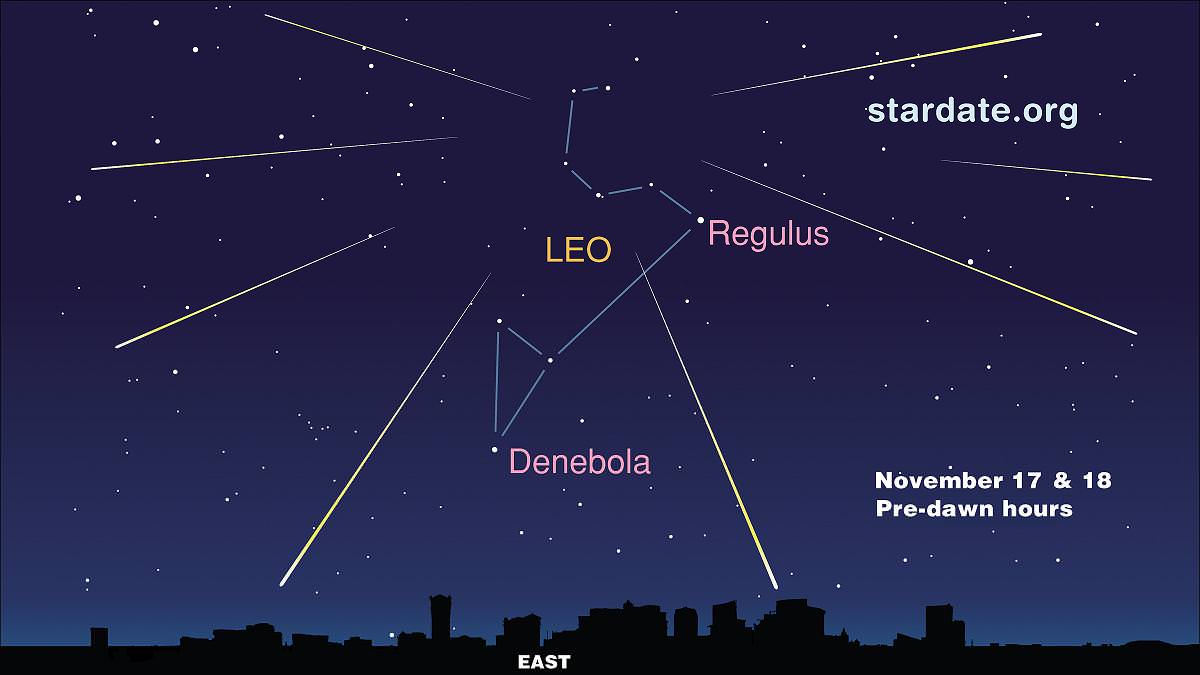
In the pre-dawn hours on the mornings of November 17 and November 18, the offspring of Comet Temple/Tuttle will be flashing through our atmosphere and just taunting you to test your meteor watching skills against bright skies. Although the phat Moon will greatly interfere with fainter meteor trails, don’t let that stop you from enjoying your monring coffee with the sparkling “cubs” that will be shooting out from the constellation of Leo.
Where? For all observers the constellation of Leo is along the ecliptic plane and will be near its peak height during best viewing times. When? Because of the Moon, just a couple of hours before local dawn is the best time to watch. Why? Read on!
Although it has been a couple of years since Temple/Tuttle was at perihelion, don’t forget that meteor showers are wonderfully unpredictable and the Leonids are sure to please with fall rate of around 20 (average) per hour. Who knows what surprises it may bring! Each time the comet swings around our Sun it loses some of its material in the debris trail. Of course, we all know that is the source of a meteor shower, but what we don’t know is just how much debris was shed and where it may lay.
As our Earth passes through the dusty matter, it may encounter a place where the comet let loose with a large amount of its payload – or it may pass through an area where the “comet stuff” is thin. We might even pass through an area which produces an exciting “meteor storm” like the Leonids produced in 1883! For those in the know, the Leonid meteor shower also made a rather incredible appearance in 1866 and 1867 – dumping up to 1000 (not a typo, folks) shooting stars recorded even with a Moon present! It erupted again in 1966 and in 1998 and produced 3000 (yep. 3000!) video recorded meteors during the years of 2001 and 2002. But remember, human eyes may only be able to detect just a few…
And I ain’t lion!
Photo Courtesy of Stardate.org, Texas University