by Astroguyz David Dickinsen | Aug 11, 2011
Perseid Credit: science1.nasa.gov
A classic summer astronomical standby may be in trouble this year, but that shouldn’t stop you from looking. That’s right, we’re talking about the Perseids, that “old faithful” of meteor showers which sees northern hemisphere residents getting bundled up to camp out under the summer stars every mid-August.
Some of our earliest astronomical memories come from watching this very shower under the dark northern Maine skies of our 1970’s childhood… yes, the Perseids are public crowd-pleaser and even an occasional Yahoo-trending fave that can even knock the likes of Brittany & friends down to the number 2 slot for a 12 hour period… so, what’s this news of the Perseids being “troubled?” They haven’t been threatened by irate pop stars, have they?
Unfortunately, this year’s menace is a more inviolate force; the Full Moon. Yes, this year’s Perseid meteor shower peaks the morning of August 13th, mere hours before the Moon reaches Full status on the same day at 14:57EDT/18:57UTC. Instead of the usual respectable zenithal hourly rate (ZHR) of around 100 meteors per hour, observers can only expect to see a paltry few of the very brightest fireballs…
But all is not lost. With a little planning, a few factors can work in YOUR favor this year. Keep in mind that the Perseids have a very broad peak, and the radiant near the head of the constellation Perseus lies above the horizon all night for observers north of 32° latitude. Plus, this month’s Full Moon (known as a Sturgeon Moon) has a southerly declination of about -11° degrees; your best bet for catching Perseids this year may lie with watching several mornings prior, in the window of time between the setting of the waxing gibbous Moon and the beginning of local twilight… and yes, you CAN still watch a meteor shower during a Full Moon and see an occasional Perseid.
Generally speaking, the farther north in latitude you are located, the more likely you’ll be able to take advantage of these twin factors. Finding as dark a site as possible and putting something physically between yourself and the bright Moon is the key. A building or a hill makes an excellent “Moon-block.” Perseids are swift movers with an atmospheric entry velocity of about 61 km/sec.
The meteors are tiny grain-like debris shed by the comet Swift-Tuttle, and the shower occurs as the Earth intersects the path of the comet every mid-August. The Perseids are also famously known as the “Tears of Saint Lawrence” who was martyred on August 10th, and are probably the most well known of all meteor showers because of their annual dependability and their timely occurrence with the northern hemisphere summer vacation and holiday season.
Historic ZHR rates have always hovered around 60, but the past several years have seen an enhanced ZHR of +100. This shower is also infamous for sparking “Meteor Shower of the Millennium!” headlines annually, Although I have yet to see the same occur this year… a shower that MAY be a contender for said headline is the Giacobinids (or do you say Draconid?) meteors in early October 2011, an obscure shower that may dazzle this year… more on this to come in October.

Wonder what that the above graphic has to do with anything astronomical? You are looking at what is known as a nomogram, a graphical device that is a neat way to show interrelationships between factors. (Hey, how do you spend your weekend?) The graphic above was adapted from a nomogram featured in the November 2002 issue of Sky & Telescope; it shows the interrelationship between the two biggest factors that affect the zenithal hourly rate; namely, the radiant’s elevation above the horizon, and the limiting magnitude of your sky. (For a way “math-y-ier” dissertation on nomograms and the ZHR, click here).
This device will be your indispensible friend and secret weapon as you plot your meteor observing adventures for this or any shower. The ZHR is a theoretical limit; it assumes that you have absolutely perfect skies with a radiant directly overhead and an unwavering 360°degree view. Unrealistic, right? Well, it’s something to strive for. As you can see after playing around with the graphic a bit, the biggest killer of how many meteors you’ll see is how dark a sky you are under.
Even when the Perseid radiant is half way (45° degrees) in altitude towards the zenith, a limiting magnitude of +4 (as is typical around a Full Moon) means you’ll see roughly 10% of the zenithal hourly rate, i.e. 6-10 meteors per hour instead of 60-100. Yes, light pollution, both natural and manmade, is a real meteor shower buzz-kill. And keep in mind, other factors can conspire to lower that rate even further, such as obstructions on the horizon and the fact that a sole observer can only cover a limited swath of the sky visually. Still, the sight of a well placed fireball can be unforgettable and just plain pure magic to witness.
Do get out there on days leading up to this week’s Perseid meteors, and be sure to follow and report the magic via #meteorwatch on Twitter; they’re worth setting an early alarm for!
David Dickinsen
www.astroguyz.com
http://twitter.com/Astroguyz

by Vicky Duncalf | Aug 11, 2011
I am the dead albatross on your boat.
I am the peacock feather in the house.
I am horseshoe carelessly nailed upside down so all the good luck falls out down a grid.
If you ever see me coming to stand next to you at a star party, meteor shower, or eclipse, you have permission to make the cross sign with your fingers and run backwards as fast as you can.
That’s because, for my 33 and a half years of sky gazing, I have managed to cause cloudy skies and inclement weather at every single major event I have attended.
Just for the record, I’m a keen amateur astronomer without a telescope. I follow as many Twitter astro accounts as I can, avidly retweeting the latest data from Cassini, and following lonely Mars landers as they bump across rusty rocks. I cried the first time I saw the ISS, and as a child, I used to stand in the garden with a compass, straining hard to see the northern lights. I never did.
My bad luck began in earnest when I went to Cornwall for the eclipse. A boyfriend and I spent a small fortune hiring out a dank, uncomfortable cottage in the middle of nowhere. I was so excited that I woke up at 6.30am every morning, causing us to be grey faced and exhausted for the whole pitiful ‘holiday.’ And of course, on the big day, there was 100% cloud cover and it was so cold we had to wear gloves.
One night, me and the chap were out in Sefton Park, Liverpool, admiring a wonderful conjunction of several planets dancing around a new moon like fairy lights. Flushed with happiness, we went in and congratulated ourselves for figuring out how to use a planisphere. Next morning we were mortified to find out aurora had been visible ten minutes after we went in.
And indeed, only last week, I was photographing some incredible clouds where I live in Bristol, only to be told a short while later that even more aurora had decided to shimmy their way on to the sky’s stage while I had my back turned.
I travelled to America last year, and on my first night, I was so jetlagged that I shut the blind to keep out an incredibly bright moon. Mr Moon was very cross at my ignorance, and proceeded to turn bright red with rage, causing me to miss a spectacular lunar eclipse.
But the thing I have had the LEAST luck with…is meteor showers. I have stood out in back gardens and dark fields trying to catch a glimpse of these fleeting sky streaks at least three times a year from the age of 15. And guess what? Except for ONE Leonid I saw, cutting through soupy orange cloud two years ago, I have not had ANY luck. Truly disheartening.
That is, if you forget about last year. I was in Portland, on the west coast of America. Through a set of remarkable coincidences, which really do make me wonder if we are being pulled through our lives by twinkling cosmic threads, I ended up meeting some wonderful people who shared my love of all things that require tipping your chin up to 90 degrees to observe.
They took me out to a pitch-black nature reserve, bundled up with blankets and deckchairs, as bullfrogs boomed in the blackness, and baby racoons cavorted in the undergrowth.
On that magical, starry, starry night, we counted several hundred Perseids, each one causing me to gasp and grip the arm of my chair. One of the most memorable experiences of my life and one I long to repeat.
So. Will I be turning my head skywards for the Perseids this year? Of course I will. But judging from past form, I’d say, chances are, Bristol is not going to enjoy clear skies. I just seem to have that unfortunate effect on the sky over my head.
So if there are any astronomers in the Bristol area hoping for a good viewing, you may want to drive me out of town with planks and pitchforks. Either that, or take a trip to Inverness.
Follow me for further antics on twitter, I am @RadioVicky

by VirtualAstro | Aug 10, 2011
Out there somewhere in our solar system is a 26 kilometre wide comet, a chunk of dirty ice on a 130 year orbit of the Sun. This giant cosmic snowball was thought to have been born in the Oort Cloud, a vast spherical region of icy objects nearly 6 trillion miles from the Sun, almost a light year. With a total mass of roughly 40 times that of Earth, the Oort Cloud is so far out that the Sun’s gravity is weak but the gravity of nearby stars can have an effect, nudging these remote icy chunks out of position and sending them on a long journey towards the inner solar system. One of these mysterious icy travellers is called Comet Swift-Tuttle, much larger than the object thought to have spoiled the party for the dinosaurs, and the largest known chunk of space stuff to make repeated passes near the Earth. Although you can breath a sigh of relief, as it poses no degree of threat for at least a few thousand years, so we get to see its associated meteor shower without that bothersome mass extinction. Comet Swift-Tuttle, which last made its closest approach to Earth in 1992, is the particular comet in question that we’re interested in for August as it produces the Perseid meteor shower.
As this comet makes its way around the solar system it leaves a trail of dusty material in its wake. Every August as the Earth passes through this debris stream we get to see probably the most reliable and best meteor showers of the year. The fine grains zip through the atmosphere at 130,000 miles per hour, at a rate of up to 90 to 100 an hour. As with anything in astronomy it’s always best to view a meteor shower from a darker location, and hopefully with the bright Moon out of the way.
OK, so here’s where your view of the August 2011 Perseids may be taken down a slight notch as compared to other years. The Moon normally gives cracking views in your binoculars or telescope, but our old friend Lunar is nobody’s friend when it comes to meteor showers as its light can wash out all but the brighter of those spectacular shooting stars. This year we have a full Moon unfortunately on the two nights of the shower’s peak. This peak time is during the pre dawn hours of Friday the 12th and Saturday the 13th of August…so that’ll be the 11th beyond midnight, and the 12th beyond midnight. You have more chance of seeing meteors in the small hours as Earth faces into the shower during this time, resulting in the chance of seeing more and faster meteors. The Perseid meteor shower actually starts from the end of July and goes up until late August, but peaks on the mornings of the 12th and 13th of August. So keep your eyes peeled for Perseids in the weeks either side of the peak too. You’ll see the the Perseids seeming to radiate from, you’ve guessed it…the constellation Perseus. Although you can actually catch them streaking across any part of the sky, they’ll just seem to be coming from the direction of that constellation. Look to the north-east after dark and you’ll see Perseus rising, it then moves higher to the east before dawn. Even though the Moon will be in the sky during the peak, don’t let that dissuade you as it’s still well worth getting outside…don’t miss it.
The great thing about meteor showers is that the only equipment needed is your eyeballs, so everyone can join in. Get some friends and make a night of it, and the best thing about the Perseids is they conveniently come at the best time of the year when it’s nice and warm (hopefully). Meteor watching requires a lot of patience, but if you sit back, relax and put some time in you should be rewarded. There’s actually another night sky attraction to admire while you’re waiting for shooting stars, and that’s the solar system’s heavyweight Jupiter. The gas giant starts rising from the east shortly before midnight on the dates of the meteor shower peak. Check it out naked eye, but if you happen to have some binoculars with you grab a quick peek at the stormy planet blazing brightly at magnitude -2.36, and get a look at those moons. Don’t get too distracted though as you’ll want to keep an eye out for Comet Swift- Tuttle’s fireworks.
Don’t forget to get involved with Meteorwatch on Twitter…tweet your location and how many meteors you observe, and see your results on the Meteormap. Good luck !
Article by John Brady of Astronomy Central

by VirtualAstro | Aug 10, 2011
A full Moon is set to disrupt the spectacular Perseids meteor shower when the annual display peaks on the 12 and 13 August.
The full Moon introduces natural light pollution that can be as bad the man-made glare in a city center and for the best views, star gazers are advised to escape the city lights and head out to the big open and dark skies of the countryside where the stars and meteors will be at their brightest.

Credit: Graham Bowes
The National Trust has produced a handy online guide to star gazing and listed some of its best ‘dark skies’ locations to catch a glimpse of this special and natural light show.
Dr Marek Kukula, Public Astronomer at the Royal Observatory Greenwich, said: “The Perseids are always an exciting meteor shower to watch out for. Even in large cities it’s often possible to catch site of some of the brighter Perseid meteors streaking across the sky, but from a really dark site you can sometimes see dozens per hour.
“But despite this year’s Perseid shower coinciding with the full Moon it’s still well worth going out for a look. The meteors can appear anywhere in the sky so try looking away from the bright Moon to maximise your chances of seeing one.
It always amazes me to think that what you’re seeing are tiny specks of dust from the tail of Comet Swift-Tuttle burning up high in our atmosphere. The comet left the dust behind hundreds of years ago and every August the Earth ploughs through it as it moves around the Sun. So each meteor is a little piece of evidence of the Earth’s motion through space.”
Some of the locations highlighted in the National Trust guide include the dramatic landscape around the world famous Stonehenge in Wiltshire and Mam Tor in the Peak District, high above Sheffield and only a short distance from the city of steel.
Philip Broadbent, National Trust Outdoors Programme Manager, said: “Its worth spending the time to find the perfect spot to gaze up at the stars; as once you’re there looking into the night sky it will take your breath away.
“And the best thing is that it won’t cost you a penny and this star time will always stay with you as one of those experiences that money can’t buy.”
This year the National Trust will be working with the team at meterowatch.org (twitter.com/virtualastro) to track the meteors from the Perseid shower as they appear. Tweeting the hashtag #meteorwatch on twitter, with the first part of a postcode and how many meteors seen will build an interactive map of the UK. As well as the map, meteorwatch.org is where you can find all the tips you need for observing the Perseids and lots more info.
August isn’t the only time for star gazing; its great all year round and the Trust website offers a basic introduction to astronomy, including monthly constellation guides, useful facts about the universe and where to find local astronomy groups and events.
More information can be found at http://www.nationaltrust.org.uk/darkskies or www.meteorwatch.org.

-ends-
For further information please contact Steve Field, Acting Press Officer, on 01793 817740, 07767 006167 or [email protected].
Notes to Editors:
The seven best National Trust sites for star gazing and see the wonders of the night sky are:
- Black Down in Sussex – Get closer to the stars on the highest point in the South Downs, just over a mile from the town of Haslemere.
- Teign Valley in Devon – Discover the stars at this Trust property within Dartmoor National Park and close to Castle Drogo.
- Penbryn Beach in Wales – Beautiful, unspoilt mile-long beach on the Ceredigion coast in west Wales, great for a bit of star gazing and a late night paddle.
- Stonehenge Landscape in Wiltshire – Step back in time and discover the ancient skies of Salisbury Plain’s chalk downlands, home to the impressive prehistoric stone monument.
- Wicken Fen National Nature Reserve in Cambridgeshire – Close to historic Ely, the wild landscape of the National Trust’s oldest nature reserve offers dark skies and a wealth of nocturnal wildlife to listen out for.
- Mam Tor in Derbyshire – Escape the bright city lights of Sheffield and experience the peace and tranquillity of Mam Tor’s dark skies in the Peak District.
- Friar’s Crag in Cumbria – Surrounded by the breathtakingly beautiful scenery of the Lake District, Friar’s Crag in Keswick juts out into the spectacular lake of Derwentwater; a restful place to contemplate the world above us.
More information about all of these sites is available by visiting: http://www.nationaltrust.org.uk/darkskies
Other great sites include: Flatford and the Dedham Vale on the Essex/Suffolk border, Leith Hill in Surrey, Clent Hills in Worcestershire, Buckstones in Yorkshire, Golden Cap in West Dorset, Slindon on the south Downs, South Milton Sands in south Devon, Winchelsea in East Sussex, Goldolphin Hill and Rinsey Cliff in West Cornwall, the Quantocks in Somerset, Divis Mountain above Belfast, Knole Park in Kent and Trelissick in Cornwall.
Dr Marek Kukula is the Public Astronomer at the Royal Observatory Greenwich, which is part of the National Maritime Museum. He has 15 years’ experience of astronomy research, specialising in the study of distant galaxies and supermassive black holes. Designed by Christopher Wren, the Royal Observatory, Greenwich is home of Greenwich Mean Time and the Prime Meridian and one of the most important historic scientific sites in the world. Today the galleries describe the achievements of the early astronomers, explain the history of the search for longitude at sea and tell the story of precision timekeeping, as well exploring modern astronomy. The Royal Observatory also is home to the state-of-the-art Peter Harrison Planetarium (PHP), London’s only public planetarium which has a regularly updated programme of shows.
The National Trust is Europe’s biggest conservation organisation and looks after special places across England, Wales and Northern Ireland for ever, for everyone. People and places are at the heart of everything it does. Over 3.8 million members and 61,000 volunteers help the Trust look after 300 historic houses and gardens, 1,100 kilometres of coastline and 250,000 hectares of open countryside. Find out more at: http://www.nationaltrust.org.uk/

by VirtualAstro | Aug 10, 2011
One of the biggest factors when observing meteor showers or not in some cases, is the weather.
Meteor showers are usually best seen a few days before and right up until their peak, so being able to plan your observing around the weather is essential.
Luckily the Met Office have developed a new interactive website: WOW Weather Observations Website, where users of the site can enter their own observations and the results will be shown on a map. Very similar to the meteorwatch meteor map.
This new tool, will be excellent for planning your meteorwatch, Astronomy, or any other weather dependent activity.
Register and start enjoying WOW.
by VirtualAstro | Aug 8, 2011
You are outside, the night sky is clear, you look up and then WOOSH! You see a shooting star!
If you see a shooting star this week will probably be a Perseid from the Perseid meteor shower.
Like most things in astronomy, you don’t need expensive telescopes or equipment to enjoy the Perseids; you just need to be comfortable and patient. Please see here on how to enjoy observing meteors.
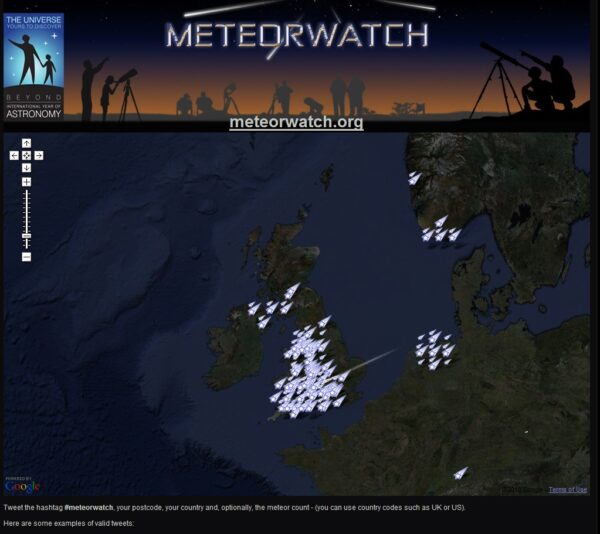
When you see a meteor, share your experience on twitter by tweeting what you saw for the meteor map.
The meteor map displays tweets of meteors seen by location and is very simple and fun to use.
Tweet the hashtag #meteorwatch then the first part of your postcode, then your country code and then optionally how many meteors you saw. Your results will then be displayed on the map shortly afterwards. Instructions can be found at the bottom of the map page.
Let’s see how many people saw a meteor or more?