Timelapse View of Earth taken from the ISS
Earth | Time Lapse View from Space, Fly Over | NASA, ISS from Michael König on Vimeo.
Earth | Time Lapse View from Space, Fly Over | NASA, ISS from Michael König on Vimeo.

Watch the first Soyuz launch from Guiana Space Center (CSG) in French Guiana
October 20, 2011 10:30:26 a.m. UT – Soyuz Flight VS01
The countdown to Soyuz’ maiden flight from French Guiana will resume for a liftoff tomorrow morning after work on the launch pad resolved a ground support system anomaly that postponed the historic mission for 24 hours.
This anomaly was identified as a leak in a launch pad pneumatic system responsible for the programmed disconnection of Soyuz’ third stage fueling lines before the vehicle lifts off.
With the issue resolved, the liftoff is now set for October 21 at 7:30:26 a.m. local time in French Guiana – a precise moment that enables the payload of two Galileo satellites to be injected into their proper orbital plane.
Soyuz’ 3-hr. 49-min. flight from the Spaceport will inject the In-Orbit Validation (IOV) spacecraft for Europe’s Galileo satellite navigation system into a 23,222-km. circular medium-Earth orbit, inclined 54.7 degrees.
Weighing approximately 700 kg. each, these satellites – along with two others to be lofted by Soyuz in 2012 – will form the operational nucleus of Europe’s full 30-satellite Galileo navigation constellation, which is being developed in a collaborative program involving the European Space Agency and European Union
With the Soyuz launcher operating out of the Guiana Space Center (CSG) in French Guiana, Arianespace is the only launch services provider in the world capable of launching all types of payloads to all orbits.
The “Soyuz in French Guiana” project covers three main aspects:
– Construction of launch facilities, including a launch pad identical to those used in Kazakhstan and Russia.
– Launcher modifications needed for operation from the Guiana Space Center (CSG), primarily ensuring compliance with the range safety rules at CSG and adaptation to the requirements of the launcher tracking network.
– Verification of compatibility of the Soyuz launcher with the environmental conditions in French Guiana (in particular the weather and wind conditions).
The Soyuz at CSG launch system, combining the new launch pad with a launcher that has been slightly modified in relation to the version launched from Baikonur, will be validated during the inaugural flight :
– The final countdown and actual flight through the end of the mission will enable validating the operation of all ground and launcher systems and equipment.
– This flight will also enable identifying any improvements that may be needed for the commercial operation of this new launch system.
Soyuz at Guiana Space center – Timelapse from Arianespace on Vimeo.
Reusability is key to the dramatic cost savings that will enable advancements in human exploration of space. The Dragon spacecraft is a fully reusable and SpaceX is working toward the goal of delivering the world’s first fully reusable launch vehicle. Check out the animation for a sneak peek at SpaceX’s exciting plans for the future.

NASA’s decommissioned Upper Atmosphere Research Satellite fell back to Earth at 12:01 a.m. EDT (0401 GMT) on Saturday, Sept. 24. The Joint Space Operations Center at Vandenberg Air Force Base in California has determined the satellite entered the atmosphere over the Pacific Ocean at 14.1 degrees south latitude and 189.8 degrees east longitude. This location is over a broad, remote ocean area in the Southern Hemisphere, far from any major land mass. The debris field is located between 300 miles and 800 miles downrange, or generally northeast of the re-entry point. NASA is not aware of any possible debris sightings from this geographic area.
This is your source for official information on the re-entry of UARS. All information posted here has been verified with a government or law enforcement agency. This is NASA’s final status report on the re-entry of UARS.
This map shows the ground track for UARS beginning off the coast of Africa at 0330 GMT and ending at atmospheric interface over the Pacific at 0401 GMT.
Six years after the end of its productive scientific life, UARS broke into pieces during re-entry, and most of it up burned in the atmosphere. Twenty-six satellite components, weighing a total of about 1,200 pounds, could have survived the fiery re-entry and reach the surface of Earth.
The Operations Center for JFCC-Space, the Joint Functional Component Command at Vandenberg Air Force Base, Calif., which works around the clock detecting, identifying and tracking all man-made objects in Earth orbit, tracked the movements of UARS through the satellite’s final orbits and provided confirmation of re-entry.
“We extend our appreciation to the Joint Space Operations Center for monitoring UARS not only this past week but also throughout its entire 20 years on orbit,” said Nick Johnson, NASA’s chief scientist for orbital debris, at NASA’s Johnson Space Center in Houston. “This was not an easy re-entry to predict because of the natural forces acting on the satellite as its orbit decayed. Space-faring nations around the world also were monitoring the satellite’s descent in the last two hours and all the predictions were well within the range estimated by JSpOC.”
UARS was launched Sept. 12, 1991, aboard space shuttle mission STS-48 and deployed on Sept. 15, 1991. It was the first multi-instrumented satellite to observe numerous chemical components of the atmosphere for better understanding of photochemistry. UARS data marked the beginning of many long-term records for key chemicals in the atmosphere. The satellite also provided key data on the amount of light that comes from the sun at ultraviolet and visible wavelengths. UARS ceased its scientific life in 2005.
Additional resources:
› NASA News Release, Sept. 24, 2011
› Re-Entry and Risk Assessment (498 KB PDF)
› Frequently Asked Questions: Orbital Debris
If you find something you think may be a piece of UARS, do not touch it. Contact a local law enforcement official for assistance.
Credit: NASA

UARS Ground Track Credit:NASA
NASA News Release : 11-350
NASA’s UARS Re-Enters Earth’s Atmosphere
WASHINGTON – NASA’s decommissioned Upper Atmosphere Research Satellite (UARS) fell back to Earth between 11:23 p.m. EDT Friday, Sept. 23 and 1:09 a.m. Sept. 24, 20 years and nine days after its launch on a 14-year mission that produced some of the first long-term records of chemicals in the atmosphere.
The precise re-entry time and location of debris impacts have not been determined. During the re-entry period, the satellite passed from the east coast of Africa over the Indian Ocean, then the Pacific Ocean, then across northern Canada, then across the northern Atlantic Ocean, to a point over West Africa. The vast majority of the orbital transit was over water, with some flight over northern Canada and West Africa.
Six years after the end of its productive scientific life, UARS broke into pieces during re-entry, and most of it up burned in the atmosphere. Data indicates the satellite likely broke apart and landed in the Pacific Ocean far off the U.S. coast. Twenty-six satellite components, weighing a total of about 1,200 pounds, could have survived the fiery re-entry and reach the surface of Earth. However, NASA is not aware of any reports of injury or property damage.
The Operations Center for JFCC-Space, the Joint Functional Component Command at Vandenberg Air Force Base, Calif., which works around the clock detecting, identifying and tracking all man-made objects in Earth orbit, tracked the movements of UARS through the satellite’s final orbits and provided confirmation of re-entry.
“We extend our appreciation to the Joint Space Operations Center for monitoring UARS not only this past week but also throughout its entire 20 years on orbit,” said Nick Johnson, NASA’s chief scientist for orbital debris, at NASA’s Johnson Space Center in Houston. “This was not an easy re-entry to predict because of the natural forces acting on the satellite as its orbit decayed. Space-faring nations around the world also were monitoring the satellite’s descent in the last two hours and all the predictions were well within the range estimated by JSpOC.”
UARS was launched Sept. 12, 1991, aboard space shuttle mission STS-48 and deployed on Sept. 15, 1991. It was the first multi-instrumented satellite to observe numerous chemical components of the atmosphere for better understanding of photochemistry. UARS data marked the beginning of many long-term records for key chemicals in the atmosphere. The satellite also provided key data on the amount of light that comes from the sun at ultraviolet and visible wavelengths. UARS ceased its scientific life in 2005.
Because of the satellite’s orbit, any surviving components of UARS should have landed within a zone between 57 degrees north latitude and 57 degrees south latitude. It is impossible to pinpoint just where in that zone the debris landed, but NASA estimates the debris footprint to be about 500 miles long.
For more information about UARS, visit:
– end –

Credit: NASA

A blog for us AMATEUR amateur astronomers. By @RadioVicky.
Bio:
I’m 33, I live in Bristol and I like astronomy. However, I don’t have a telescope and even if you did give me one, I’d be uncertain where to put my eye. I write comedy and I’m a professional blogger. My favourite colours are beer and dark skies.
Telescopes scare me. Not in the way a stranger in my bedroom or a spider in my knickers would scare me, but they do fill me with a certain fear.
I mean, I absolutely love things that go *shine* in the night, and have since I was a little girl, but the prospect of going out and buying a scope – something I know NOTHING about — is fairly petrifying. It even makes me feel a bit of a fraud. How can I be in to astronomy when I don’t even know my azimuth from my elbow? And also, I’m not too hot on my constellations either – sure, I know the main ones they teach you at school, but ask me to point out Lyra? Pegasus? Lucky Jim’s Pirate Ship?
OK, I admit it, I’m an AMATEUR amateur astronomer, but so is 99.9999999999999999999999% (possibly more nines than that, I didn’t have time to conduct a survey) of the world’s population, so it’s a cool club to be in.
Before I got friendly with astronomers on Twitter, I always fancied one of those thin tubular ones they sell for £90 in Argos. Surely I would be able to see the storms on Jupiter, the arms of Andromeda, and the Bristol football team practicing from 10 miles away? Turns out I’d be better off peering through a toilet roll tube with some cling film on the end of it – I’ve been told that cheap telescopes merely turn unimpressive white dots into marginally less impressive WOBBLY white dots, so I’m saving the cash for a Virgin Galactic space holiday instead. I hear the weather’s quite exceptional on Mercury…
But something happened this weekend that made me feel better about scope envy. I’ve been getting friendly with our very own @virtualastro on Twitter, and when I discovered I had 900 free minutes to use before the end of the month, I thought it was nigh on time we spoke to each other.
So, I called him up, and we spent a total of FIVE HOURS on the phone over the course of Saturday and Sunday night. Rest assured Twitter, we have plotted and planned some very exciting things together which will be blazing your way like a comet made of ideas instead of muddy ice soon …but the best, most wonderful, amazing, magical thing we did was…GO STAR HOPPING TOGETHER. Without a freakin’ telescope!
Even though we are about 70 miles apart (I live in Bristol, he lives in Oxfordish somewhere) we were both able to look up at the same sky, see the same ISS passes, and the same meteors. It was remarkable to be on the phone to someone with such an incredible knowledge of the skies. I sat gob smacked, mouth and ears open, as he talked me through constellations, clusters, satellites and gory Greek myths. I had no idea Cassiopeia had been a naughty girl and was sentenced to dangle upside down on a chair for eternity. I’d never heard of the Cygnus Rift — an ominously dark patch of sky in our milky way. I couldn’t even pick out the summer triangle, but now I know where it lives I will undoubtedly point it out to people in the pub, spilling cider as I leap around, trying to remember which stars make it up.
The best part was a dazzling ISS pass with a Perseid meteor streaking past like an arrow through a love heart. @VirtualAstro even had to put the phone down to deal with the deluge of tweets, and it felt amazing to be part of something so communal, so magical, yet so fleeting.
He also reassured me I didn’t need a telescope to enjoy the skies – which is fabulous because I was getting a bit sick of wishing for one on every meteor I saw. He said ‘if you look up at the sky…then you’re already an astronomer,’ a line which neatly castrated the last traces of my scope envy.
As I lay back and looked at the star-flecked sky, with crickets singing in the hedge, fired up with a guided tour of our resplendent heavens, it dawned on me. This was better than any naughty phone chat line. He could quite easily wire up a premium-rate number to his phone and charge £1.50 a minute for the pleasure of his knowledge.
Yep, I had a great time star-gazing without a scope last night. To the point of rubbing my thighs and drooling a bit. And how was it for you, darling?

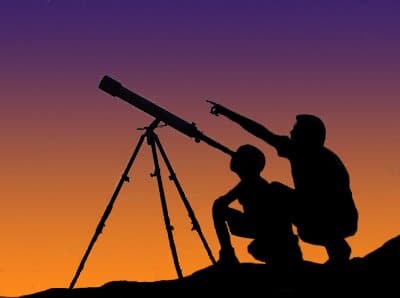
Vicky pretended she was having fun looking through the telescope, but the view was better with just her eyes.


