Aurora over Cumbria 5/6th August 2011 Credit: Raymond Gilchrist
On the evening of the 5th of August 2011 the Aurora Borealis, Northern Lights were seen as far South as Southern England!
At approximately 18:00 Universal Time (19:00 BST) the Earth’s magnetosphere was hit by a coronal mass ejection from the sun, triggering a powerful geomagnetic storm and Aurora.
This storm measured 8 on the K index (aurora richter scale) which ranges from 0 – 9 so this was a big storm.
It is quite common to see Aurora in Northern Scotland, but at approximately midnight, aurora was seen as far south as Berkshire, Wiltshire and Hampshire in Southern England.
I was incredibly lucky to briefly see the pale greenish hue of the aurora through clouds from my back garden in West Berkshire. It is incredibly rare to see aurora this far south and the last time I remember was in 2003.
Unfortunately a lot of people in England and Scotland were under thick cloud and missed this fantastic display, but thanks to fantastic astro photographers such as Raymond Gilchrist (@RayGil on twitter) we are able to see the aurora through his images.
I am unsure of what the rest of the world witnessed, but geomagnetic activity remains high as I write this article, so I hope the sky clears and we are given another fantastic display of this rare phenomenon soon.
Aurora over Cumbria 5/6th August 2011 Credit: Raymond Gilchrist
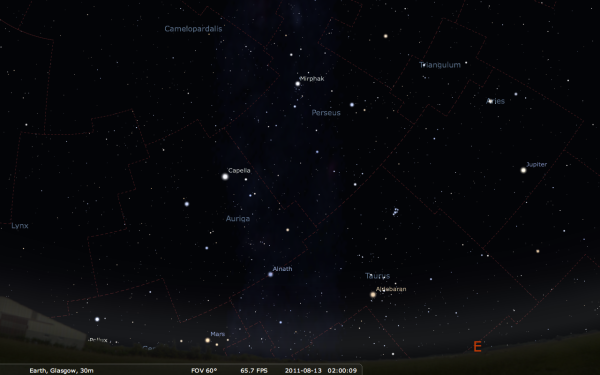
This is one of the most prolific meteor showers and is associated with the comet Swift-Tuttle. During the peak of the perseids, the radiant (the place the meteors appear to come from) often seems to be the ‘sword handle’ within the constellation of Perseus.
(the above image was taken using the iPhone app Star Walk)
The Perseid meteor shower peaks on 12/13 August every year and can have anything from 80 to 140 meteors an hour. Observers have been known to describe Perseid meteors as being fast and bright in appearance. Often a large number of them leave a trail behind them as they enter the Earths atmosphere and in the past many of them have turned into fireballs.
It wasn’t until 1866 that the association with Comet 109P/Swift-Tuttle was proved by Giovanni Schiaparelli. The Perseid meteor shower itself has been known and observed for a long time. The first known recorded accounts were by the Chinese in AD36. Both the Japanese and Koreans also have documentation of observing the Perseids from the 8th century onwards. Western observations seem to start during the 19th century, or at least the ones that were documented.
Now with advances in technology we can watch the meteor shower (Moon dependent of course this year) from the comfort and warmth of our own living rooms. We can track who has seen meteor showers by using a twitter map and discuss in real time if any of our online friends spot a fireball. Modern technology gives us new ways to interact with other astronomers, and not just locally, it allows us to encourage others to get out in the back garden and just look up.
Originally posted on Dark Sky Diary as “Perseids Meteor Shower 2011” by Steve Owens @darkskyman on twitter
This month sees the most reliable meteor shower of the year; the Perseids. You can begin watching for Perseid meteors now, and the shower will last until mid-August, but the peak of the shower occurs in the small hours of Saturday 13 August 2011.
Perseus under dark skies
Perseus under moonlit skies
Unfortunately this year’s shower will be obscured by the full Moon which occurs on the same day, and so it won’t present its usual excellent display.
The number of meteors that you will observe every hour depends on a number of factors:
the density of the cloud of dust that the Earth is moving through, that is causing the shower in the first place;
the height above the horizon of the radiant of the shower, the point from which the meteors appear to radiate;
the fraction of your sky that is obscured by cloud;
the naked-eye limiting magnitude of the sky, that is a measure of the faintest object you can see.
Please visit Dark Sky Diary for the rest of this article………..
Everyone is welcome to join in, whether they are an astronomer, have a slight interest in the night sky or just wonder?
As well as looking up, enjoying the night sky with us and seeing meteors, maybe for the first time? You will have the opportunity to contribute for fun with images and online, or to Scienceif you wish, by tweeting and seeing your results on a map, or by submitting Observing Forms if you are a more serious observer.
This event follows on from the popular Twitter Meteorwatchheld in August and December of 2009 and 2010 “Meteorwatch 2009”
Use the hash tag: #Meteorwatch and get involved, ask questions, do some science, follow the event and enjoy the wonders of the night sky with us. Images and other information will be tweeted as it happens. Live!
The highlight of the summer meteor showers: The Perseids reach maximum around the 12th/ 13th of August and may put on a display of approximately 80 to 100 meteors per hour under ideal viewing conditions.
Conditions this year aren’t ideal due to there being a full moon, but the brighter meteors will be seen. Let’s hope the skies stay clear.
Perseid meteors are often bright with persistent trails which can linger for a while after the meteor has burned up. Further information on the Perseid meteor shower and how to view it, can be found here.
While you are looking formeteors, there will be other objects to look out for such as the Planet Jupiter late in the evening, the Milky Way, Summer Triangle, manmade Satellites and more.
The Twitter Meteorwatch will start at 21.00 BST on the 11th of August and will continue through to the evening of the 13th. Amateur and professional astronomers and stargazers from the US and other countries are invited to join in and take over from the UK, when the sun comes up here, helping make the event run continuously and be truly international.
This evening I decided to try some iPhone astrophotography. This blog post will let you see how I got on, and give you the info you need to get started yourself.
While the iPhone 4 camera is far from ideal for astrophotography (the sensor is small compared with a DSLR; in fact it’s not even as good as most point and shoot cameras) it does have one distinct advantage – it’s usually very much to hand, just in my pocket in fact.
There are two kinds of astrophotography you can do with an iPhone: with and without a telescope. The former is called afocal astrophotography, but it is the latter that I tried out tonight: just using the iPhone camera, some extra hardware, a 59p app, and a clear sky.
Afocal Astrophotography. Simply hold the camera to the eyepiece of a telescope (or binoculars) and snap a picture of whatever is in the field of view. For this you can just use the standard camera app on the phone to snap a picture, and it’ll use software to ensure that the image is exposed correctly (although this might not always work). I’ve tried this once before, using the Moon as my target, with decent enough results:
Pic of the moon taken on my iPhone 3GS held to the eyepiece of my 110mm TAL-1 telescope
You can also buy several apps that claim to allow you to take longer exposures, even letting you use a bulb setting (this isn’t actually possible with the iPhone shutter hardware – each of these apps is actually using a clever software work around, but you’re not getting a true 60 second exposure when you set your “shutter speed’ for 60 seconds).
The apps that I use are:
Slow Shutter Cam: has shutter speeds of 0.5, 1, 2, 4, 8, 15? and a B (bulb) setting, plus a crucial self timer delay to prevent wobble when pushing the “button” to take the shot (£0.59 on iTunes App Store)
Magic Shutter: has shutter speeds of 1, 2, 4, 8, 15, 30 and 60? and a B (bulb) setting, but no self timer (£1.79 on iTunes App Store)
Both of these apps have a variety of software setting to allow you to get the best picture; tonight I used Magic Shutter with a 60s shutter speed.
(These apps might allow you to take better images while the camera is mounted to a telescope, but I haven’t tried this yet. Watch this space for test of this later in the year.)
Afocal Astrophotography Hardware
The main obstacle to taking long exposure shots with the iPhone (apart from the fact that the hardware won’t actually let you!) is that you need to make sure that the iPhone doesn’t move at all during the duration of the exposure, so holding it in place with your hand isn’t an option. Luckily there’s a great gadget available from a company call Magnilux. The device is called the Magnilux MX-1 Telescope Adaptor, which allows you to attach your iPhone to any telescope eyepiece. It also doubles as a tripod adaptor.
Magnilux MX-1 Telescope Adaptor
Magnilux MX-1 Telescope Adaptor with iPhone 4 attached (works with any iPhone model)
Magnilux MX-1 Telescope Adaptor configured as a tripod mount
Astrophotography Without a Telescope
Tonight I didn’t connect my iPhone to my telescope since my target, the International Space Station (ISS), moves so quickly and travels across such a large part of the sky that you need as wide a field as possible to catch it.
To capture the ISS you need a long exposure (use Magic Shutter app – see above). The pass tonight lasted 4’19?, and traveled 90° through the sky (from 254° WSW to 164° SSE). The iPhone 4 camera field of view is only 60.8° so I couldn’t capture the whole pass. Instead I decided to try to capture a 60s exposure as the ISS rose to its highest and brightest, at 206° (SSW).
With a 60? exposure, of course, I had to have my iPhone mounted to a tripod. I could have used the Magnilux MX-1 Adaptor set up for tripod mode (see above) but instead I opted to use my new Kungl iPhone case with built in tripod thread, which I attached directly to my tripod.
Kungl iPhone Case
This held the iPhone still, and using the Magic Shutter app set to 60? exposure I managed to get this image:
The ISS passing over, iPhone 4 Camera, Magic Shutter App set for 60″ exposure, 2344, 23 June 2011
Far from ideal, but not bad given (a) it was my first attempt, (b) I had one chance to take the image before the ISS faded from view, (c) the sky was very bright (this was taken at 2344 on 23 June 2011, just after midsummer, with the sky just out of civil twilight), (d) cars kept driving past (note the light art in the foreground!).
Once the sky darkens again later in the year I hope to test this set up under a truly dark sky to see whether it can pick up sharp star images. I suspect that might be tricky!
If anyone else has tried iPhone Astrophotography please let me know in the comments.