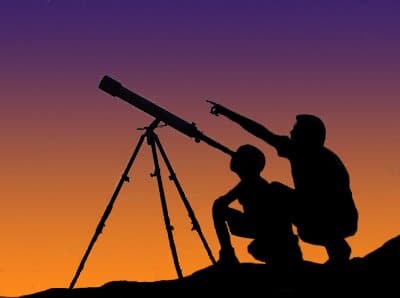
If you ask someone to describe or draw a telescope, nine times out of ten it will be a refractor.
The refractor telescope is quite possibly the most common or easily recognized telescope. It is a very simple design, which has been around for hundreds of years.
The history of the refractor is that it was first invented in the Netherlands in 1608, and is credited to 3 individuals; Hans Lippershey, Zacharias Janssen – spectacle-makers and Jacob Metius. (more…)
On Saturday 8 October 2011 a rare event may occur – a meteor storm! The usually sedate Draconids meteor shower only produces a few shooting stars per hour in most years, but in some years we have a meteor storm, and that’s just what’s predicted for this year.
It Won't Look Like This
During a meteor storm the Earth passes through a particularly dense clump of comet dust, meaning that rates of shooting stars temporarily spike, and estimates this time suggest the possibility of up to 10 shooting stars per minute during the peak of the storm. However a nearly full Moon may spoil the view, possibly drowning out all but the brightest meteors, reducing the actual observed rate perhaps 1 per minute – still well worth looking out for.
The peak is set to occur at 2000UT (2100 BST), and is ideally placed for observers in the UK. Activity is expected to increase from 1600UT (1700 BST) but at that stage the sky will still be bright in the UK.
If you’re keen to witness this (possibly) amazing event here are some top tips:
Head out early. Start your meteorwatch once the sky gets dark enough. For most people in the UK this will be from 1900 – 1930 BST (anyone living in the north of Scotland will have to wait a bit longer). Although the peak of the storm is estimated to occur around 2100 BST there will be plenty to see in the hours leading up to the peak.
Know where to look. The Draconids all appear to originate from the constellation Draco, which will be high in the NW sky, just above and to the left of the north star, Polaris. However the meteors will streak across the entire sky so don’t just look NW.
Know what to look for. Meteors appear as bright streaks of light moving rapidly across the sky. They last for a fraction of a second, but the Draconids are unusually slow meteors. Still, blink and you might miss one.
Keep the Moon to your back. The full Moon will drown out the light from all but the brightest Draconids, and if you look at the Moon it will spoil your night vision, so keep it behind you, ideally blocked out by a building or tree.
You just need your eyes. Binoculars and telescopes, while ideal for observing faint nebulae and planets, are no good for meteorwatching. You want to take in as much of the sky as you can, and have as wide a field of view as possible, so just use your eyes.
Get comfortable. The best bit of meteorwatching kit is a reclining lawn chair. Point it towards the NW, lie back, look up and enjoy the show.
Keep warm. It will be very cold outside if it is clear, so wrap up warm. If you’re lying back on a reclining chair, wrap yourself in a blanket or sleeping back form maximum warmth.
Get away from city lights. This isn’t as important for this shower, as the Moon is flooding the sky with natural light anyway, but in general the fewer lights you have around you the better.
Get away from clouds. This hopefully goes without saying, but if your sky is cloudy you won’t see much. The UK Met Office website can tell you if there is a clear sky anywhere near you, and you should consider traveling to get clear skies. You can also check out meteor activity using the Meteor Live View.
Reusability is key to the dramatic cost savings that will enable advancements in human exploration of space. The Dragon spacecraft is a fully reusable and SpaceX is working toward the goal of delivering the world’s first fully reusable launch vehicle. Check out the animation for a sneak peek at SpaceX’s exciting plans for the future.
Sure, you’ve heard of the August Perseids that come blazing across the sky and are invariably trumpeted by the news as the “Meteor Shower of the Millennium!” on a yearly basis. Perhaps you’ve even heard of the Leonids, normally a feeble November shower prone to legendary outbursts roughly every 33 years. But have you ever heard of the October Draconids?
I’ll admit I hadn’t until the October 1998 issue of Sky & Telescope arrived on my doorstep. Or should I say tent-flap? You see, the last half of 1998 found me deployed with my U.S. Air Force squadron to Al Jaber, Kuwait. In those days, email (and spam) were still a hip “new thing,” giant washing-machine-like CRT monitors adorned many office desks, and we were involved with a cat-and-mouse game between Saddam and the U.N. Inspectors that eventually became the shooting war of Operation Desert Fox. A military base in the desert was also a fine place to do some causal astronomy. The Leonids put on a fine show that year approaching storm levels of 1,000 per hour from our longitude. I remember mentioning the Leonid meteors to one of our F-16 pilots, and they later briefed not to mistake the fireball flashes for Iraqi AAA (an important distinction!) (more…)
Sunset with the Massive Sun Spot 1302 (Upper left on the Sun) Credit: Adrian Scott
A highly active region on the Sun threatens to deliver powerful geomagnetic storms over the week ahead. Highly energetic solar eruptions are likely heading in our direction to give Earth’s magnetic field a significant glancing blow!
Over the past few days the new sunspot AR1302 has been incredibly active, hurling massive X-class solar flares into space and it will soon face Earth.
The massive sunspot, many times larger than the Earth (see images below) is expected to increase in size and energy, and is expected to release powerful solar flares, sparking strong geomagnetic storms. (more…)